Friday, June 7, 2019

And Don't Forget

At the end of another year, Walt Whitman comes to mind. Yes, life can be tough and struggles are inevitable. At the same time, we are here. So it's time to get to work


Sunday, March 31, 2019

Learn! Create! Play?

All people want to learn.

All people want to create.

All people want to dig into ideas and discover what life has to offer.

All people want to experiment with materials and visions of what can be. 

All people want to play.

This is not a school thing. This is a human thing.

But what happens in school? As kids get older, this kind of exploration gets less relevant, because it gets less emphasized. Play disappears. The goal of learning shifts from doing, experiencing, and being active to watching, recalling, and being passive. A disconnect develops between being a learner and being a student, as if the former has nothing to do with the latter. It seems like schools stop viewing kids as people with natural curiosity, maybe even to the point that students stop trusting their own curiosity. The idea of play, so important for kids, is no longer considered to be a critical feature of the learning process.


Growth measured with tests, understanding quantified with a number, success and failure determined by a letter: these are the conventional ways to define learning. Ultimately, this status quo undermines the messy, exciting, intrinsically rewarding process of learning. After all, it's no longer about process; it's about the tests, the points, the grades. It ultimately makes me wonder:

Educators, parents, students: we all have a stake in considering this question. 


Wednesday, February 13, 2019

I Celebrate My Story

In 1855, Walt Whitman published a book of poetry, Leaves of Grass. Only, at the time, nobody knew it was published by Walt Whitman. There was no name. Not on the cover. Or on the spine. Or even inside the book. There was, however,  a picture of a man, standing informally with a hand on his hip and the other in his pocket, with his collar unbuttoned and his hat resting at bit of an angle on his head:

To me the picture says, "Here I am. Accept me or not. It makes no difference. I am who I am." Of course, I know Whitman styled the image to achieve this response, so, in a way, it is an act. At the same time, I always felt that there was an authenticity to it. A genuineness. Even if there was no name attached. I wonder if people in 1855 felt the same way? 

Turning the page, a reader in 1855 would have seen these lines: "I celebrate myself,/And what I assume you shall assume,/For every atom belonging to me as good belongs to you." Interesting. A book with no name, a picture with no given identity, and then opening lines that emphasize "I." 

Perhaps the idea is to get the reader to identify as "I" while reading, to speak the "I" and, thus, become it. Or maybe the idea is to focus on our commonalities. Yes, we all have different names. But, ultimately we share a common humanity. We are different, but we are one. Or maybe the idea is to be proud of who you are, and to own your unique identity because it matters. Or maybe it is all of these together and more.

And now, I've crafted a blackout poem in response:

A little song
I know
I own
--
my story

I like it--the way "know" and "own" play off of each other, the way it downplays life with the phrase "my story," which is actually anything but small big, and the way it picks up on Whitman's use of singing as a metaphor for living. 

It feels good to respond in this way. In fact, maybe it is unique in all of the responses ever written to Whitman's words. There's a thought.

Thursday, September 27, 2018

3 for 5: gods & culture

We are finishing our fifth week of school, which means it is a good time to take a breath and reconsider some of the stuff that has come my way. While I share similar material with students from year to year, there's always something new, whether generated by them or me. Here are three statements that had me wondering over the last month.

"We are gods in ruins"--R.W. Emerson

This is a statement I had not heard before. It came up in a video I showed about Emerson from the YouTube Channel, "The School of Life." I paused on it in class and asked students to contemplate its meaning. And it has stuck with me since. For Emerson, it had to do with his pantheistic worldview: we all have a "divine spark." However, I think about it in less of a religious sense and more as a metaphor. I think about "god" as a being with the potential to be a powerful creator. Yet, we constantly undermine our potential by not taking creative risks or being honest with who we are and what we believe.


"Kneading Culture as Bread"--Kevin Coval

This line is from Coval's poem about Jane Addams, called "How Down She Be." I used it in class last year. It does a fantastic job illustrating how a poem can shine a light on significant people and events. And it illustrates the way a poet can use a minimum of words to coney layers of meaning. In this case, we understand that through her work with Hull House, Addams nurtured culture for people who typically did not have access to it. The idea of "kneading" is very physical. It is a hands-on approach. This was Jane Addams. At the same time, "kneading" is a homophone with "needing," which extends the metaphor from a person nurturing culture to the necessity for culture in this area. It is a great example of an artist making the most of language. And I imagine him having fun while doing it.

"The most radical division is that which splits humanity into two classes: those who make great demands on themselves and those who demand nothing special."--Jose Ortega y Gasset


This statement was quoted by a different writer, Louis Beres, in his essay, "The few, the proud, the individuals." Talk about being counter-cultural. I feel like our culture stresses superficiality, finding the easiest ways to get things done, and being a consumer above all else. These have nothing to do with embracing challenges or accepting that struggle is a part of life. When I read these words, I know which "class" I want to belong to. I know which group offers something of value. I know which side will lead me to a more fulfilling life. Perhaps this is one that I need to write on walls and windows and sidewalks. This is one to remember.


As I look back at these statements, I think about what I'll encounter in the coming weeks. I wonder what ideas I have within me and if I will have the courage to share them, to make them known. In the meantime, I will continue to be open. I can at least demand that from myself.

Monday, September 3, 2018

Filling in the blank canvas

I have always been fascinated by artists. They start with a blank page, a blank canvas, a collection of chords. Then, through sweat, determination, and vision, something incredible happens. Worlds are born, songs are crafted, paintings are created. Since high school, I wanted a part in this. But how? As a 36 year old, I decided one possible avenue. With the help of some talented friends, I picked up the guitar and have been playing it ever since.


My plan now? To keep learning, to keep playing. Maybe write some songs, even if they are just for me.

Thanks for reading.

Tuesday, March 20, 2018

Nothing is Truth is Nothing

Throughout his novel The Things They Carried, Tim O'Brien plays with our ideas about truth. Of course, he says he is not playing at but trying to expose the reader to the life he lived for a year while a foot soldier in Vietnam. It was a year of ambiguity, confusion, and lack of truth. A year when "the old rules were no longer binding." While O'Brien illustrates the number of burdens soldiers had to carry, among the heaviest was the feeling that truth no longer existed except in on way: they would never be at a loss for violence. And people would not understand.    
   1.
We use stories to make sense of our world and to share that understanding with others.  They are the signal within the noise.
                 
  2.
Can I ever really understand somebody else's story?  Or my own?

  3.
[The] intention was to capture the experience of combat, boredom and fear through the eyes of the soldiers themselves. Their experiences are important to understand, regardless of one's political beliefs. Beliefs are a way to avoid looking at reality. This is reality.

  4.
Those who knew
what was going on here
must give way to
those who know little.
And less than little.
And finally as little as nothing.

  5. 


   6.
If you don't care for obscenity you don't care for the truth.

   7.
What's obscene is ideology--the hardening of opinion into stubborn belief.  With ideology, one no longer has to think. With ideologies, stories become brittle.

   8.
It has become a kind of rule that neatness counts in narrative: don't leave the audience wondering.

   9. 


   10.
Once I read an essay by Jacques Barzun.  He said no truths last forever.  Humans are truth-seekers, but they are even better truth-inventors.

   11. 
The letters weighed 10 ounces.  They were signed Love, Martha, but Lt. Cross understood that Love was only a way of signing and did not mean what he sometimes pretended it meant.

   12.
I remember Mitchell Sanders smiling as he told me that story.  Most of it he made up, I'm sure, but even so it gave me a quick truth-goose.  Because it's all relative.

   13.
Almost everything is invented.

   14. 
Don't ask me nothin' about nothin'
I just might tell you the truth. 

   15.

                   Bob Dylan Wrote Propaganda Songs
   16.
There it absolutely and positively and f***ing well is.
. . .
1  Sebastian Junger and Tim Hetherington,  comments on Restrepo
2  Frank Rose,  The Art of Immersion 
4  Wislawa Szymborska,  "The End and The Beginning"
5  Nick Ut
6  Tim O'Brien,  The Things They Carried
8  Robert Fulford,  The Triumph of Narrative
11-13 Tim O'Brien
14 Bob Dylan, "Tom Thumb's Blues"
15 The Minutemen, "Bob Dylan Wrote Propaganda Songs"
16 Tim O'Brien 

Wednesday, March 14, 2018

In The Things They Carried, Tim O'Brien spends a chapter discussing the finer points of telling a "true war story."


Made with Padlet

Tuesday, November 28, 2017

Bill Russell: Courage at Center

As an English teacher, I spend a portion of every year discussing American ideals, like self-reliance, freedom, and individuality. I enjoy hearing what students have to say about Ralph Waldo Emerson’s directions to “detect and watch that gleam of light that flashes within” ("Self-Reliance") and Walt Whitman’s belief that we all can “contribute a verse” (“O Me O Life"). Then again, it goes beyond simply introducing these ideas to others. Each year, these writers remind me of how I want to live. I want to trust my ideas. I want to be open to experiences. I want to share what I have learned with others.

In class, I have used a variety of people to model these ideals: Colin Kaepernick, Edward Snowden, Jane Addams. Whether a person agrees or disagrees with their actions, each of these individuals followed their own thinking. Each of these individuals refused to conform. Each of these individuals exercised courage.

Courage. 

It is impossible to downplay the importance of this trait for those who attempt to live self-reliant lives. Undoubtedly, Kaepernick, Snowden, and Addams show just how much others, including the State, will denounce and even attempt to destroy you for actions that challenge conventional thinking. Without courage, none of these people would have persisted.

And I found one more individual who personifies courage: Bill Russell. I have known of Bill Russell, the great Celtic center, for a long time. I heard his name mentioned by older relatives who watched him play in the NBA's earlier days. I saw his appearance in a handful of commercials, always playing the older spokesman. And I watched the news when Obama awarded him the Presidential Medal of Freedom. But I was unaware of his story. I was unaware of the extent of his accomplishments. I was unaware of his dedication to our American ideals--freedom, opportunity, justice for all--especially during a tumultuous time when speaking out meant endangering his career. And life. I was just unaware. 

Now that I am aware, I have written a poem in an attempt to capture what makes him a courageous American, worthy of being called "hero."


Bill Russell transcends basketball. That's the way he saw himself and that is the way we should see him. In 2013, Russell gave a speech at the Lincoln Memorial, the great president with whom he shares a birthday. According to reporter Bill Littlefield, "he spoke of himself, not as a basketball player, but as a man who played basketball." Throughout his life, Bill Russell refused to allow others to define him in any way except based on his merits. He saw himself as the embodiment of the American Dream-rising up from poverty, instilled with the attitude to work hard and persist. He has set an example for all Americans to follow.


Tuesday, October 31, 2017

This Moment Is Mine

If there is an ultimate take-away I try to impart to Humanities students, it is this: be a creator. Make creating a daily practice. The tools do not matter. The subject does not matter, nor the product itself. The act itself is what matters, because to be a creator is to be a participant in your world. To be creator is to be an observer of your world. To be creator is to be a wanderer of your world. A wonder-er of your world.

Or, as the street artist Swoon says:

There’s that feeling you get when you see something that you don’t understand the origin of: wonderment. It brings about a kind of innocence, and I love that. I love to witness it. I love to be a part of making those moments happen.

Which brings me to a problem I encountered about six years ago. I did not create much. I messed around with some visual projects once in awhile. But I did not have a routine or a practice that I returned to regularly. This produced an overwhelming dissonance. I felt fraudulent. Here I was, cajoling and imploring students to create, to take chances, to challenge themselves.

What about me?

My first outlet was learning guitar. Music has always been a big part of my life, and it depressed me that I did not play an instrument. So this seemed like a natural starting point. It was incredible. For all of the frustration — and, oh my, was there frustration — I loved the growing number of chords I mastered, the growing catalogue of songs I could play.

Now, I value the way playing guitar helps me to hear music differently, to appreciate it more deeply. As much as I was in awe of songwriters like Elliott Smith and Steve Earle before learning guitar, being able to play made me aware of their songcraft, the way they connect chords in surprising and resonant ways. Additionally, guitar offers me an out. If I play for 45 minutes, it is 45 minutes without a screen. It is 45 minutes during which my focus narrows even while my mind roams.

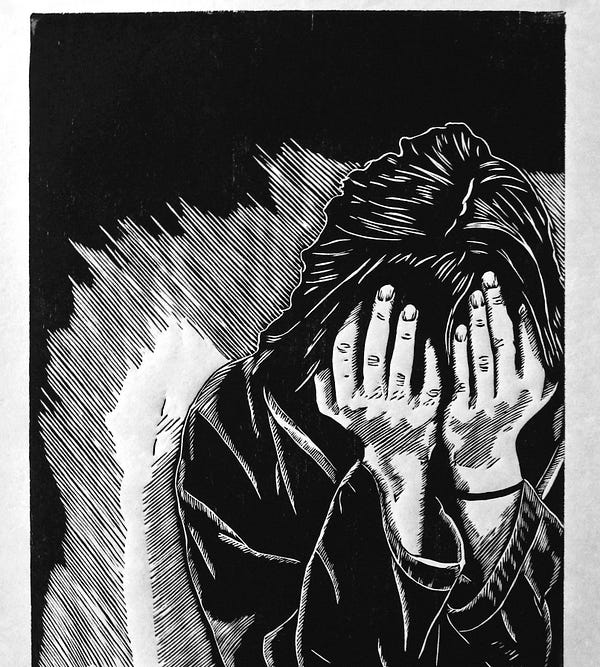
I wanted other outlets, though. In particular, I wanted something visual. Ultimately, I decided on woodblock printing. I have always been attracted to its aesthetics—the use of negative space, the simultaneous starkness and richness of black ink, the bold lines, the simplicity of the materials that belies a complexity of technique.

Like this print.
“Cacophonous Voices,” Alex Gillies
The artist conveys a dynamic story with wood, ink, and paper. I find myself a bit lost in the details, considering, for example, the way he renders the hair. Or the bracelet on the left wrist. Or the creases on the jacket. When I look at this piece, I think, “I want to do this.”

I want to do this. How many of these moments do I have when looking at art, listening to music, watching a film? I want to do this.

Often, I follow that declarative statement with the question “can I do this?” And, way too often, I have answered that question by saying, “no, of course I can’t.” I think many people have the same looping inner monologue. Where does this “no” come from? For me, it arises from a sense that what I might create would pale in comparison to what I have seen others do, as if somehow my work will be judged and mocked by the world. I know. This is ludicrous. First of all, I can share or not share as I see fit. Second, even if I choose to share, very few people will see my work. Third, getting eyes on my work is not even the point. The point is to feel engaged. To do something with intention and attention. To surprise myself by what I might be capable of. To find enjoyment and to seek a vision.

To turn the “no, of course I can’t” into “yes, I can. And will.”

So that is what I have done over the last two years. With the help of a great colleague, friend, and mentor, I have started to make art. To make prints. The work is slow and challenging. There have been some successes, but far more blunders, frustrations, and failures. However, when I turn the kitchen island into the production studio, when I roll the ink on to the carved block, place the paper down, rub the baren across its surface, and peel it back. . .


It is for me.


Tuesday, June 6, 2017

A Learner and A Teacher

Over the years, I have enjoyed acquiring a range of hobbies and interests: I like to cook; I like to play guitar; I like to make some art; I like to do yoga; I like to paddleboard. While I take these activities seriously, I have not done any of them enough to be an expert. I am not a chef. I am not a musician. I am not an artist.

So, is there anything that I do about which I feel like an expert? Probably not. But maybe I come closest when I consider my experience as a teacher and a learner.


Monday, May 1, 2017

Decide. Execute. Assess. Redo: A Daily Art Challenge

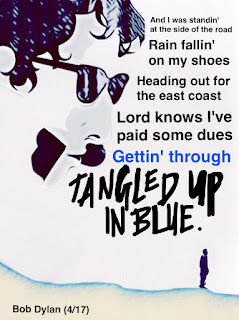
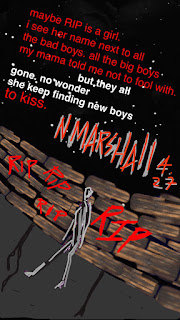
For the second year in a row, I undertook an art challenge for the month of April. In case you were unaware, April is #NationalPoetryMonth. Perhaps you are thinking, “that sounds like a month designed for and observed by English/Language Arts teachers.” I’m pretty certain that is what some of my students were thinking.

Although this post is not meant to be a defense of poetry, I will say this: good poetry amazes me. It stuns me. It wakes me. Like a perfectly executed 3 chord riff, a poem relies on so little — a sharply worded observation and an attention to language that can otherwise seem so commonplace. And it relies on so much — the desire by poets to take an active interest in our world and share what they see, what they think they know, and what they know they don’t know, with the rest of us. Like any other art, when a poet makes it click. . .magic.


Back to my self-imposed challenge. I decided that for each day of April I would use Snapchat to illustrate a bit of a poem. And that’s about it. While I allowed myself to import images from my camera roll, I decided I would only use the editing tools available within the app: filters, cut-outs, drawing, and text. No outside photo editors. I think I stuck to it. The only other major requirement was to post by midnight. I think the closest I got was 11ish, which was close enough to make me worry. I also knew I had to make room on each post for the poet’s name and date. I know I forgot that last one a few times.


Pretty quickly I discovered a few of things:

1. Restrictions are useful. I guess this was less of a discovery than a reminder. I remember watching The Five Obstructions some years back. Lars Von Trier challenges Jorgen Leth to remake one of Leth’s film. Each time, Von Trier gives him obstructions to the creative process. The problem-solving Leth employs is pretty spectacular. It was probably the first time I understood how limits can bolster creative thinking. I am also a big fan of On Kawara's Today Series, in which the Japanese conceptual artist attempted to paint each day's date every day. He painted each canvas according to some pretty strict guidelines for size, color, and lettering. Furthermore, if he failed to finish a canvas by midnight, he threw out it away. When I have watched and read about both of these art experiments, I have tried to imagine how it would feel to create under such a regimen. While my project is small by comparison, it still gave me insight into how and why an artist would choose to limit their options.


2. Setting out to make something everyday greatly impacts your schedule. This must seem obvious, but it was powerful nevertheless. Since each one could take me anywhere from 45 minutes — 2 hours, I found myself looking at downtime quite differently. A free fifteen minutes before a class? Work on my #poemsnap for that day. Ten minutes of waiting for my daughter’s track practice to end? Work on my #poemsnap for that day. My wife needs five minutes before we watch The Americans? #Poemsnap time.

Recently I have heard interviews and read articles that make a case for boredom. At issue is the way so many of us use our devices to fill in moments of boredom with distraction. According to these interviews and articles, when we give in to the distractions offered by our devices, we are robbing ourselves of time to be bored, which is time to crank up the imagination. This might have particularly insidious effects for younger people. My project gave me something to do in these moments: I was either working on the snap or reading poetry and finding voices that were new to me. It kept me invigorated and distractions became unnecessary. It focused my attention.


3. It is exciting to get it right. And scary. It was so satisfying to (almost) perfectly execute an illustration that captures a mood, an idea, a feeling of some lines of poetry. But it was also daunting because as soon as I posted the snap, I immediately started to think about the next day: the poem, the imagery, the shape of the text. Recently, I watched an episode of the documentary series, Abstract, that focused on the graphic artist Christoph Niemann. In it, he talks about the anxiety caused by success: can it be followed? Will there be another idea? Will he reveal himself to be a fraud? Niemann calls these "lucky moments" when he has "won the lottery." Of course, I am not comparing my #snapchatart to Niemann’s deadlines for New Yorker covers. But I grasped his point. As the month progressed, I was aware of not wanting to copy myself, of not replaying the same moves. It was rough.
I drew these hands on my iPhone screen!

If there is one other thing I loved about the project, it was spending so much time being intentional. I think this could be one of the greatest benefits of creative work. If I make thousands of decisions a day, which research suggests, most of them are done without much thought. Perhaps whole days go by without some overarching theme or reason. Or intention. But throughout April, I had a reason for each day. And when I was creating each snap, I was living intentionally. Decision upon decision. Execute. Assess. Perhaps redo. And then make more conscious decisions.

The scale of the work might be small, but the consequences, as it turns out, are massive.
Here is a link to the entire album


Tuesday, April 18, 2017

Passing Through GBS

At noon, by the old pit,
rumbling past the parapros,
students fill up the stairways.


A girl in a Cubs jersey leans into her screen
listening to music through black earbuds,
left leg resting on the front seat.
Whatever she sees makes her nod. Smile.


A senior boy
with a backwards Hawks hat 
darts by the bookstore
where kids line up to buy novels.


In the moment when the rumbling slows
and the kids at the bookstore hustle back to class
you can see an excited student tell a teacher
about a success outside of school.


Moments like that, you can love GBS.


Tuesday, March 7, 2017

To Be A Storyteller

I've always had trouble telling stories. This frustrates me. I was raised by incredible storytellers: my mom and dad, my grandmothers and my grandfathers, aunts and uncles.


Not only that, but I fell in love with reading stories early on. I craved books. I craved movies. I craved opportunities to be immersed in other lives.


I was an English major in college, for God's sake, and am now an English teacher! So, yeah, it's frustrating when I find myself without stories to tell.


Growing up, my dad used to tell me and my brother a bedtime story. It was an episodic, ongoing tale about a kid named Billy Poobah and his gang of misfit friends. Billy falls into his father's underwear drawer and each installment focuses on his effort to get back home. 


Over the years he told the story, my dad maintained that he got the story from a custodial worker when he was a student at Bradley University. He and this guy would sit on a bench, and this guy would tell it. I believed this origin story for probably too long. Ultimately, I discovered that he was just making it up as he went along. Now I can see some of the influences: The Wizard of Oz and Gulliver's Travels, among others. 


When I had my own kids, I thought about doing this kind of storytelling. But it wasn't in me. I read books instead. I couldn't quite grasp how to weave together characters and plots and dialogue. I wanted to, though. Badly.  


In The Things They Carried, Tim O'Brien says this about stories: "you dream it as you tell it, hoping that others might then dream along with you, and in this way memory and imagination and language combine to make spirits in the head." Exactly. 


Storytelling is both individual and communal. It's an act of self-preservation. But it also binds people together. It awakens a sense of self and invites others to share in your experience.


Man, I want to be a storyteller.

Quote from Tim O'Brien, The Things They Carried


Thursday, January 26, 2017

Semester Two To Do

I'm not much for making resolutions. Something about setting a goal for the ensuing year always seems simultaneously overwhelming and unmotivating. The energy propelling it usually falters by late spring (if even). Maybe I just haven't found the right way to frame it.

However, there are things I would like to change or add to my daily routine. There are activities I want to participate in more, relationships I want to strengthen, ideas I want to explore, questions I want to wonder about. Maybe by making some of these public, I will be a bit more compelled to follow up on them.

Here, then, are 6 MUST-WILL-CAN-SHOULDS for Spring '17.

I Can Take More Walks and #makeartnotpics

I Should Seek More Ideas From Students

I Must Make Postcards Out Of My Art

I Will Think Of A Better Answer To "How Are You?" (busy is boring. tired is tired. who isn't?)


I Should Do Some More Social Media Experiments

I Can Smile More

So there they are. As I look over this list, they seem achievable. Maybe I'll follow up with future posts showing my progress on one or more of these. Thanks for reading.

Thursday, December 22, 2016

A Poem for The Gene

How does a writer start a book?


Especially when it is a book about something
as complex as the story of what we are?
Of what makes us into us?
Of proteins and phenotypes.
Genes and enzymes.
RNA, DNA,
ribosomes, hemoglobin,
eugenics, natural selection,
genomic coding,
genomic engineering,
genetic disorders,
embryonic development,
Crick and Watson and Franklin
and the laws of
heredity.
. . .


. . .
How does a writer start a book? And keep it moving.
Start with Mendel and end with

How does he
keep it moving through
discussions of Darwin,
who was not bothered
by human descent from
apelike ancestors?

and the horrors of Mengele, 
whose putrefied experiments,
masquerading as science,
no scientist
could take seriously?

And right up to
the aspirations of science to
sequence our selves?

I have no idea how it's done.


(And then, there's this:)