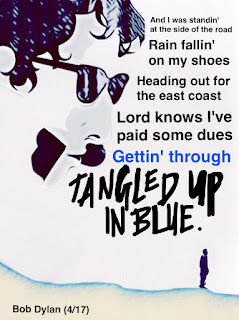
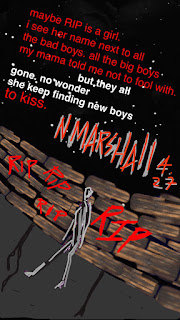
Or, as the street artist Swoon says:
There’s that feeling you get when you see something that you don’t understand the origin of: wonderment. It brings about a kind of innocence, and I love that. I love to witness it. I love to be a part of making those moments happen.
Which brings me to a problem I encountered about six years ago. I did not create much. I messed around with some visual projects once in awhile. But I did not have a routine or a practice that I returned to regularly. This produced an overwhelming dissonance. I felt fraudulent. Here I was, cajoling and imploring students to create, to take chances, to challenge themselves.
What about me?
My first outlet was learning guitar. Music has always been a big part of my life, and it depressed me that I did not play an instrument. So this seemed like a natural starting point. It was incredible. For all of the frustration — and, oh my, was there frustration — I loved the growing number of chords I mastered, the growing catalogue of songs I could play.
Now, I value the way playing guitar helps me to hear music differently, to appreciate it more deeply. As much as I was in awe of songwriters like Elliott Smith and Steve Earle before learning guitar, being able to play made me aware of their songcraft, the way they connect chords in surprising and resonant ways. Additionally, guitar offers me an out. If I play for 45 minutes, it is 45 minutes without a screen. It is 45 minutes during which my focus narrows even while my mind roams.
I wanted other outlets, though. In particular, I wanted something visual. Ultimately, I decided on woodblock printing. I have always been attracted to its aesthetics—the use of negative space, the simultaneous starkness and richness of black ink, the bold lines, the simplicity of the materials that belies a complexity of technique.
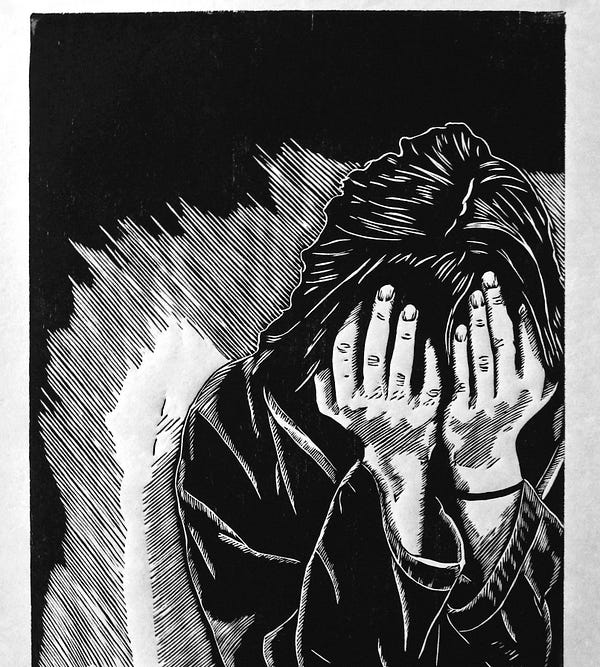
Like this print.
The artist conveys a dynamic story with wood, ink, and paper. I find myself a bit lost in the details, considering, for example, the way he renders the hair. Or the bracelet on the left wrist. Or the creases on the jacket. When I look at this piece, I think, “I want to do this.”
I want to do this. How many of these moments do I have when looking at art, listening to music, watching a film? I want to do this.
Often, I follow that declarative statement with the question “can I do this?” And, way too often, I have answered that question by saying, “no, of course I can’t.” I think many people have the same looping inner monologue. Where does this “no” come from? For me, it arises from a sense that what I might create would pale in comparison to what I have seen others do, as if somehow my work will be judged and mocked by the world. I know. This is ludicrous. First of all, I can share or not share as I see fit. Second, even if I choose to share, very few people will see my work. Third, getting eyes on my work is not even the point. The point is to feel engaged. To do something with intention and attention. To surprise myself by what I might be capable of. To find enjoyment and to seek a vision.
To turn the “no, of course I can’t” into “yes, I can. And will.”
So that is what I have done over the last two years. With the help of a great colleague, friend, and mentor, I have started to make art. To make prints. The work is slow and challenging. There have been some successes, but far more blunders, frustrations, and failures. However, when I turn the kitchen island into the production studio, when I roll the ink on to the carved block, place the paper down, rub the baren across its surface, and peel it back. . .
 |
| “Cacophonous Voices,” Alex Gillies |
I want to do this. How many of these moments do I have when looking at art, listening to music, watching a film? I want to do this.
Often, I follow that declarative statement with the question “can I do this?” And, way too often, I have answered that question by saying, “no, of course I can’t.” I think many people have the same looping inner monologue. Where does this “no” come from? For me, it arises from a sense that what I might create would pale in comparison to what I have seen others do, as if somehow my work will be judged and mocked by the world. I know. This is ludicrous. First of all, I can share or not share as I see fit. Second, even if I choose to share, very few people will see my work. Third, getting eyes on my work is not even the point. The point is to feel engaged. To do something with intention and attention. To surprise myself by what I might be capable of. To find enjoyment and to seek a vision.
To turn the “no, of course I can’t” into “yes, I can. And will.”
So that is what I have done over the last two years. With the help of a great colleague, friend, and mentor, I have started to make art. To make prints. The work is slow and challenging. There have been some successes, but far more blunders, frustrations, and failures. However, when I turn the kitchen island into the production studio, when I roll the ink on to the carved block, place the paper down, rub the baren across its surface, and peel it back. . .
It is for me.