Although this post is not meant to be a defense of poetry, I will say this: good poetry amazes me. It stuns me. It wakes me. Like a perfectly executed 3 chord riff, a poem relies on so little — a sharply worded observation and an attention to language that can otherwise seem so commonplace. And it relies on so much — the desire by poets to take an active interest in our world and share what they see, what they think they know, and what they know they don’t know, with the rest of us. Like any other art, when a poet makes it click. . .magic.

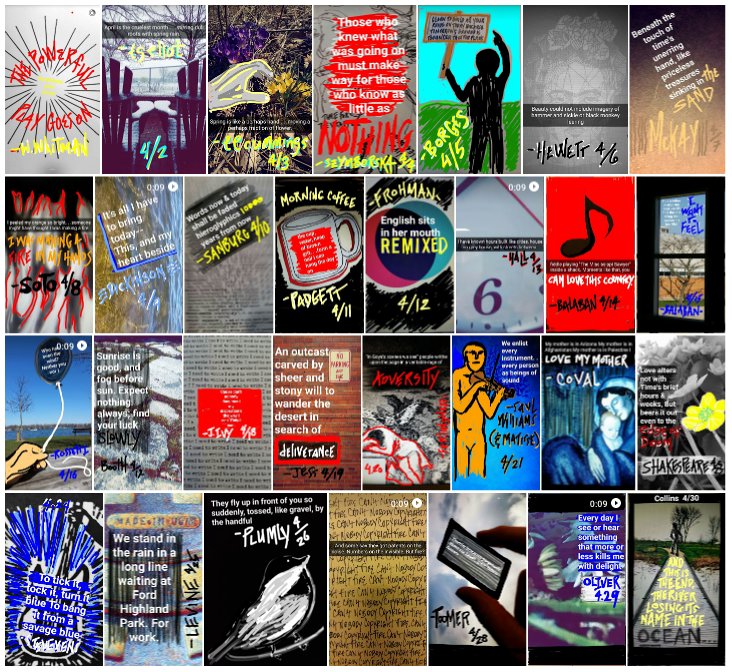
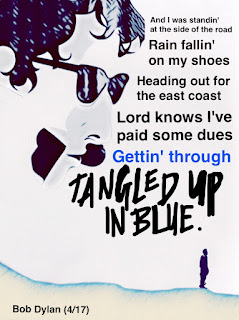
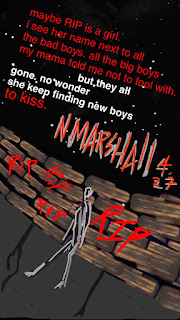
Back to my self-imposed challenge. I decided that for each day of April I would use Snapchat to illustrate a bit of a poem. And that’s about it. While I allowed myself to import images from my camera roll, I decided I would only use the editing tools available within the app: filters, cut-outs, drawing, and text. No outside photo editors. I think I stuck to it. The only other major requirement was to post by midnight. I think the closest I got was 11ish, which was close enough to make me worry. I also knew I had to make room on each post for the poet’s name and date. I know I forgot that last one a few times.

Pretty quickly I discovered a few of things:

2. Setting out to make something everyday greatly impacts your schedule. This must seem obvious, but it was powerful nevertheless. Since each one could take me anywhere from 45 minutes — 2 hours, I found myself looking at downtime quite differently. A free fifteen minutes before a class? Work on my #poemsnap for that day. Ten minutes of waiting for my daughter’s track practice to end? Work on my #poemsnap for that day. My wife needs five minutes before we watch The Americans? #Poemsnap time.
Recently I have heard interviews and read articles that make a case for boredom. At issue is the way so many of us use our devices to fill in moments of boredom with distraction. According to these interviews and articles, when we give in to the distractions offered by our devices, we are robbing ourselves of time to be bored, which is time to crank up the imagination. This might have particularly insidious effects for younger people. My project gave me something to do in these moments: I was either working on the snap or reading poetry and finding voices that were new to me. It kept me invigorated and distractions became unnecessary. It focused my attention.


1. Restrictions are useful. I guess this was less of a discovery than a reminder. I remember watching The Five Obstructions some years back. Lars Von Trier challenges Jorgen Leth to remake one of Leth’s film. Each time, Von Trier gives him obstructions to the creative process. The problem-solving Leth employs is pretty spectacular. It was probably the first time I understood how limits can bolster creative thinking. I am also a big fan of On Kawara's Today Series, in which the Japanese conceptual artist attempted to paint each day's date every day. He painted each canvas according to some pretty strict guidelines for size, color, and lettering. Furthermore, if he failed to finish a canvas by midnight, he threw out it away. When I have watched and read about both of these art experiments, I have tried to imagine how it would feel to create under such a regimen. While my project is small by comparison, it still gave me insight into how and why an artist would choose to limit their options.
2. Setting out to make something everyday greatly impacts your schedule. This must seem obvious, but it was powerful nevertheless. Since each one could take me anywhere from 45 minutes — 2 hours, I found myself looking at downtime quite differently. A free fifteen minutes before a class? Work on my #poemsnap for that day. Ten minutes of waiting for my daughter’s track practice to end? Work on my #poemsnap for that day. My wife needs five minutes before we watch The Americans? #Poemsnap time.
Recently I have heard interviews and read articles that make a case for boredom. At issue is the way so many of us use our devices to fill in moments of boredom with distraction. According to these interviews and articles, when we give in to the distractions offered by our devices, we are robbing ourselves of time to be bored, which is time to crank up the imagination. This might have particularly insidious effects for younger people. My project gave me something to do in these moments: I was either working on the snap or reading poetry and finding voices that were new to me. It kept me invigorated and distractions became unnecessary. It focused my attention.
3. It is exciting to get it right. And scary. It was so satisfying to (almost) perfectly execute an illustration that captures a mood, an idea, a feeling of some lines of poetry. But it was also daunting because as soon as I posted the snap, I immediately started to think about the next day: the poem, the imagery, the shape of the text. Recently, I watched an episode of the documentary series, Abstract, that focused on the graphic artist Christoph Niemann. In it, he talks about the anxiety caused by success: can it be followed? Will there be another idea? Will he reveal himself to be a fraud? Niemann calls these "lucky moments" when he has "won the lottery." Of course, I am not comparing my #snapchatart to Niemann’s deadlines for New Yorker covers. But I grasped his point. As the month progressed, I was aware of not wanting to copy myself, of not replaying the same moves. It was rough.
 |
| I drew these hands on my iPhone screen! |
If there is one other thing I loved about the project, it was spending so much time being intentional. I think this could be one of the greatest benefits of creative work. If I make thousands of decisions a day, which research suggests, most of them are done without much thought. Perhaps whole days go by without some overarching theme or reason. Or intention. But throughout April, I had a reason for each day. And when I was creating each snap, I was living intentionally. Decision upon decision. Execute. Assess. Perhaps redo. And then make more conscious decisions.
The scale of the work might be small, but the consequences, as it turns out, are massive.
Here is a link to the entire album.