It's easy to overlook this last necessity in the midst of the tangible rebuilding efforts. But this intangible is crucial. With a sense of shared experience, people are more willing to support one another, be empathetic towards what others are enduring, and work together. So how do communities nurture these connections? One way, according to Candy Chang, is through art.
Although her project, "Before I Die, I Want To," is not targeted specifically at communities most affected by the Hurricane, it did turn an abandoned space in her New Orleans neighborhood into a giant chalkboard on which she asked people from her community to share with each other their hopes, goals, and dreams in a very public way. As she says in her inspiring Ted Talk, "[A community chalkboard is] about knowing you're not alone. It's about understanding our neighbors in new and enlightening ways." As she shows pictures of the statements people left, she expresses her incredulity at the project's popularity. Not only did her neighbors flock to the wall to share their profound and humorous thoughts, complex and simple goals, but people from across the country and around the world began to do the same in their own communities.

Lately, I've been wondering about the degree to which art can help affect social change. This short, spirited talk by Chang provides me with an uplifting answer: art can do much to rectify issues within our communities. With this idea in mind, I have curated a number of artists who provide examples of using art to affect change on large and small scales.
Edi Rama has affected change on a large scale. The mayor of Tirana, Albania, Rama, like Chang, employed the vocabulary of art to convince his constituents to take ownership of their city. Instead of using text, however, Rama used color itself.
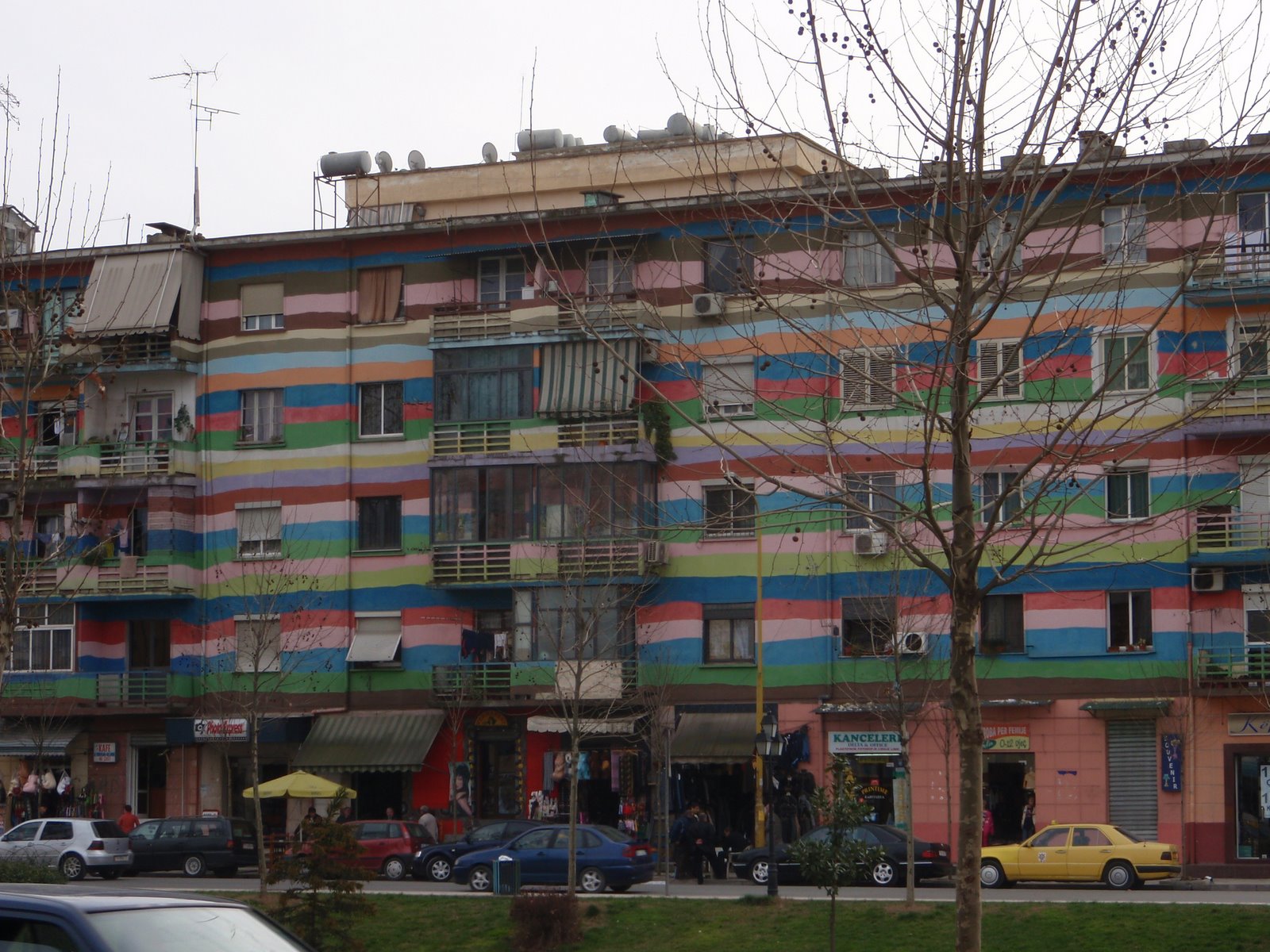 In his Ted Talk, "Take Back your City With Paint," Rama describes the immediate effect that painting buildings had on the citizens of Tirana: "When we painted the first building. . something unimaginable happened. There was a traffic jam and a crowd of people gathered as if it were the location of some spectacular accident, or the sudden sighting of a visiting pop star."
Of course, this is an art project on a grand scale. Grander, even, than Chang's. In order to succeed with his project, Rama used the political leverage at his disposal.
So what happens if an individual does not have this kind of political muscle? Or even the wherewithal that Chang shows in taking over an abandoned building? Perhaps that is where an individual can participate in projects made possible by social media, like JR's "Inside Out" campaign.
