Showing posts with label #clmooc. Show all posts

Tuesday, September 6, 2016

Is Blogging a Mindset?

Here is something I have been chewing on for a few days:


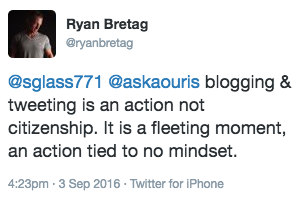
Ryan tweeted this after I tagged him in a tweet of my own:


So, yes, I instigated the debate that ensued. And it was lively. Ryan, a colleague, questioned the necessity for an online presence and balked at reducing citizenship to a discussion of devices and online activity. I agree. I am weary of the calls for "digital citizenship" training in schools because these calls usually have a limited focus: how to be safe, how to maintain privacy, how to cultivate your brand. I find that last one particularly irksome. I'm a person, not a brand.

But I keep coming back to that tweet, particularly the statement that "blogging. . . is a fleeting moment, an action tied to no mindset." Really? As I sit here (paused, fingers over the keys, trying to decide my next move), I disagree completely with the assumption that what I am doing is not indicative of a mindset.

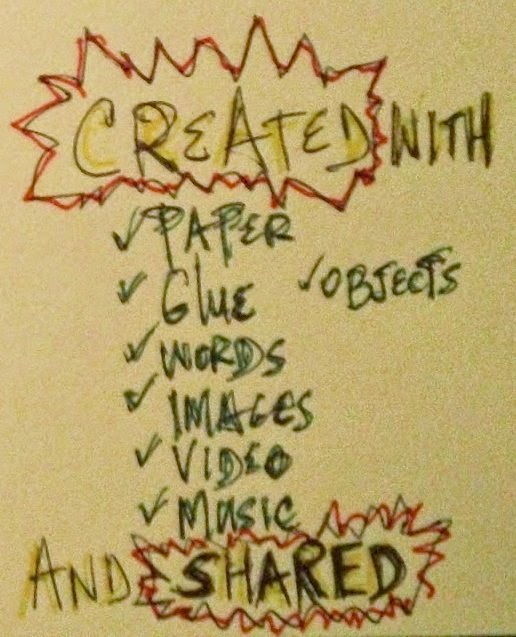
Here is a simple definition:


What, then, is the mindset that blogging affords? Or, what are the attitudes I hold due to blogging?

As I try to answer those questions, let me start by thinking about the writing mindset more generally:

Writing is thinking. It is a kind of mindfulness in that I use it to slow down; to investigate an idea or question more deeply; to take a measurement of my mind. Sure, I think while not writing. But when I want to scan my world more widely and/or deeply, I need to dedicate myself to my thoughts in a way that only writing provides.

Writing is creating. Lately, in education, it feels like STEM (and STEAM) own the words "creating" and "making." If students are not rigging something out of legos, cardboard, and circuits in a maker-space, they must be languishing in classes that deprive them of meaningful opportunities to pursue their curiosity. Wrong. Writing is all about pursuing curiosity and then using the most amazing technology humans have devised in order to express themselves: our language.

Perhaps some of the fault resides with us, the language arts teachers. Maybe we focus too much on teaching students how to fill out forms in the guise of 5-paragraph essays. We should never cease to be amazed by our ability to write clearly, confidently, and engagingly. We should stand in awe at our ability to calm and organize the jumbled and undisciplined cracks of insight in our minds so that, to paraphrase Ralph Waldo Emerson, the innermost can become the outermost. Writing makes this possible.

Writing is craft. Like any creative pursuit, it requires attention to detail and intentionality. When attempting to convey myself thoughtfully and interestingly and clearly, choices seem to be endless. Actually, I'll let the great writer, Tim O'Brien, explain this one:

There are twenty-six letters in our alphabet. And there are some punctuation marks, and that’s it. All we’ve got. Nothing else. And out of those 26 letters you can make Ulysses, or the Iliad, in translation – or . . .some piece of junk. The same twenty-six letters! And it’s the responsibility of the writer to pay attention to those letters, putting them in order so that they’re graceful, lucid, clear, all the things that matter to you as a writer. 

But what about blogging, in particular. So far, the mindset I have described does not require an online presence. So what mindset does blogging prompt and perpetuate? Here are three attitudes:

I can join the conversation. A grad school professor I had stated this once, and it has stuck with me. His point? For virtually anything we are interested in there exists online a robust conversation. The first job of the writer is to familiarize herself with this conversation. The second is to join. Blogging (and technology) has made joining possible for a much wider range of voices than ever before. Of course, joining does not insure an audience. But I know from experience that crafting a blog post makes me consider the potential audience or community, and this has serious implications for the way I present myself. 

I can be generous and empathetic. This goes for me as a blogger, but also as a reader of other people's blogs. I have written blogs in which I highlight other people's ideas and give credit to people for pushing my own thinking. This includes linking to their work as a way to give them more audience. I have also commented and tweeted my gratitude to writers whose work I value. While these actions might not seem like much, I know they matter, both for the individual as well as for a broader community that these actions can help to establish. Similar to joining the conversation, being generous and empathetic are vital to a participatory culture in which people feel comfortable sharing, agreeing, and disagreeing. This is a mindset I mean to practice daily in my digital routine and in my blogging. 
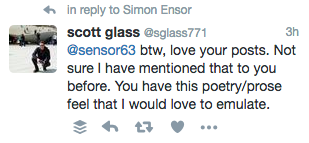

I can be an active producer instead of a passive consumer.

Yes, I do believe that writing is a mindset. And blogging, too.

Tuesday, August 2, 2016

The Immediacy of a Conversation

The Process
It started with an early morning phone call to Kevin Hodgson, fellow #clmooc traveller. Our chat lasted about 10 minutes, which I uploaded, unedited, to Soundcloud. There were pauses, non-sequiturs, and stumbling attempts to formulate questions (by me). It was an untidy and excellent record of our voices on a July morning, full of springboard ideas.


My next task: shape the 10 minutes so that those ideas could flourish. I accomplished this in Soundtrap. My first decision--remove my voice. I did not make this decision because I am averse to hearing myself. Like most people, I am not crazy about listening to my voice, but I have done it often enough to not get hung up on how strange it sounds. Instead, I cut myself out in order to highlight Kevin.

After snipping a bit more, I added a few musical interludes. I enjoyed playing around with these bits of guitar loops. I listen to podcasts and am always interested in the way that music shapes narrative, moves conversations along, and accentuates mood.


Satisfied with how I highlighted Kevin's compelling thinking about the morning, the unknown, the need to let ideas simmer, I uploaded the Soundtrap file back to Soundcloud as a post that was now half as long as the original.


A Take-away
It is fantastic to hear Kevin's voice. While I've always enjoyed his writing, listening to him reflect on how and why he creates feels even more immediate.

But why?

Maybe this is due to the unified, polished quality of published writing. As readers we know that writers struggle, revise, and, probably, feel a degree of frustration in order to articulate a thought sharply and clearly. (I just spent 10 minutes on that last sentence. . .) But, typically, this is not what we think about in the moment we are engaged with an essay, blogpost, or article. Instead, our minds are occupied by the ideas. If I consider the writing itself, usually it is to relish the masterful way the writer has shaped a particularly powerful moment.

Returning to the point about immediacy, as I listened to Kevin talk, I could hear him working out his ideas in the moment. Seeking, revising, emphasizing: these were happening simultaneously. Or, to put it another way, I got to listen to Kevin's thinking process. I heard him cobbling together explanations, searching for examples, making leaps and taking momentary rests. For both of us, there was this lingering anticipation of what might come next. Maybe this is what it comes down to. In a conversation, anticipation is in play for both the speaker and the listener, whereas, when we read a piece of writing, the shared anticipation is gone. Only the reader feels it.

As I think about this now, I wonder how much different his remarks would be if I emailed him some questions and asked him to respond in writing. It is quite possible that the ideas would be the same. However, Kevin is indisputably a great writer, and I am sure his answers would be executed in a more planned and polished way. Without a doubt, it would be an absorbing piece of writing and one that I would gladly dig into. Sometimes, though, it is conversation, with its messiness, that supplies brighter glimmers than polish can provide.

Thursday, June 2, 2016

Dear Next President

In the midst of this election year, the National Writing Project and KQED have created Letters To The Next President. The idea: motivate students and teachers to get involved. The point is not to campaign for a particular person, but to articulate issues and raise questions that the next leader should consider, regardless of who it is.

Regardless of specific policy positions, I want the next president to be thoughtful, honest, and tolerant.
With that in mind, here's my (first) letter, multimedia style:


Thanks for watching!

Sunday, January 24, 2016

It Was Time

I have always been fascinated by artists. They start with a blank page, a blank canvas, a collection of chords. Then, through sweat, determination, and vision, something incredible happens. Worlds are born, songs are crafted, paintings are created. Since high school, I wanted a part in this. But how? As a 36 year old, I decided one possible avenue. With the help of some talented friends, I picked up the guitar and have been playing it ever since.


My plan for the future: to write songs, even if just for myself.

Thanks for reading.

Tuesday, September 15, 2015

Fall: Time To Play

So maybe it is not officially fall, yet; however, the prairie plants in my yard have that look. I guess they do not worry as much about calendars and meteorological pronouncements.

In any case, there should be a word for this period between the heat of summer and the chill of autumn. As far as indeterminate spaces go, it is one of my favorites. Temperatures vacillate. Night creeps in more quickly. The light falls differently than during those dry tinder days of July and August.

There should be a word. Maybe something along the lines of gloaming--quite possibly my favorite time of day, when the dipping Western sun takes on the look of rose-tinged klieg lights against the houses and trees across the park. There should be a word. For now, I'll not worry about the naming, but just enjoy the changes according to their own logic.

To this end, it seems like the perfect time to do a little creating.


A note to my students and anybody else who is interested:
People might wonder why I took the time to make this. Here are five reasons:
  • I wanted to spend some time creating, not consuming.
  • I wanted to spend some time experimenting with materials and tools.
  • I wanted to capture a moment and be an active observer.
  • I wanted to feel connected to my world.
  • In a moment of boredom, I wanted to resist being a mindless scroller.
Wait. I just thought of a sixth:
  • I wanted to have a little fun.
It took me somewhere between 90 minutes-2 hours to put this all together and write this post. What could I have done with that time instead? Certainly, I could have watched t.v. I could have read, taken a nap, thumbed my way through Twitter, taken a walk. But it's not about what I could have done. Giving my attention to this project meant giving attention my thinking, to my breathing, to my fingers, to my eyes, to my legs. As a colleague put it, it meant striving to be a "proactive authentic being." That's what these tools at my disposal, like my exacto knife, my phone, my laptop, can help me to become. 


Tuesday, August 26, 2014

Hello New School Year

I've never really committed goals for a new school year to print. Of course, I've had some goals, and maybe I've even shared them vocally. But this year I've decided to more formally list what I hope to accomplish. Perhaps it will motivate me to pursue these five goals more vigorously than I would otherwise. So, in no particular order, here they are:

  • Carve out space to focus on student agency. Since presenting on this at the Chromebook Institute this past June, I've been thinking a lot about it. It is always a goal, and I think I've done fairly well at times. But I want to make a more concerted effort to reflect on what agency means and how to work with my students to empower them to pursue their interests. 

  • Do more making in the classroom. This encompasses working with both digital and physical materials. After participating in #CLMOOC this summer, I have been reminded of the way that creating stimulates ideas and fosters a more thoughtful, even mindful, attitude. In our fast paced culture, creating requires slow, which is sorely needed in most of our lives. Not to mention more time for play.
  • Be an advocate for connected learning. Again, something I was reminded of in #CLMOOC. My Diigo links have multiplied greatly this summer as I picked up ideas regarding projects and tools from my colleagues. Not to mention the benefits I continue to accrue while taking part in a host of twitter chats. For that matter, I also want to stay connected to the great people I've learned from online.
  • Encourage my own kids to be creators like I do with my students. While attending Educon last January, I had a number of conversations with other educators about this. Too many of us agreed that we wished our own children had the opportunities in their classes that we were trying to provide for our students. And we agreed that, with the time-consuming nature of teaching, it is too easy to lament a lack of vision in our kids' classrooms without trying to rectify this at home. A huge oversight.
  • Lighten up and have more fun with my colleagues. I could probably include my students as well, but we have light moments in class. Outside of class, however, there is just so much to do. I find it too easy to bury myself at my desk. This is not right. I work with outstanding people. Interesting people. Funny people. Not to mention that research shows that laughter keeps you healthier. This is an imperative.
So there they are. Five goals. I could have listed more. For instance, I didn't even broach the need to work with students to help them create healthy digital routines that revolve around generosity, kindness, and curiosity. But I guess that one goes without saying. Tomorrow the new year begins. As the artist Chuck Close says, "Inspiration is for amateurs. The rest of us just show up and get to work." I'm ready.

Monday, June 30, 2014

My Agency, Meme Style

I constantly tell my students not to disregard what is unfamiliar or what they don't understand. I enjoy quoting John Coltrane's wife who said something along the lines of, "not everything must be embraced with open arms." Some things are difficult to understand; other things seem of little consequence. To be a learner means to look at these things. To look again. And again. To resist the temptation to shrug and walk by.

And so it is with memes.

Before this week long dive into memes with #CLMOOC, I paid very little attention to this form of internet communication.  In general, they did nothing for me. I have come across some clever ones, but I was always turned off by the limited visual language: the baby holding up his fist, the tyrannosaurus rex, the line drawing of the deformed head. Ultimately I saw these like text messages with a picture. In many ways, I still feel this way.  I think what it comes down to is agency. Kevin Hodgson mentioned this in a Google+ post, and it really stuck with me. The memes that I am drawn to most are the ones where I see the most agency being employed by the creator.

Having just led a workshop on creating student agency in the classroom, this word was already on my mind. In that workshop, we brainstormed what agency truly meant. Here's a part of the list we made --->>

"Having a story," "Control," "Joy": these are so crucial to the creative process. And there can be no creative process without autonomy for the creator. As I worked on my own memes, I found myself drifting into a "flow" state. Probably not as deeply as what Csiksentmihalyi describes in his work. But present were the deep focus and mindfulness. As I meticulously cut out figures in Pixlr Editor, I could feel my breathing change and eyes narrow.
For me, the meaningfulness of the exercise did not come from inserting a phrase into a generator that limited the visual options of my message. With a meme, in fact, the visual structure is crucial. As far as digital writing is concerned, memes are a great example of how the interplay of text and image produce a message. Going back to the list, I did not want to cede control of half of my work.  Of course, I could upload my own image into a meme generator, but there was still a limitation on how it could look.


Perhaps I'm missing the point. Maybe the great thing about memes is that they do have this limited visual vocabulary out of which hundreds of thousands of statements are made. I don't know. I'll need to consider this further.

After a week of experimenting, however, what I do know is this: given the time to play and experiment with tools and choices, I want to know that the meme I create and the story I tell has as much of me in it as possible.


Monday, June 23, 2014

How To Ignore A List

At the suggestion of #clmooc, I offer a reflection on the first week of making in list form. Here's what I had planned on doing this past Saturday:

First
De-moss the brick patio.


Second
Finish mulching the side plot.
Third
Flagstone path maintenance: Fill in material that has washed away.
Fourth
Weed!

So how much of that did I accomplish? None. Why? Because I started to work on a "How To" video instead:


I thought I would take an hour to look over the footage my son helped me shoot the day before and start to piece a video together in YouTube Editor. Sure enough, three hours later, suddenly I realized. . that three hours had passed, and I was still working on the video. While those other tasks are important, and, each in their own way, enjoyable (even the weeding), I could not stop editing until the project was done. As my attention and focus became deeper and deeper, it shot to the top of the list.  It became the most meaningful and relevant challenge for me on that Saturday morning. 

Now, here comes the educational tie-in: I just presented at the Midwest Chromebook Institute. The thrust of the workshop I led was the need to establish a classroom culture based upon student agency and meaningful learning experiences. With more and more schools going 1:1, including my own, I suggested that teachers early on challenge students with quick creative challenges aimed at having students reflect on and create multimedia statements about themselves.

The hope is that these kind of projects immediately introduce to the students a few critical ideas:
  1. They will use their devices to create,
  2. They will consider what is meaningful to them,
  3. They will share their work.
Making my video reinforced what happens when relevant making enters the picture. We want to continue to explore, shape, craft, and, eventually, get feedback in order to continue the iterative process. The trick is to carve out time for this work in the classroom.

It was a Saturday well spent.

Now it's time to get the mulch.


Friday, July 26, 2013

Reflect-->reEnVision


http://picasion.com/i/1VLgA/
Time for some reEnvisioning of my teaching


Having navigated the #clmooc, it's time to reflect on what I accomplished. Here are 5 key things I experienced.  


                                                                                                                                                                                                           Now it's on to the classroom in the fall. How much can I provide a physical and digital space that allows my students to have the same experiences? Not sure. However, this is more than just an "in addition to."  If my goal for everything we do in the classroom is to "make it matter," then these 5 experiences are imperative.  Not only will they help to foster an academic digital routine, which they desperately need, but it will also bring a healthy dose of Terry Elliot's "messification" to the classroom.  Not to mention positioning students and me on the edge of the "emergent possible."

Sunday, July 21, 2013

The Credo-Flection

I finally had some time to think about my credo.  I decided to try organizing it using Blogger's mosaic view.  If read in the correct order, each post adds to the overall belief.  The problem is that the correct order could prove a bit challenging.


Flip the pictures over from left to right.  Depending on how Blogger feels at the particular moment you check it out, there should be three rows. The clearer picture of me should be the last one.  Here's the link: Credo-Flection.  Thanks for checking it out.

Thursday, July 18, 2013

American Lit or American Ideas?


I woke up this morning wondering, "how important is it that students have a course called 'American Literature'?"  Ok, so I didn't wake up thinking that, but actually arrived at the question after reading a piece discussing the skills students will need to be successful in the 21st Century. The list was predictable: collaboration, creativity, adaptability, curiosity, communication. Predictable is not meant as an insult.  It doesn't mean this list is incorrect; if anything, predictable denotes how critical these skills are. Predictable signifies that there is a consensus surrounding the importance of these skills. I've read  blog posts, reports, articles, interviews with education leaders, books, and tweets that equate one or more of these skills to becoming productive and successful 21st Century existence.

So back to my original question.  Is "American Literature" necessary?

Of course, as an English teacher, and literature fan in general, I am not asking if literature is important or necessary.  Reading fiction, and simply being a reader, is also a critical activity.  But is there a compelling argument for insuring that students have read canonical American Literature?  If students do not experience Fitzgerald, Twain, Melville, or other classic American authors, will they be deficient citizens, unable to fully grasp the American Experiment?

America is a place founded on ideas about equality, opportunity, and freedom.  Undoubtedly, it is crucial for young people to struggle with these ideas, especially as the ideas move from the plastic-wrapped sanctity of our founding documents to the messy, conflict-laden reality of day-to-day life. Naturally, one way to get young people to do this is by having them read and consider Huck's dilemma as he navigates the Mississippi or Tom Joad's relentless stand against a venal, inequitable system.  

But is it necessary that students know these names to understand what democratic citizenship requires?  If young people have less familiarity with these names, does it jeopardize our cultural heritage and generational cohesion, making it less possible for the American Experiment to flourish?

While colleagues will disagree with me, as an American Lit teacher, my answer to these last two questions is 'no.'  

While I grant that cultural literacy has been and will continue to erode, I am not particularly upset about it.  Sure, I'm surprised, even saddened sometimes, by the growing list of dead references I encounter in the classroom.  However, this seems inevitable as our access to information grows and our media experiences become more diffuse.  All the same, this does not mean that we lose sight of our deeply held principles.  It is imperative that students confront the tensions inherent in the American Experiment, even if these confrontations do not grow out of reading The Scarlet Letter. 

As I said earlier, I will continue to stress how important it is for them to be readers.  I will continue to make a case for how fiction works as a testing ground where we encounter great minds asking difficult questions.  I will continue to help them become confident, thoughtful, tolerant thinkers and communicators.  And I will continue to look for ways to help them ignite their curiosity and find the questions and ideas that make them passionate.  I will continue to do these things because I believe this is how the American Experiment remains vibrant.  

My point is not to forgo all classic works simply because they are classics.  Instead, what I am trying to figure out is if a regimen of canonical American works somehow creates a more motivated, conversant American citizen.  This seems unlikely.  Instead, more and more, I'm confident that it's important to teach "American Principles" or "American Ideas", where the curriculum is flexible enough to include any media texts that are compelling and can enrich my students as human beings and as participants in all that America has to offer.

What I am less sure about is how critical it is for students to know that James Gatsby was born Jay Gatz.  If not, they can still understand what it means to be an American.  

Friday, July 12, 2013

More Than a Map, It's Polychrome Fingers


During the latest make cycle for #clmooc, I found

myself thinking less about the general theme,

maps, and more about the bits of paper stuck to

my fingers and the relationship between the brain,

eyes, and hands.


As I worked, I was reminded of the great origami documentary, Between the Folds.

My favorite scene is when artisan/craftsman Paul Jackson is working with his colored paper.  As he busily roughs up and colors the parchment, what always grabs my attention are his hands. Covered in greens, yellows, reds, and blacks, they're the hands of a maker.  They're a badge announcing his membership in a group to which I want to belong.  They're the embodiment of a thought process and signifiers of a passion to make tangible one's idiosyncratic vision.

Those rough, thick, polychrome fingers always stir within me a determination to make.

So now, as I tore pieces of New York state and swaths of New Mexico geography into strips and shreds and re-imagined borders, rivers, and landscapes, I paid attention to my fingertips. They were blackened and covered with worn, cottony pulp.  I paid attention to the way my eyes narrowed and I naturally held my breath as I slowly ripped the paper along some imagined, but no less important, line.

As Jackson says during his own moment of deep crafting, "The process of making is the point of it."

I wasn't lost in the activity, even though that would be a great metaphor for a project about maps.  Instead, I was subsumed by the activity. The materials, the journal page: I was creating a landscape, and I had the fingers of a maker to show for it.


Monday, July 1, 2013

The Bottom of the Bag

I had not poked around in this particular bag for quite some time: the white mesh one we used to take to the beach when we lived in Chicago.  Having pretty young kids, it is easy to guess the objects within: small shovels, various sand castle molds, an assortment of dinosaurs and action figures. While we now live on a smaller lake with a little beach about 300 yards from our house, this particular bag has not seen much action. The kids are older, and this collection of toys no longer garners much attention.

Therefore, it was the perfect bag to dig through for the toyhack.


So what did I find?  A little dumptruck.  A rubber shark.  A small Cro-magnon-looking action figure. I can't even imagine how this last one found its way into the bunch.

But the bigger thing I found was a sense of challenge and purpose.  Add to this the fact that it was an engaging way to spend a couple of hours, and I had the three necessary ingredients for a creative endeavor.    As I worked with the toys and shopped through our tools and art supplies for needle nose pliers, Gorilla Glue, Sharpies, pipe cleaners, and more, I focused on the evolving vision and on my hands, breaking apart the objects and putting them back together.  Of course I wanted to make something in order to share it with the #clmooc.  But this became secondary to crafting something with which I would be satisfied.

And I was ultimately satisfied.  The end result was a bit goofy, but it made sense in some '70's cartoon universe way.

Thinking more about the white mesh bag, I have to admit that the first time I looked through it I felt unimpressed with the materials. Nothing grabbed me. I actually put the bag down and started to pick around  in the garage. Before long, however, I decided to challenge myself with an obstruction: I had to use this rejected material.

So, here comes the educational payoff.

Digging to the bottom of the bag and using the less obvious materials:  How many times have I implored my students to do exactly this?  To move past initial ideas?  To resist their first thoughts, which are usually obvious and reactionary?  To embrace ideas that are only partially formed, a bit jumbled, possibly confusing?  So often it is in the murkier recesses that we find the makings for more compelling creations.  The toyhack proved to be an excellent reminder of what it is like to practice these directions instead of just saying them.  And how much easier it is to do so when interested in the task.