Showing posts with label creativity. Show all posts

Monday, November 14, 2016

Dreaming of Opportunity

In her essay, "What is the American Dream," writer Kimberly Amadeo poses the question, "Is the American Dream a myth?" Unfortunately, many economists and political scientists would say "yes." Amadeo herself cites sociologist Richard Wilkinson, who argues "if Americans want to live the American Dream, they should move to Denmark." Ouch. Apparently, Mr. Wilkinson no longer believes the American Dream exists. At least not in America. However, the question of whether the American Dream is reality or myth, does not really matter. What matters is the way it reverberates across time and place to give people hope. The most important definitions of the American Dream highlight the opportunity for all to live meaningful lives as thinkers and creators.

Recently, I was looking at the responses to npr's Your American Dreams. A number of them caught my attention, but here is one that got me thinking:


Historically, our faith in meritocracy has been a major difference between America and other countries. Regardless of who you are, who your parents are, or where you are from, you can succeed as long as you are willing to take advantage of opportunities and work. I realize that for too many people this has been more rhetoric than reality. But still. A dream based on entitlement? This sounds less like people expecting a chance and more like people expecting special treatment.

Then again, I wonder exactly what kind of entitlement this person is talking about. The word gets used in a number of contexts: sometimes it’s used as a criticism of government programs that people rely on, like social security or welfare. But it can also apply to people who have grown up with all the advantages. For sure there are people who go to great schools, take great vacations, and generally get what they want without ever worrying. People in this situation can end up with the attitude that they deserve all of these things simply for being them, and if other people do not have this wealth, it must be due to some deficiency. The problem with this latter definition is that it hinders a person’s ability to think beyond herself.

Can there even be an America if this becomes our underpinning? It would undermine our belief in opportunity. It would make people selfish and unwilling to entertain a shared purpose. It would erode our ability to empathize.
Right now, I am reading Death of a Salesman with students. A country based on entitlement would be like a country full of Howards, Willy Loman's self-absorbed boss. I could picture his contribution to the npr site looking something like this:
After all, when Willy comes to talk to him about his inability to support himself and his family, Howard is much more interested in his shiny new technology: the wire recorder. Willy needs Howard to hear him, but all Howard hears is his own wealth and security. Howard even suggests Willy buy one and "tell the maid to turn the radio on when Jack Benny comes on" (78). He is saying this to a desperate man willing to sell himself out for $50. Howard might be listening to the recording of his family, but he is tone-deaf. Earlier in the play, Linda, Willy's wife, implores her sons that "attention must be paid" (56), even though he can be belligerent, judgemental, and irrational. She demands empathy for her struggling husband. But Howard seems to lack the moral imagination to empathize with Willy. A dream based on entitlement, I fear, makes these types of interactions all the more likely. A dream based on entitlement undermines an individual's desire to grow and to celebrate the growth of others.

What about me, though? What would I say my American Dream entails? How about something like this:
Can meaningfulness be found through work? Sure. Can it be achieved through volunteering for a cause? Yes. Can it be nurtured through relationships with loved ones? Definitely. Can it be developed by living lives of curiosity, wonder, and creativity? Absolutely. How about a combination of all of these? This is the point, of course. Naturally, it is important to feel settled, safe, and provided for. But defining the Dream this way leaves untapped that which really makes us not just Americans, but humans: our desire to expand who we are and to"contribute a verse." 

Finally, part of our verse should be the opportunity to define the American Dream as we each see fit, and to leave space for others to define it as well. Hopefully we do not have to go to Denmark to make that a reality.

Tuesday, October 18, 2016

My Eyes Stretched Wide

I'm not a huge fan of the word "inspiration." Unfortunately, I feel like it has been co-opted by kitty poster market and self-help movement. When I hear the word "inspiring," I can't help but imagine


Still, I know that I do get inspired by ideas. I get inspired by artists. I get inspired by words and music and creators of all kinds.

For instance, when Walt Whitman says, "habit yourself to the dazzle of the light and every moment of your life," I feel that push to engage with my world. He inspires me to be active instead of passive. He inspires me to be interested in where I am right now. So here's to Whitman:


Henry David Thoreau also had an unrelenting desire to know the world firsthand. He neither tolerated nor excused passivity. And he did not concern himself with what others thought of his lifestyle. People criticized him for choosing to live at Walden; however, it made no difference to him. Instead, he faced life with the determination to "drive [it] into a corner." When I read this, I think, "how about me? Do I live vibrantly? Do I live vigorously?" So here's to Thoreau:


Both motivate me to observe, think, and create, even if that creating stays private. After all, it's not about changing the world. It's about changing myself. I guess I can be inspired. I know I should remember this:


Tuesday, August 23, 2016

The Best of Time and Place

In 2007, Eric Schlosser wrote a short piece called "The Freak Show." His aim: to show the variety of artists and events that contributed to his understanding of America and offer a brief perspective on the country.

Using his writing as a model, I created my own inventory of stuff that has shaped my view of the United States. It was a definite challenge to pare down my list. For every name and event listed, I thought of five more that easily could be included, especially when considering musicians and filmmakers. Here it is:

The Best of Time and Place

My idea of America was formed by my dad explaining to me how politics works and why it is vital to treat all people with respect, by the music of the Dead Kennedys, Bob Dylan, and dozens of unknown indie and punk bands driving town to town in their vans, by the films of Martin Scorsese, the Coen Brothers and Jim Jarmusch, by writers like Walt Whitman, Tim O’Brien, and the art of Chuck Close, by characters like Huck Finn, by Reagan’s theory that taxes for the rich will trickle down to the rest, by the 1980 hockey team defeating the Soviet Union, and our questionable response to 9/11.

The America that I love combines patriotism with a healthy sense of scepticism. It is made up of people who strike out for the unknown and create their own lives, but who also never forget that they are a part of something greater than any one person. The stories that have forged my perspective can be dark: a low growl meant to warn strangers to tread carefully. At the same time, the optimistic sense that, as Walt Whitman says, “we have the best of time and place” lingers on.


And a short video accompaniment.

Thanks for reading.

Thursday, May 12, 2016

Snap To It: A Creative Challenge

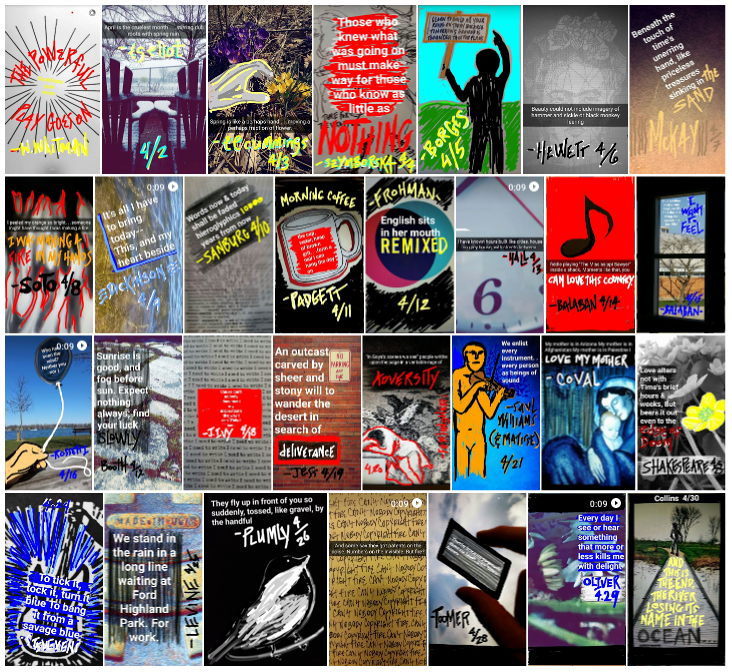
April is National Poetry Month. This year, I decided to celebrate it by giving myself a challenge: create one original piece of Shapchat art each day that would combine some kind of visual with a line from a poem.


Going into the project, my main goal was to learn Snapchat. As a parent and teacher, I have seen it become the preferred social media platform for young people, so I wanted to get a sense of it. What I discovered, though, went beyond how to use the app. Here are 3 of the more important things I realized.

I like poetry.

Sounds funny coming from an English teacher, but I don’t spend a lot of time with poetry in my classes. Typically, I’ll throw 3-4 poems at my students over the course of a year. And these end up being my go-tos. Since this project required me to find 30 lines of poetry, I had to range far beyond the old standbys. This searching and reading reminded me of how powerfully poets combine language and brevity in order to convey their thoughts about the deepest, most complex questions confronting human beings.

Tim O’Brien, my favorite writer, says that all we have is 26 letters and a few punctuation marks through which we try to make ourselves understood to others. Poets are in the business of using these letters and punctuation marks to make concise observations about our world. Gabriel Orozco, one of my favorite artists, says that he wants to be intimate with the world, and art is the attempt to build bridges so others can also experience that intimacy. Poets use a slender toolbox indeed in order to build their bridges.


I like to use my technology for a purpose.

Here I am thinking about the way so many of us fall into the scroller trap. Think about how often you or people you know fill downtime with tech time. For years, I resisted getting a phone. Now that I have one, I find myself reaching for it when I have a few minutes with nothing to do. Like when I am picking up my kids from soccer practice, am in a waiting room, am on a train. More often than not, I am looking for nothing in particular. It is mindless scrolling. I have tried to be more aware of this tendency and to resist it.

My poetry project gave me a goal or destination for these moments. Throughout April, when I found myself reaching for my phone to fill in some seemingly empty moments, I went to poets.org or the poetry foundation and read poems. I was always on the lookout for the poems and even specific lines that made me say, “whoa! yes!” For the lines that gave me that chill factor. Instead of tuning out during the downtime, this searching kept me thinking. Interestingly, I found myself putting away the phone after a particularly compelling poem in order to think about what I just read and how I might use it in my project. As an educator, I have participated in numerous conversations about helping kids to become thoughtful, critical, and creative citizens, online and off. This project helped me to achieve these goals.


Speaking of creativity. I like to create (and to give myself creative challenges).

A few years back, I read a book by David Gauntlett called Making is Connecting. It is wonderful and I highly recommend it. In his writing, Gauntlett offers his definition for everyday, personal creativity. For Gauntlett, this kind of creativity is typified by making something novel for oneself. Too often, he found that definitions of creativity were written with society in mind. For something to be considered creative, it needed to be judged and accepted by a community of experts. Like Gauntlett, this view of creativity ignores the creative urge we all feel. When I made the Snapchat images, I was primarily concerned with making something pleasing to me. I knew others would see my creations. That is the point of social media. However, my main concern was with my experience. How did I feel while in the process? What kinds of decisions did I need to make as I created? How well did I execute those decisions? What did I think about the finished work?

Taken together, these questions and this thought process gave me a sense of autonomy, a sense of agency, and a deep sense of satisfaction. Consider how many decisions we make everyday, and, of those decisions, how many are done without thinking. This kind of creative project provided me with thoughtful decisions. Color choices, layouts, text position: for such small works, the choices could be almost overwhelming. But these choices required intentionality, and I liked that feeling.

Ultimately, the project led me to this: Yes, I could be a creator, not a consumer. I could bring something new into the world, even if on a small scale. I could translate an idea into a tangible work. I feel accomplishment, even when I struggled. Or especially when I did. Well worth the investment.


Here is a link to the entire album.  


Sunday, April 10, 2016

Teaching Failure: A Curiosity Conversation

The Hollywood producer, Brian Grazer, is known for his blockbuster movies, like Apollo 13, his blockbuster hair, and, more recently, his habit of having "curiosity conversations." While it is unlikely that I will duplicate either of the first two accomplishments, as soon as I heard about the last one, I knew that I had to try it.

As a teacher, it is critical that I remain a learner. After all, how can I ask my students to challenge themselves in new ways if I am unwilling to do the same. In the last year, my desire to learn, to be a student, has led me to woodblock printing and Kurt Webb.

Kurt teaches Ceramics and art at my school, Glenbrook South. While I have known Kurt since I started at GBS 19 years ago, it is through his generous mentorship in printing that I have acquired a deeper appreciation for who he is as a teacher, artist, and colleague. Our carving and printing sessions typically turn into rich discussions on creativity, education, and culture in general. He seemed perfect for my first attempt at a curiosity conversation. And he did not disappoint.

As you listen, you will see my comments. These are questions I found myself asking. I think any one of these questions could make for an interesting, thought-provoking bit of research. If you have a question of your own or a response to one of mine, feel free to leave it on the Soundcloud track or as a comment to this blog.


Thanks for reading and listening.

Sunday, January 24, 2016

It Was Time

I have always been fascinated by artists. They start with a blank page, a blank canvas, a collection of chords. Then, through sweat, determination, and vision, something incredible happens. Worlds are born, songs are crafted, paintings are created. Since high school, I wanted a part in this. But how? As a 36 year old, I decided one possible avenue. With the help of some talented friends, I picked up the guitar and have been playing it ever since.


My plan for the future: to write songs, even if just for myself.

Thanks for reading.

Monday, November 23, 2015

It's The Process

I have shown the PBS documentary Between The Folds to students a number of times. While I find the whole exploration into paper folding engaging, my favorite moment occurs when origamist Paul Jackson shows his folding technique. Why does this moment stand out? It's all about the hands.


When I see his fingers, I know I am looking at a creator. I am looking at experimentation, knowledge, curiosity, and passion. Those smudges of green, yellow, and blue confirm Jackson's desire to be active and engaged with materials, with the world. Those are not the hands of a passive consumer.

Speaking of process, Jackson explains that "making [something] is the point of it." I could not agree more. In my own experience, creating, even if just for myself, provides an experience that is hard to replicate elsewhere. Whether it is messing around on guitar, figuring out how to carve and print a woodblock, exploring ways to use digital tools to make personally meaningful media, or even crafting a blog post, these activities give me deeper access to my thoughts. A quiet, singular focus replaces the noise that daily competes for my attention. What I hear instead is my own breath and its rhythm, sometimes held at a key moment. Now exhaled.

This physical nature of work can not be overlooked: the senses, the heartbeat, the feel of my fingertips on the materials, whether an exacto knife or keyboard. Together these make the aesthetic experience unordinary. At another point in the documentary, folder Chris Palmer demonstrates a lengthy process of creating a flower/tower. I see how intent he is. But I also hear it--his breath mixing with the sound of the paper being manipulated.

After spending four hours on his work, Palmer says that "the process is 2/3rds of what's special about something that got made." I think I saw this documentary for the first time almost 10 years ago. Since then, I have worked to become a creator. Now I better understand why Palmer and Jackson celebrated the process itself. 
And now I wonder if this could be the most important lesson for students in my classroom.

Sunday, October 4, 2015

Make It Matter: Hands-on in the English classroom

As a teacher, part of the cycle of the year includes revisiting certain ideas, statements, and questions. Sometimes students ask if it gets boring talking about the same books, the same essays, the same films. While I try to bring in fresh material as much as possible, the fact remains that I have a long term relationship with some content.

Is this a problem? Not necessarily. In fact, I count among the benefits of teaching the certainty that I get to grapple with particular works of art and literature over time. I am not static. As I get older, as my own kids grow, as I add to my range of experiences, my ideas about teaching and learning progress. And, inevitably, my relationship to art, including those pieces I know best, deepens.

In the last week, I have greeted back into my room two individuals: the 19th Century writer, philosopher, and naturalist, Henry David Thoreau; and the 21st Century multimedia artist, Gabriel Orozco. This year, more so than in the past, I saw a connection best exemplified by the following statements:


Engagement. That's what both men want. I want it, too. But not just for me. In the classroom, it is the goal: to help students gain entry into the worlds created by these artists and thinkers, to help them consider potential meanings, to help them understand how the ideas and questions raised by these individuals may apply to their own lives. Perhaps this is the biggest challenge I face as a teacher: to find that edge or in-road that makes students want to care, want to try, want to engage. I know it is the most exciting part of my job.

But how do I achieve this? Wow, that is a big, important question. As such, I have no easy answer. However, here are three certainties:

Value what they are interested in and wonder about, and give them opportunity to pursue these things in class. It's about choice. This year, I have embarked on a 20% Time project with some students. We are early in the process, but many of the students are excited by the possibilities. But I need to find ways to incorporate the 20% concept in smaller ways as well. As an English teacher, one way I can do this is by giving students more freedom regarding writing. Instead of essay topics that lead to formulaic, thesis-driven essay analyzing literature, students need opportunities to "essay," in the traditional sense of the word: to explore.

Give them opportunity to be makers/creators in class. With the growing popularity of the maker movement, I want to find ways to bring this ethos into the English classroom. However, it is not always apparent how to do so. Of course, writing is craft. Writing is making. But another way is to open up moments for students to engage in visual crafting. For example, I recently gave students 30 minutes to work on the poem, The Writer. When I say "work on," I don't mean annotating lines, looking for symbols, and answering questions regarding overall meaning. This came later. First, though, students manipulated the poem in a variety of ways in their mindbooks (a blank-paged sketchbook).


Why spend this time in class? Here are three reasons:
  1. Deep focus. It’s interesting to see how intently people work at cutting, gluing, and designing the layout for this basic page. I think the focus is deeper than if we just moved straight to a conversation. In fact, many students display deeper focus and attention during these times than at any other point.
  2. Play time. How often during their days do students have time to experiment with materials? I don’t think it happens very often for many of them. Ultimately, this connects with #1--we need times of quiet. Whether they are reflecting on what they are making or on the poem too, students benefit from an opportunity to interact in this different way.
  3. Engagement. It’s just my speculation, but I do think some of them reread the poem more and consider it more as they are cutting it up. The text is not just visual material, but it has meaning as well. In follow-up conversation, some students echoed this idea. The rich conversation we had after this exercise bears this out.

Actually, here is one more reason to make time for this kind of work in the English classroom--it can be fun to create in these ways. And one more--it can be satisfying to see one's vision come to life in a visual way.

Taken together, all of this brings me back to my original point. We must find ways to make it matter.

Tuesday, September 15, 2015

Fall: Time To Play

So maybe it is not officially fall, yet; however, the prairie plants in my yard have that look. I guess they do not worry as much about calendars and meteorological pronouncements.

In any case, there should be a word for this period between the heat of summer and the chill of autumn. As far as indeterminate spaces go, it is one of my favorites. Temperatures vacillate. Night creeps in more quickly. The light falls differently than during those dry tinder days of July and August.

There should be a word. Maybe something along the lines of gloaming--quite possibly my favorite time of day, when the dipping Western sun takes on the look of rose-tinged klieg lights against the houses and trees across the park. There should be a word. For now, I'll not worry about the naming, but just enjoy the changes according to their own logic.

To this end, it seems like the perfect time to do a little creating.


A note to my students and anybody else who is interested:
People might wonder why I took the time to make this. Here are five reasons:
  • I wanted to spend some time creating, not consuming.
  • I wanted to spend some time experimenting with materials and tools.
  • I wanted to capture a moment and be an active observer.
  • I wanted to feel connected to my world.
  • In a moment of boredom, I wanted to resist being a mindless scroller.
Wait. I just thought of a sixth:
  • I wanted to have a little fun.
It took me somewhere between 90 minutes-2 hours to put this all together and write this post. What could I have done with that time instead? Certainly, I could have watched t.v. I could have read, taken a nap, thumbed my way through Twitter, taken a walk. But it's not about what I could have done. Giving my attention to this project meant giving attention my thinking, to my breathing, to my fingers, to my eyes, to my legs. As a colleague put it, it meant striving to be a "proactive authentic being." That's what these tools at my disposal, like my exacto knife, my phone, my laptop, can help me to become. 


Monday, August 17, 2015

Something I Love: 1 Guitar + 1 Voice

There's something special about playing guitar. Maybe it's the populist nature of the instrument: learn a few chords, a few patterns, and you're ready to go. Put it over your shoulder and you're ready to go: the porch, the campground, a friend's house. It is made to travel.

Woody Guthrie

When accompanying a voice, the guitar adds depth. It adds texture. It adds backbone to the experience being communicated. In the right hands, the guitar builds worlds. It's like a hammer, a wrench, a screwdriver: a tool so essential and simple, but also so damned vital.


Picking up the guitar fosters creativity. So many songs have been written. However, like the variations inherent in every chess match, the unique combinations of notes and chords are practically unlimited. And, as I've learned from experience, you're never too old to start. It's about dedication and the desire to have a space to create, both of which I value having in my life. Even if I can't sing. Yet.

Thursday, December 11, 2014

Creativity Brings Life

Recently I came across this Vine, compliments of @timneedles:


It inspired me so much, I decided to remix it and use it as the basis for a short video:


For such a short video, this actually took me quite some time. Naturally, somebody might ask why I would spend a couple of hours putting this together, knowing that few others would see it. The simple answer? Creating, regardless of what it is, provides a break.

It is about the process. Whether making a video


A piece of micro fiction:

Or a multimedia collage:


Working on this material or with paper, scissors, and glue removes me from my daily routine and reminds me how important it is to explore the emergent possible. It is too easy to coast, to skate, to not think beyond what needs to be done. But life is mysterious and wonderful and difficult. Creating restores an awareness of what is in front of me and, more importantly, what is inside me.
Creativity brings life. Rejoice! Inside, you'll find power. You'll find ability good for a big heart.

Sunday, August 24, 2014

No Thanks Google--I'll Do the Editing

Since last winter, I have made Google photo my main online space for saving my photographs.  It has proven to be a useful way to keep my pics organized and always at the ready for use. And it has been interesting to experiment with Google Photo's Auto-Awesome feature. With this feature turned on, Google will manipulate images in a number of ways. Some of these I have quite enjoyed, like the way it will turn a series of images into a gif:


This has been quite handy and fun to explore. What I am less sure about is the way Google will enhance photos:

IMG_20140805_084347-EFFECTS.jpg
IMG_20140805_084347.jpg

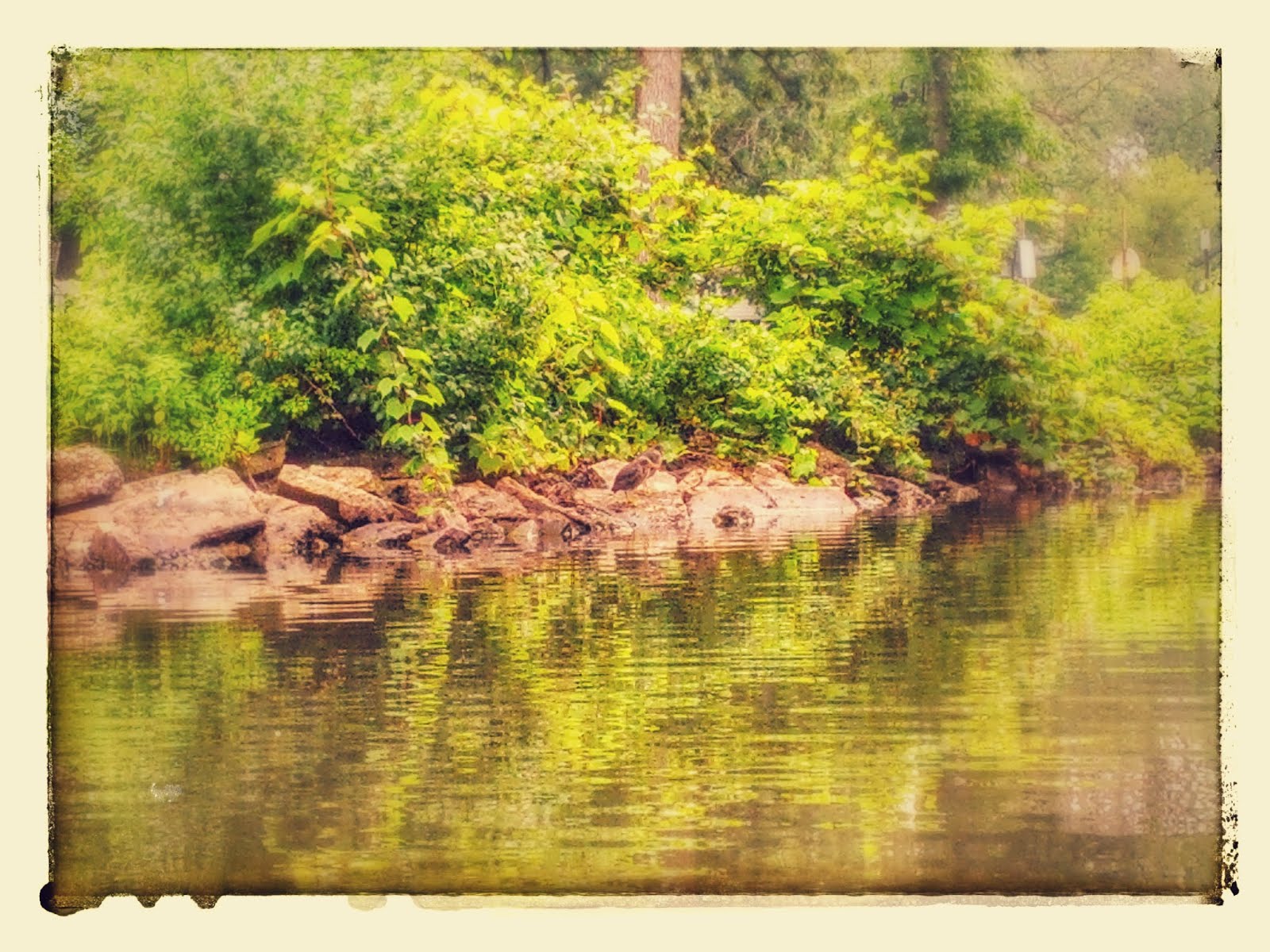
On the right is my photo. The "auto-awesome" enhancement is on the left. It’s a great image, but I had nothing to do with it beyond pointing and clicking the camera. At times I consider posting these, but I don’t because it is not my work. I enjoy editing my pics, whether I do this in Google photo, Pixlr Express, or PicMonkey. In fact, here's my own editing process for the photo on the right, including cropping, brightening areas, applying tilt focus, and frame:


Regardless of the outcome, the value is in the process itself. It is reminiscent of David Gauntlett's ideas about creativity in his book Making is Connecting. Here's what he had to say in an interview with Henry Jenkins:


Everyday creativity refers to a process which brings together at least one active human mind, and the material or digital world, in the activity of making something which is novel in that context, and is a process which evokes a feeling of joy.

An active human mind--exactly. This is not about becoming a professional photographer. It is about having agency over the way I represent the world I see around me. Instead of letting a program do the work for me, I want to be in control. There is meaning in my decisions that disappears when I allow Google to manipulate the image.

I start the new school year this week. As I do, I will be thinking a lot about student and teacher agency. In this era of high stakes testing and top-down mandates, the challenge is to carve out the time and space necessary for my students and I to focus on questions that are relevant and engaging. And to make the classroom a collaborative learning community where we produce and share work based on these questions. As I think about what I want for my students and myself, it is to experience the frustration, surprise, and wonder that comes from creating, regardless of medium. There is no way to cut corners in this. There is no way to cheat. One must put in the effort to experiment. Whether working with images, video, or text, discovery and resonance only arise when one takes responsibility for creating based upon individual vision.

That's awesome. And I'm ready to begin again.