So, is there anything that I do about which I feel like an expert? Probably not. But maybe I come closest when I consider my experience as a teacher and a learner.
Showing posts with label teaching. Show all posts
Showing posts with label teaching. Show all posts
Tuesday, June 6, 2017
A Learner and A Teacher
Over the years, I have enjoyed acquiring a range of hobbies and interests: I like to cook; I like to play guitar; I like to make some art; I like to do yoga; I like to paddleboard. While I take these activities seriously, I have not done any of them enough to be an expert. I am not a chef. I am not a musician. I am not an artist.
So, is there anything that I do about which I feel like an expert? Probably not. But maybe I come closest when I consider my experience as a teacher and a learner.
So, is there anything that I do about which I feel like an expert? Probably not. But maybe I come closest when I consider my experience as a teacher and a learner.

Tuesday, August 26, 2014
Hello New School Year
I've never really committed goals for a new school year to print. Of course, I've had some goals, and maybe I've even shared them vocally. But this year I've decided to more formally list what I hope to accomplish. Perhaps it will motivate me to pursue these five goals more vigorously than I would otherwise. So, in no particular order, here they are:


- Carve out space to focus on student agency. Since presenting on this at the Chromebook Institute this past June, I've been thinking a lot about it. It is always a goal, and I think I've done fairly well at times. But I want to make a more concerted effort to reflect on what agency means and how to work with my students to empower them to pursue their interests.
- Do more making in the classroom. This encompasses working with both digital and physical materials. After participating in #CLMOOC this summer, I have been reminded of the way that creating stimulates ideas and fosters a more thoughtful, even mindful, attitude. In our fast paced culture, creating requires slow, which is sorely needed in most of our lives. Not to mention more time for play.
- Be an advocate for connected learning. Again, something I was reminded of in #CLMOOC. My Diigo links have multiplied greatly this summer as I picked up ideas regarding projects and tools from my colleagues. Not to mention the benefits I continue to accrue while taking part in a host of twitter chats. For that matter, I also want to stay connected to the great people I've learned from online.
- Encourage my own kids to be creators like I do with my students. While attending Educon last January, I had a number of conversations with other educators about this. Too many of us agreed that we wished our own children had the opportunities in their classes that we were trying to provide for our students. And we agreed that, with the time-consuming nature of teaching, it is too easy to lament a lack of vision in our kids' classrooms without trying to rectify this at home. A huge oversight.
- Lighten up and have more fun with my colleagues. I could probably include my students as well, but we have light moments in class. Outside of class, however, there is just so much to do. I find it too easy to bury myself at my desk. This is not right. I work with outstanding people. Interesting people. Funny people. Not to mention that research shows that laughter keeps you healthier. This is an imperative.
So there they are. Five goals. I could have listed more. For instance, I didn't even broach the need to work with students to help them create healthy digital routines that revolve around generosity, kindness, and curiosity. But I guess that one goes without saying. Tomorrow the new year begins. As the artist Chuck Close says, "Inspiration is for amateurs. The rest of us just show up and get to work." I'm ready.
Wednesday, February 26, 2014
Meet My Friend: A Great Book
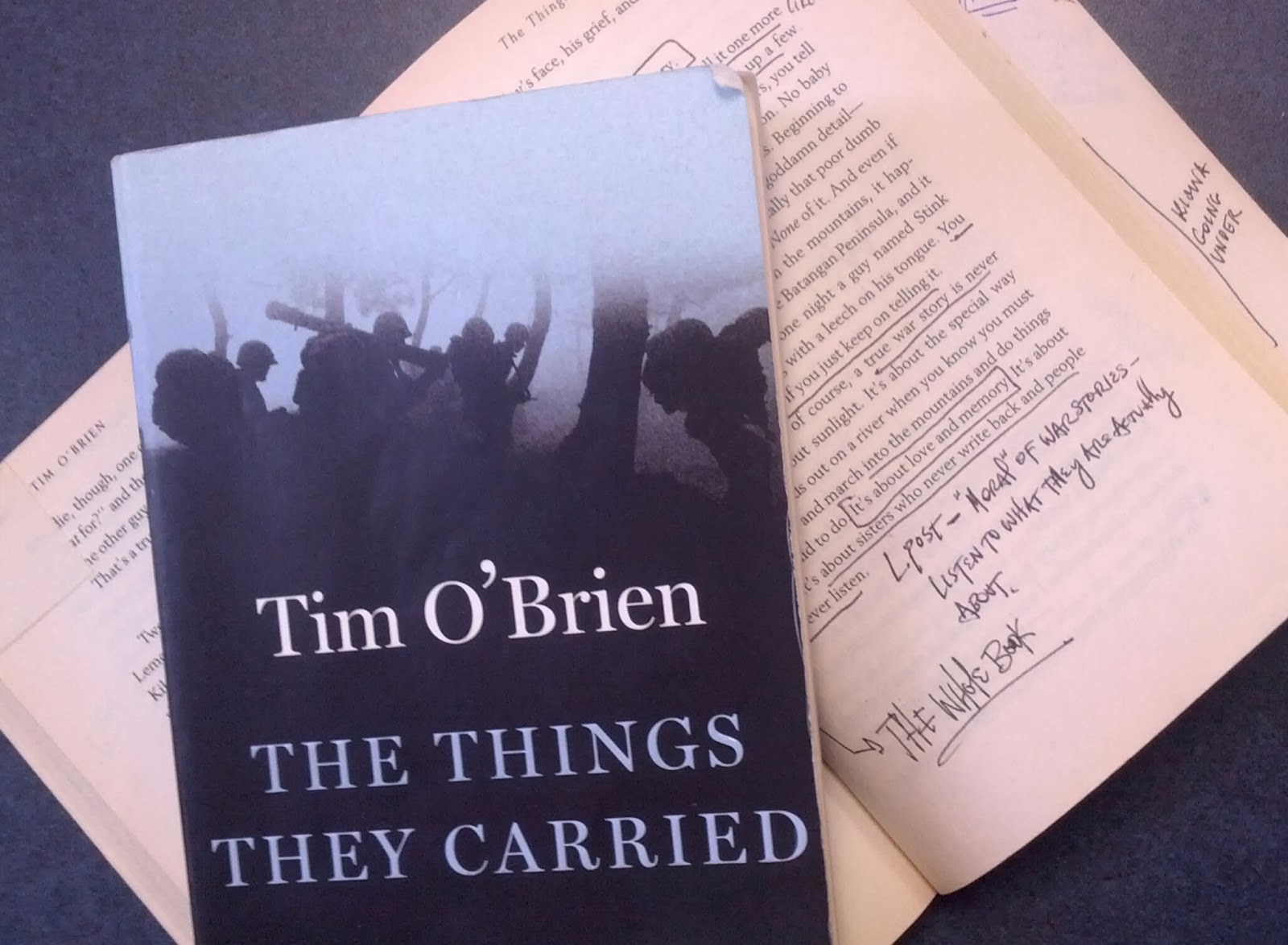

For me, the book in question is Tim O'Brien's The Things They Carried. Here's something Mr. O'Brien says about one of the character's perspectives on storytelling:
O'Brien is referring to Rat Kiley's proclivity for mixing healthy doses of imagination into his stories in order to conjure the deepest emotional resonance in his audience. The same idea is in play for me when discussing the book in class. After all, this novel thoroughly changed my perspective about so much. For example, it made me reconsider the following: how artists use form to communicate ideas; why stories are so important to tell and to hear; how stories themselves are created; what we mean by the word "truth"; and what it means to be human and to struggle with the burdens of love, death, joy, grief, and all of the "intangibles [with] their own mass, specific gravity, [and] tangible weight" (20). In light of all this, it is not surprising that I feel frustrated when I perceive the kids are not getting it or are unmoved.
Perhaps some students have come to expect books they read in class to have little relevance in their lives. Maybe reading books in class too often has followed a similar trajectory: read, take quizzes, write a paper, take a test. O'Brien himself suggests that literature is meant for more than this. In an interview with Big Think, he states that, "literature makes you feel. . .less alone in the world." This makes so much sense. After all, when a reader takes up a book, she must be willing to develop a relationship with the writer. Unlike any other art form, a book is only completed when a writer's words have been processed in another person's mind.
I want my students to have this relationship with Tim O'Brien. Sometimes I see it grow. Often times, I do not. It is difficult to accept when the relationship does not materialize. It is like introducing students to a close friend who they have rejected without really getting to know. Of course, it is quite possible that the way I frame the book is not helping students to connect with it in deeper ways. This just makes it worse. Like I know they would love this friend if I could just find something they have in common.
 Unfortunately, the introduction only happens once, which is a lot of pressure. Not to sound melodramatic or unnecessarily solemn, but introducing students to these voices is an important duty. Whether it is O'Brien, Miller, Hurston, Thoreau, or any number of others, the great challenge of my job is to lay the groundwork for a lasting relationship. Realistically, I know this relationship will not take root between every student and every writer. We all have our discrete tastes. Still, I view every book launch in my classroom as an opportunity to create the conditions for a deep student-writer bond, while grappling with student's rejection of works and writers.
But when it is an old friend, it hurts a little deeper. Tim O'Brien says that "literature does touch people; it's not just to be read in English classes" (Big Think). However, the classroom can be that place where people learn to be readers. Mr. O'Brien, you're out there somewhere. Thank you for such an incredible work (and for all of your work). Know that I'm trying to do it justice.


Subscribe to:
Posts (Atom)