Thursday, May 12, 2016

Snap To It: A Creative Challenge

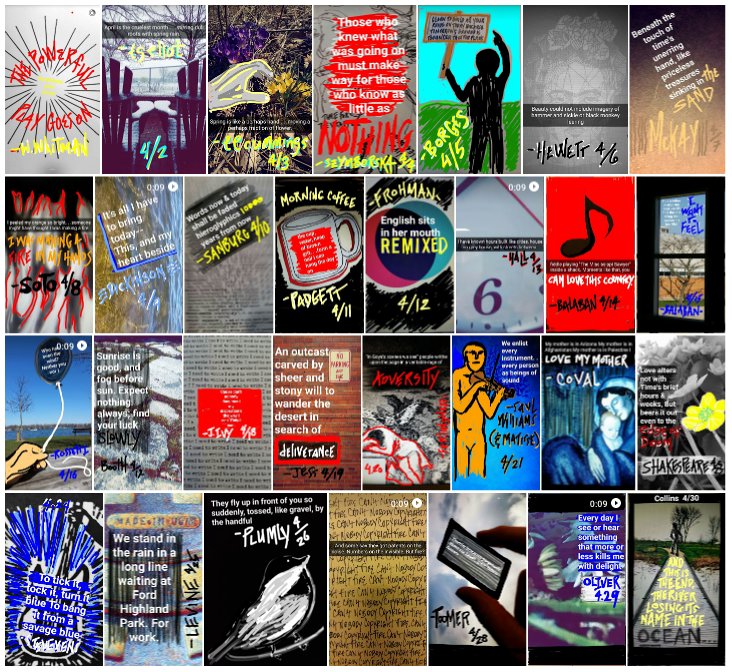
April is National Poetry Month. This year, I decided to celebrate it by giving myself a challenge: create one original piece of Shapchat art each day that would combine some kind of visual with a line from a poem.


Going into the project, my main goal was to learn Snapchat. As a parent and teacher, I have seen it become the preferred social media platform for young people, so I wanted to get a sense of it. What I discovered, though, went beyond how to use the app. Here are 3 of the more important things I realized.

I like poetry.

Sounds funny coming from an English teacher, but I don’t spend a lot of time with poetry in my classes. Typically, I’ll throw 3-4 poems at my students over the course of a year. And these end up being my go-tos. Since this project required me to find 30 lines of poetry, I had to range far beyond the old standbys. This searching and reading reminded me of how powerfully poets combine language and brevity in order to convey their thoughts about the deepest, most complex questions confronting human beings.

Tim O’Brien, my favorite writer, says that all we have is 26 letters and a few punctuation marks through which we try to make ourselves understood to others. Poets are in the business of using these letters and punctuation marks to make concise observations about our world. Gabriel Orozco, one of my favorite artists, says that he wants to be intimate with the world, and art is the attempt to build bridges so others can also experience that intimacy. Poets use a slender toolbox indeed in order to build their bridges.


I like to use my technology for a purpose.

Here I am thinking about the way so many of us fall into the scroller trap. Think about how often you or people you know fill downtime with tech time. For years, I resisted getting a phone. Now that I have one, I find myself reaching for it when I have a few minutes with nothing to do. Like when I am picking up my kids from soccer practice, am in a waiting room, am on a train. More often than not, I am looking for nothing in particular. It is mindless scrolling. I have tried to be more aware of this tendency and to resist it.

My poetry project gave me a goal or destination for these moments. Throughout April, when I found myself reaching for my phone to fill in some seemingly empty moments, I went to poets.org or the poetry foundation and read poems. I was always on the lookout for the poems and even specific lines that made me say, “whoa! yes!” For the lines that gave me that chill factor. Instead of tuning out during the downtime, this searching kept me thinking. Interestingly, I found myself putting away the phone after a particularly compelling poem in order to think about what I just read and how I might use it in my project. As an educator, I have participated in numerous conversations about helping kids to become thoughtful, critical, and creative citizens, online and off. This project helped me to achieve these goals.


Speaking of creativity. I like to create (and to give myself creative challenges).

A few years back, I read a book by David Gauntlett called Making is Connecting. It is wonderful and I highly recommend it. In his writing, Gauntlett offers his definition for everyday, personal creativity. For Gauntlett, this kind of creativity is typified by making something novel for oneself. Too often, he found that definitions of creativity were written with society in mind. For something to be considered creative, it needed to be judged and accepted by a community of experts. Like Gauntlett, this view of creativity ignores the creative urge we all feel. When I made the Snapchat images, I was primarily concerned with making something pleasing to me. I knew others would see my creations. That is the point of social media. However, my main concern was with my experience. How did I feel while in the process? What kinds of decisions did I need to make as I created? How well did I execute those decisions? What did I think about the finished work?

Taken together, these questions and this thought process gave me a sense of autonomy, a sense of agency, and a deep sense of satisfaction. Consider how many decisions we make everyday, and, of those decisions, how many are done without thinking. This kind of creative project provided me with thoughtful decisions. Color choices, layouts, text position: for such small works, the choices could be almost overwhelming. But these choices required intentionality, and I liked that feeling.

Ultimately, the project led me to this: Yes, I could be a creator, not a consumer. I could bring something new into the world, even if on a small scale. I could translate an idea into a tangible work. I feel accomplishment, even when I struggled. Or especially when I did. Well worth the investment.


Here is a link to the entire album.  


Sunday, April 10, 2016

Teaching Failure: A Curiosity Conversation

The Hollywood producer, Brian Grazer, is known for his blockbuster movies, like Apollo 13, his blockbuster hair, and, more recently, his habit of having "curiosity conversations." While it is unlikely that I will duplicate either of the first two accomplishments, as soon as I heard about the last one, I knew that I had to try it.

As a teacher, it is critical that I remain a learner. After all, how can I ask my students to challenge themselves in new ways if I am unwilling to do the same. In the last year, my desire to learn, to be a student, has led me to woodblock printing and Kurt Webb.

Kurt teaches Ceramics and art at my school, Glenbrook South. While I have known Kurt since I started at GBS 19 years ago, it is through his generous mentorship in printing that I have acquired a deeper appreciation for who he is as a teacher, artist, and colleague. Our carving and printing sessions typically turn into rich discussions on creativity, education, and culture in general. He seemed perfect for my first attempt at a curiosity conversation. And he did not disappoint.

As you listen, you will see my comments. These are questions I found myself asking. I think any one of these questions could make for an interesting, thought-provoking bit of research. If you have a question of your own or a response to one of mine, feel free to leave it on the Soundcloud track or as a comment to this blog.


Thanks for reading and listening.

Thursday, March 17, 2016

Considering Individuality

1
Healthy, free, the world before me, leading wherever I choose.

2
A learner with the simplest. . .a novice beginning.

3
. . . I wanna be somebody

4
These are the voices we hear in solitude, but they grow faint and inaudible as we enter into the world.

5


6

Why?

7


8
Slow down here. Is there something I can say to delay 

this troubling attitude from sinking in?

9 

You are here,

10 

The powerful play goes on and you can contribute a verse


because nothing is at last sacred but the integrity of your own mind.


12
 
Believe your own thought, believe what is true for you in your private heart is true for all.


Isn't this more like it?  Raise them confident.  Raise them Bold.


14
Nobody living can ever stop you.

15
Then again

16
For nonconformity, the world whips you with its displeasure.

17
Be bold.  Be confident.  Be yourself.  Such basic advice, we hear it in commercials for cars and for in jingles for jeans.

18


19
But these are just ads--unreal ways of being.  In the end, what if it just leads to pain?  Not to mention rebellion.

20
But the play is going on.  I want them to contribute a verse.

21
I want them to say 


-------
1. Walt Whitman, "Song of the Open Road"
2. Walt Whitman, "Song of Myself"
3. Saul Williams, "List of Demands"
4. Ralph Waldo Emerson, "Self-Reliance"
7. Brian Jonestown Massacre, "Wasting Away"
9. Walt Whitman "O Me! O Life!"
10. Walt Whitman "O Me! O Life!"
11. Ralph Waldo Emerson, "Self-Reliance"
12. Ralph Waldo Emerson, "Self-Reliance"
14. Woody Guthrie "This Land is Your Land"
16. Ralph Waldo Emerson, "Self-Reliance"
18. Levi's Commercial, "O Pioneers"
21. Jurassic 5, "I Am Somebody"

Tuesday, March 1, 2016

Create Community. Create Art!

Hurricane Katrina devastated the Gulf Coast.  Among the hardest hit areas is New Orleans's 9th Ward.  Since 2005, local, state, and federal funds have been used to re-establish the institutions that are necessary for a community's survival: housing, schools, health services, etc.  While these are all necessities, there is one more requirement for a robust community: a sense of shared experience among its people.  

It's easy to overlook this last necessity in the midst of the tangible rebuilding efforts.  But this intangible is crucial.  With a sense of shared experience, people are more willing to support one another, be empathetic towards what others are enduring, and work together.  So how do communities nurture these connections?  One way, according to Candy Chang, is through art.

Although her project, "Before I Die, I Want To," is not targeted specifically at communities most affected by the Hurricane, it did turn an abandoned space in her New Orleans neighborhood into a giant chalkboard on which she asked people from her community to share with each other their hopes, goals, and dreams in a very public way. As she says in her inspiring Ted Talk, "[A community chalkboard is] about knowing you're not alone. It's about understanding our neighbors in new and enlightening ways."  As she shows pictures of the statements people left, she expresses her incredulity at the project's popularity.  Not only did her neighbors flock to the wall to share their profound and humorous thoughts, complex and simple goals, but people from across the country and around the world began to do the same in their own communities.   

Lately, I've been wondering about the degree to which art can help affect social change. This short, spirited talk by Chang provides me with an uplifting answer: art can do much to rectify issues within our communities.  With this idea in mind, I have curated a number of artists who provide examples of using art to affect change on large and small scales.

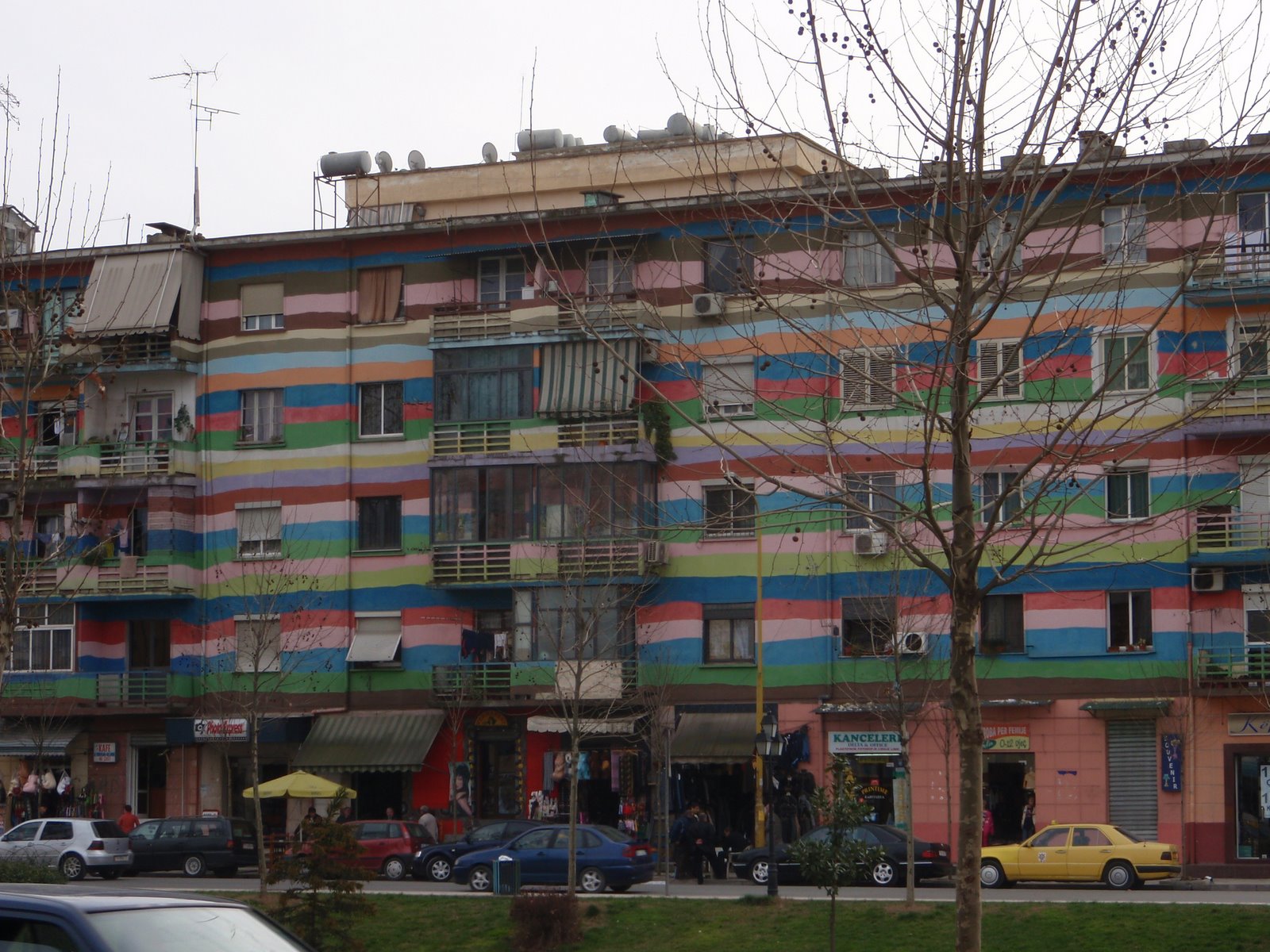
Edi Rama has affected change on a large scale. The mayor of Tirana, Albania, Rama, like Chang, employed the vocabulary of art to convince his constituents to take ownership of their city. Instead of using text, however, Rama used color itself.


In his Ted Talk, "Take Back your City With Paint," Rama describes the immediate effect that painting buildings had on the citizens of Tirana: "When we painted the first building. . something unimaginable happened. There was a traffic jam and a crowd of people gathered as if it were the location of some spectacular accident, or the sudden sighting of a visiting pop star."

Of course, this is an art project on a grand scale.  Grander, even, than Chang's. In order to succeed with his project, Rama used the political leverage at his disposal. 

So what happens if an individual does not have this kind of political muscle?  Or even the wherewithal that Chang shows in taking over an abandoned building? Perhaps that is where an individual can participate in projects made possible by social media, like JR's "Inside Out" campaign.

Thursday, February 25, 2016

Culottes and Tongues: War's Transformative Power

In The Things They Carried, Tim O'Brien says


The contrast of images in this passage makes them memorable. Clearly, O’Brien dresses Mary Anne Bell in a way that accentuates her femininity. The culottes sound more appropriate for a day at a country club. And, of course, she doesn’t just wear a sweater. It’s a “pink” sweater. The color most associated with the stereotypical girl. However, he then finishes off her ensemble with a token of absolute gruesomeness: the tongues. The outlandish incongruity of her appearance suggests an important point: war changes people. However, maybe this statement is too easy. Maybe O'Brien is saying something more than this generally agreed upon point. After all, look at the character O'Brien has created.

Mary Ann Bell is "an attractive girl [with] terrific legs, a bubbly personality, a happy smile" (90). She comes from a small Ohio town and knows exactly what her future will be: getting married to Mark Fossie and "liv[ing] in a fine gingerbread house near Lake Erie" (90). She is about as far from the stereotypical image of the soldier as one can get.


And yet, her transformation makes Rambo look soft. Take, for example, her own description of how she feels when out in the land. She says, "I get scared sometimes--lots of times--but it's not bad. I feel close to myself. . .I'm burning away into nothing. . .I know exactly who I am" (106). This isn't about change. This is about a person who has come into contact with a deeper, darker part of herself. Beneath the suburban girl femininity lurks a being that embraces and thrives on the brutality and violence of war. The fact that she says "close to herself" emphasizes that what she is becoming is not something foreign. Instead, she sees this as a transformation to a truer self.

When he was telling the story, Rat makes the point that the soldiers should not be surprised by Mary Anne's transformation. After all, he argues, it is what happens to them all: they "come over clean and get dirty." I suppose this is true. At the same time, this none of the other soldiers in the unit go quite this far: not Rat, not Fossie, not Eddie Diamond. Rat even says that most of them liked their post because it kept them out of danger. Only Mary Anne found comradeship with the Greenies and their “decayed leopard head” and “stacks of bones” (105). Mary Anne senses how she has been seduced by the war in ways that the other soldiers have not when she tells Fossie, “you’re in a place where you don’t belong” (106). This line can be read in so many ways. Fossie doesn’t belong in the Greenies hooch. Fossie doesn’t belong in Vietnam. Fossie doesn’t belong in the dark, mysterious place that she has found within herself. So, returning to Rat’s statement, I wonder about the degrees of “dirtiness” and why Mary Anne went so much deeper.

I wonder if we all are barely removed from wearing a necklace of tongues.

Tuesday, February 2, 2016

Witnesses to the Sorrow

I have been watching the documentary Restrepo. The film gives an unprecedented look at the experiences of soldiers deployed in one of the most dangerous parts of Afghanistan: the Korengal Valley.


But the film is not just about maneuvers and strategy. Instead, it gives the viewer a look at how this combat deployment affects the men by interlacing interviews with on the ground footage. It is these interviews that make the film so potent.

These are some powerful statements by Sgt Aron Hijar, and maybe even surprising. Too often, our culture focuses on the soldier as warrior, a man unaffected by the violence swirling around him. But these interviews suggest something different. Like Joseph Robertson in "Germans in the Woods," these men understand that they have witnessed painful events that they will carry with them for the rest of their lives. In Robertson's case, although decades had passed since his lethal confrontation with a young German soldier in WWII, he says "I still see him in my dreams, and I don't know how to get him out of my mind." As he chokes out these words, Robertson's voice tells us everything we need to know about the consequences of taking another life.

However, it is not just what they say. It is how they say it. It is their eyes as the speak. What the filmmakers capture before and after each soldier speaks is a mixture of sorrow, uncertainty, resignation, and endurance. The film shows us war and its consequences: a middle distance stare in search of meaning.

Sunday, January 24, 2016

It Was Time

I have always been fascinated by artists. They start with a blank page, a blank canvas, a collection of chords. Then, through sweat, determination, and vision, something incredible happens. Worlds are born, songs are crafted, paintings are created. Since high school, I wanted a part in this. But how? As a 36 year old, I decided one possible avenue. With the help of some talented friends, I picked up the guitar and have been playing it ever since.


My plan for the future: to write songs, even if just for myself.

Thanks for reading.