Tuesday, April 18, 2017

Passing Through GBS

At noon, by the old pit,
rumbling past the parapros,
students fill up the stairways.


A girl in a Cubs jersey leans into her screen
listening to music through black earbuds,
left leg resting on the front seat.
Whatever she sees makes her nod. Smile.


A senior boy
with a backwards Hawks hat 
darts by the bookstore
where kids line up to buy novels.


In the moment when the rumbling slows
and the kids at the bookstore hustle back to class
you can see an excited student tell a teacher
about a success outside of school.


Moments like that, you can love GBS.


Tuesday, March 7, 2017

To Be A Storyteller

I've always had trouble telling stories. This frustrates me. I was raised by incredible storytellers: my mom and dad, my grandmothers and my grandfathers, aunts and uncles.


Not only that, but I fell in love with reading stories early on. I craved books. I craved movies. I craved opportunities to be immersed in other lives.


I was an English major in college, for God's sake, and am now an English teacher! So, yeah, it's frustrating when I find myself without stories to tell.


Growing up, my dad used to tell me and my brother a bedtime story. It was an episodic, ongoing tale about a kid named Billy Poobah and his gang of misfit friends. Billy falls into his father's underwear drawer and each installment focuses on his effort to get back home. 


Over the years he told the story, my dad maintained that he got the story from a custodial worker when he was a student at Bradley University. He and this guy would sit on a bench, and this guy would tell it. I believed this origin story for probably too long. Ultimately, I discovered that he was just making it up as he went along. Now I can see some of the influences: The Wizard of Oz and Gulliver's Travels, among others. 


When I had my own kids, I thought about doing this kind of storytelling. But it wasn't in me. I read books instead. I couldn't quite grasp how to weave together characters and plots and dialogue. I wanted to, though. Badly.  


In The Things They Carried, Tim O'Brien says this about stories: "you dream it as you tell it, hoping that others might then dream along with you, and in this way memory and imagination and language combine to make spirits in the head." Exactly. 


Storytelling is both individual and communal. It's an act of self-preservation. But it also binds people together. It awakens a sense of self and invites others to share in your experience.


Man, I want to be a storyteller.

Quote from Tim O'Brien, The Things They Carried


Thursday, January 26, 2017

Semester Two To Do

I'm not much for making resolutions. Something about setting a goal for the ensuing year always seems simultaneously overwhelming and unmotivating. The energy propelling it usually falters by late spring (if even). Maybe I just haven't found the right way to frame it.

However, there are things I would like to change or add to my daily routine. There are activities I want to participate in more, relationships I want to strengthen, ideas I want to explore, questions I want to wonder about. Maybe by making some of these public, I will be a bit more compelled to follow up on them.

Here, then, are 6 MUST-WILL-CAN-SHOULDS for Spring '17.

I Can Take More Walks and #makeartnotpics

I Should Seek More Ideas From Students

I Must Make Postcards Out Of My Art

I Will Think Of A Better Answer To "How Are You?" (busy is boring. tired is tired. who isn't?)


I Should Do Some More Social Media Experiments

I Can Smile More

So there they are. As I look over this list, they seem achievable. Maybe I'll follow up with future posts showing my progress on one or more of these. Thanks for reading.

Thursday, December 22, 2016

A Poem for The Gene

How does a writer start a book?


Especially when it is a book about something
as complex as the story of what we are?
Of what makes us into us?
Of proteins and phenotypes.
Genes and enzymes.
RNA, DNA,
ribosomes, hemoglobin,
eugenics, natural selection,
genomic coding,
genomic engineering,
genetic disorders,
embryonic development,
Crick and Watson and Franklin
and the laws of
heredity.
. . .


. . .
How does a writer start a book? And keep it moving.
Start with Mendel and end with

How does he
keep it moving through
discussions of Darwin,
who was not bothered
by human descent from
apelike ancestors?

and the horrors of Mengele, 
whose putrefied experiments,
masquerading as science,
no scientist
could take seriously?

And right up to
the aspirations of science to
sequence our selves?

I have no idea how it's done.


(And then, there's this:)


Monday, November 14, 2016

Dreaming of Opportunity

In her essay, "What is the American Dream," writer Kimberly Amadeo poses the question, "Is the American Dream a myth?" Unfortunately, many economists and political scientists would say "yes." Amadeo herself cites sociologist Richard Wilkinson, who argues "if Americans want to live the American Dream, they should move to Denmark." Ouch. Apparently, Mr. Wilkinson no longer believes the American Dream exists. At least not in America. However, the question of whether the American Dream is reality or myth, does not really matter. What matters is the way it reverberates across time and place to give people hope. The most important definitions of the American Dream highlight the opportunity for all to live meaningful lives as thinkers and creators.

Recently, I was looking at the responses to npr's Your American Dreams. A number of them caught my attention, but here is one that got me thinking:


Historically, our faith in meritocracy has been a major difference between America and other countries. Regardless of who you are, who your parents are, or where you are from, you can succeed as long as you are willing to take advantage of opportunities and work. I realize that for too many people this has been more rhetoric than reality. But still. A dream based on entitlement? This sounds less like people expecting a chance and more like people expecting special treatment.

Then again, I wonder exactly what kind of entitlement this person is talking about. The word gets used in a number of contexts: sometimes it’s used as a criticism of government programs that people rely on, like social security or welfare. But it can also apply to people who have grown up with all the advantages. For sure there are people who go to great schools, take great vacations, and generally get what they want without ever worrying. People in this situation can end up with the attitude that they deserve all of these things simply for being them, and if other people do not have this wealth, it must be due to some deficiency. The problem with this latter definition is that it hinders a person’s ability to think beyond herself.

Can there even be an America if this becomes our underpinning? It would undermine our belief in opportunity. It would make people selfish and unwilling to entertain a shared purpose. It would erode our ability to empathize.
Right now, I am reading Death of a Salesman with students. A country based on entitlement would be like a country full of Howards, Willy Loman's self-absorbed boss. I could picture his contribution to the npr site looking something like this:
After all, when Willy comes to talk to him about his inability to support himself and his family, Howard is much more interested in his shiny new technology: the wire recorder. Willy needs Howard to hear him, but all Howard hears is his own wealth and security. Howard even suggests Willy buy one and "tell the maid to turn the radio on when Jack Benny comes on" (78). He is saying this to a desperate man willing to sell himself out for $50. Howard might be listening to the recording of his family, but he is tone-deaf. Earlier in the play, Linda, Willy's wife, implores her sons that "attention must be paid" (56), even though he can be belligerent, judgemental, and irrational. She demands empathy for her struggling husband. But Howard seems to lack the moral imagination to empathize with Willy. A dream based on entitlement, I fear, makes these types of interactions all the more likely. A dream based on entitlement undermines an individual's desire to grow and to celebrate the growth of others.

What about me, though? What would I say my American Dream entails? How about something like this:
Can meaningfulness be found through work? Sure. Can it be achieved through volunteering for a cause? Yes. Can it be nurtured through relationships with loved ones? Definitely. Can it be developed by living lives of curiosity, wonder, and creativity? Absolutely. How about a combination of all of these? This is the point, of course. Naturally, it is important to feel settled, safe, and provided for. But defining the Dream this way leaves untapped that which really makes us not just Americans, but humans: our desire to expand who we are and to"contribute a verse." 

Finally, part of our verse should be the opportunity to define the American Dream as we each see fit, and to leave space for others to define it as well. Hopefully we do not have to go to Denmark to make that a reality.

Tuesday, October 18, 2016

My Eyes Stretched Wide

I'm not a huge fan of the word "inspiration." Unfortunately, I feel like it has been co-opted by kitty poster market and self-help movement. When I hear the word "inspiring," I can't help but imagine


Still, I know that I do get inspired by ideas. I get inspired by artists. I get inspired by words and music and creators of all kinds.

For instance, when Walt Whitman says, "habit yourself to the dazzle of the light and every moment of your life," I feel that push to engage with my world. He inspires me to be active instead of passive. He inspires me to be interested in where I am right now. So here's to Whitman:


Henry David Thoreau also had an unrelenting desire to know the world firsthand. He neither tolerated nor excused passivity. And he did not concern himself with what others thought of his lifestyle. People criticized him for choosing to live at Walden; however, it made no difference to him. Instead, he faced life with the determination to "drive [it] into a corner." When I read this, I think, "how about me? Do I live vibrantly? Do I live vigorously?" So here's to Thoreau:


Both motivate me to observe, think, and create, even if that creating stays private. After all, it's not about changing the world. It's about changing myself. I guess I can be inspired. I know I should remember this:


Wednesday, September 21, 2016

So Many Scott Glasses

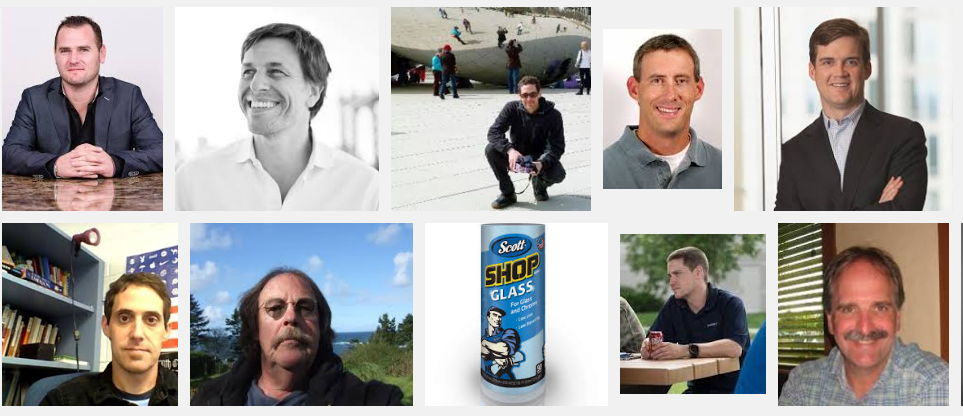
A Google search of my name, Scott Glass, generates an array of people, one of whom is me. It is a bit strange to look at these other men who (might) share my name. Who are these other Scott Glasses?

I look at their faces and have the feeling that I am looking into an alternate dimension: could have been him; could have been him; could have been. A businessman “Scott Glass," a dealmaker “Scott Glass,” a couple of mustachioed “Scott Glasses.” But I am not any of these Scott Glasses. I am me. I am my own history. I am my own experiences. Still, it is a little weird and disarming to see all of these Scott Glasses.

But I wonder, what does this name have to do with me, with my history, with my experiences?

After all, I had no choice in the matter. My parents selected “Scott” without any input from me. They wanted an “S” name because, in the Jewish tradition, children are named for the deceased. In this case, I am named for my Great Grandpa Sam. If I had a say, I would have picked that name. I like that name. It sounds strong in a way I do not think mine does. But that's the way it goes. My own kids had no say in their names. My son, Inman, is named for the protagonist in the novel Cold Mountain. We found our daughter’s name, Brin, on a walk through Chicago's Rosewood Cemetery.
Yep, that's the way it goes.

I am thinking about this because I watched Idris Goodwin’s spoken word, “Say My Name.” In his piece, he explores the meaning of his name and what it was like growing up in midwest, middle-class America with an unusual name. As he puts it, “I asked my mom if I could change my name to something else. Mark, Tony, Sean, something else.” By the end of his piece, however, it is clear that he has embraced his name and has made it his own.

Perhaps this is what freedom means: the ability to make your name resonate with the specific who that you are.

Then again, while watching the film Into The Wild, the main character goes about it a bit differently. After hitting the road with plans to tramp across the United States, he decides he needs to name himself. Goodbye Chris McCandless. Hello Alexander Supertramp.


This reminds me of another spoken word piece, this one by Saul Williams. It is called "Coded Language," and in it he says this:
Which gets me thinking. What if, at a certain age, children could decide whether or not the wanted to stick with the name their parents gave them or if they wanted to change it? How many kids would take advantage of that opportunity? And what does it mean to "claim oneself?" Is that what McCandless was doing by becoming Alexander Supertramp? Williams makes this clear connection between "naming" and "claiming." In fact, it is what we have done throughout our history. As soon as we had language we began to symbolically identify everything around us. Trees became rees, ants became ants, sky became sky. Our names made these things knowable. Our names allowed us to define things and pass on our knowledge. So, yes, to name is to claim, to know, to own. Maybe we should give kids this option.

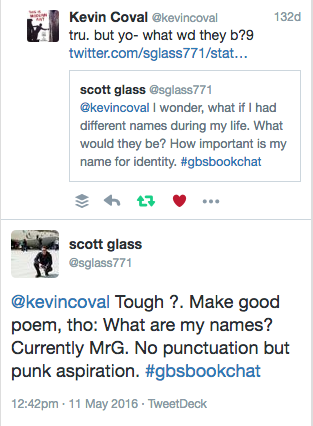
I tweeted Williams's statement once, and a hip-hop poet I know reminded me of Malcolm X’s journey through an array of names. Each corresponded to a certain moment in his development. It made me think about what names I might choose to represent my development. I am not sure what I would pick for my teens, my twenties. But as I get closer to the age I am now, I think about MrG and what it means. Here is one possibility:

Screen Shot 2016-09-20 at 1.13.56 PM.png