Monday, April 28, 2014

A Mystery No More: What Gatsby Wants

For the people who don't know Jay Gatsby, he is a shadowy figure and the subject of outlandish rumors.  Perhaps he killed a man?  Perhaps he is a German spy?  Perhaps he is related to King Wilhem?  These rumors all have a sinister undertone.  Gatsby is not somebody with whom one should tangle.  However, for Nick Carroway, Gatsby's neighbor, friend, and confidante, the eccentric millionaire presents himself quite differently:


At the heart of Fitzgerald's classic American novel is a mystery: exactly who is Jay Gatsby?  Of course, we find out specific details about his past.  He was born James Gatz, a poor North Dakotan; he served in WWI; on his way to the fighting in Europe, he met the love of his life, Daisy.  But what motivates this man?  This is the key question of the novel.

Instead of immediately answering this question, Fitzgerald introduces his main character with purposeful ambiguity:


Isolated is a perfect word for describing this character.  Throughout the novel, Gatsby is an odd mix of introvert and extrovert.  On the one hand, he throws lavish parties for hundreds of people. However, at these parties, "no one swoon[s] backward on Gatsby. . .and no singing quartets [are] formed with Gatsby's head for one link" (55).  Simply put, he refuses to mingle with any of his guests:


Of course, by the 6th chapter we understand why he throws his parties and what he was reaching for at the end of chapter 1. In both cases, it is for Daisy. Still, it is hard to say if Gatsby is reaching for Daisy or something that Daisy represents. Perhaps it is that "her voice is full of money" (127) as Gatsby points out to Nick. One thing is for certain, the prospect of being with Daisy rattles Gatsby's perfect composure:


Was it just Daisy that made him so nervous?  No. Gatsby's reaction stems from the fact that he is about to come face-to-face with what he has dreamed about since he was a poor man on the shore of Lake Superior.  


He might have loved Daisy because he saw in her a beautiful, thoughtful human being.  It is possible.  What is more possible, though, is that he loved what Daisy represented, an idea alive and well in America, even though it is false: money allows one to live vibrantly and passionately.  

Wednesday, February 26, 2014

Meet My Friend: A Great Book

Being an English teacher is not easy. However, one part is particularly difficult, and it is not about grading papers. It is when students do not like a book that is one of your favorites. Actually, strike that. It is not a matter of like or dislike because much harder to accept is when students appear complacent about a favorite book and what the writer is trying to communicate.

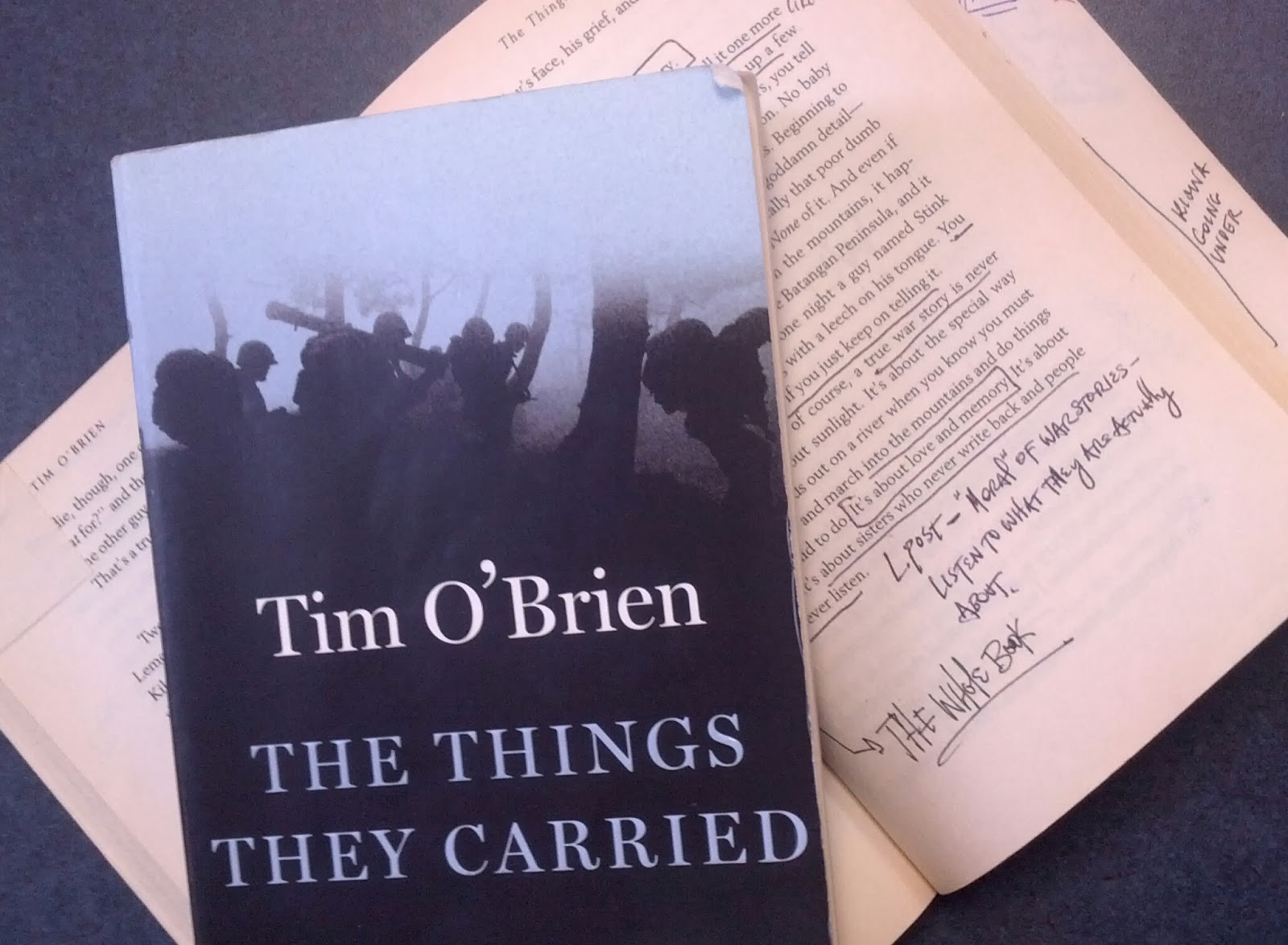
For me, the book in question is Tim O'Brien's The Things They Carried. Here's something Mr. O'Brien says about one of the character's perspectives on storytelling: 

O'Brien is referring to Rat Kiley's proclivity for mixing healthy doses of imagination into his stories in order to conjure the deepest emotional resonance in his audience. The same idea is in play for me when discussing the book in class. After all, this novel thoroughly changed my perspective about so much. For example, it made me reconsider the following: how artists use form to communicate ideas; why stories are so important to tell and to hear; how stories themselves are created; what we mean by the word "truth"; and what it means to be human and to struggle with the burdens of love, death, joy, grief, and all of the "intangibles [with] their own mass, specific gravity, [and] tangible weight" (20).  In light of all this, it is not surprising that I feel frustrated when I perceive the kids are not getting it or are unmoved.  

Perhaps some students have come to expect books they read in class to have little relevance in their lives. Maybe reading books in class too often has followed a similar trajectory: read, take quizzes, write a paper, take a test. O'Brien himself suggests that literature is meant for more than this. In an interview with Big Think, he states that, "literature makes you feel. . .less alone in the world." This makes so much sense. After all, when a reader takes up a book, she must be willing to develop a relationship with the writer. Unlike any other art form, a book is only completed when a writer's words have been processed in another person's mind. 

I want my students to have this relationship with Tim O'Brien. Sometimes I see it grow. Often times, I do not. It is difficult to accept when the relationship does not materialize. It is like introducing students to a close friend who they have rejected without really getting to know. Of course, it is quite possible that the way I frame the book is not helping students to connect with it in deeper ways. This just makes it worse. Like I know they would love this friend if I could just find something they have in common. 

Unfortunately, the introduction only happens once, which is a lot of pressure.  Not to sound melodramatic or unnecessarily solemn, but introducing students to these voices is an important duty. Whether it is O'Brien, Miller, Hurston, Thoreau, or any number of others, the great challenge of my job is to lay the groundwork for a lasting relationship.  Realistically, I know this relationship will not take root between every student and every writer. We all have our discrete tastes. Still, I view every book launch in my classroom as an opportunity to create the conditions for a deep student-writer bond, while grappling with student's rejection of works and writers.

But when it is an old friend, it hurts a little deeper. Tim O'Brien says that "literature does touch people; it's not just to be read in English classes" (Big Think). However, the classroom can be that place where people learn to be readers. Mr. O'Brien, you're out there somewhere. Thank you for such an incredible work (and for all of your work). Know that I'm trying to do it justice. 


Monday, February 17, 2014

CIO: A Special Object

There was just something about the mahogany Alvarez acoustic six string: the deep brown color, the feel of the fretboard, the double “As” on the neck.  It was not the only guitar at the Old Town School of Folk Music in my price range, but it was the only one for me. Since buying it three years ago, I have put a lot of miles on it, some smooth and some bumpy. However, during even the most frustrating moments, like learning barre chords, it has remained my most important possession. In fact, the frustrating moments make it important because those moments have taught me about grit. And of the importance of having a creative outlet.


Sunday, February 9, 2014

What I Learn From Being a Student

This past week, I wrote a 14 page paper for Literary Theory, a graduate class I am taking. Besides considering questions about ideology and the formation of the self in essays by Louis Althusser and Jacques Lacan, here's what else I learned.  Or remembered.

1. It's tough to write a paper when you feel like you only have a tenuous grasp of the material. Theory is difficult stuff.  The professor leading the class explained the material well.  I took good notes in class, asked, and even answered questions.  But I still spent the weekend chiseling my way through sentences like, "The jubilant assumption of his specular image by the kind of being. . .the little man is at the infans stage thus seems to me to manifest in an exemplary situation the symbolic matrix in which the I is precipitated in a primordial form, prior to being objectified in the dialectic of identification with the other, and before language restores to it in the universal, its function as subject" (Lacan, "The Mirror Stage"). Surely, none of the material I give my own students compares to this, right?  But it's not about the relative difficulty of the material. Instead, it's about recognizing in my own anxiety exactly how students must feel when faced with certain writing assignments. Overall, I was able to understand enough to cobble together answers to the questions. But it required reading and rereading. And then rereading again.  Which leads to the second thing:


2. It's time consuming to write a paper when you have a tenuous grasp on the material but are really invested and want to do well.  Knowing that I had other responsibilities to take care of, I gave myself blocks of time. For example, on Saturday morning I said I would work from 9-11, then do some other business.  I remember looking at the clock, thinking, "ok, it's 10:30. Let me finish working on this one point."  And then I remember looking up to see that it was noon. It's like this work creates a weird kind of missing time syndrome.

But that's not all, because working on the paper also reminded me of this:

3. Writing is grueling. It's a mental workout like no other. Sometime in the last year, I heard somebody describe writing as the most difficult thing you can do because it's like conducting an orchestra.  There is just so much to keep track off.  For starters, there's the ideas, the stylistic decisions, and the clarity. At the same time I am attending to Lacan's mirror stage and trying to delineate the ways in which it informs an Althusser's theory that all individuals are subjects of ideology, I also need to consider my use of language, grammar, and punctuation. Did I just write a bunch of long sentences? Then how about a short one. Right here. I looked forward to the opportunity to shovel my driveway because it offered an hour long respite from the mental calisthenics.

Which brings me to the final thing:

4.  As a teacher, I must do my best to remember these things I've learned or been reminded of because it is humbling.  I've read a lot about design thinking lately.  One of the most attractive aspects of the process is the focus on empathy. We all agree that students need situations that ask them to practice this skill. But so do teachers. Generally speaking, the people I work with are among the most empathetic I know. However, most of us know our content so well that, even if we don't know our field as thoroughly as we should, we can rely on our previous experience with the material to see us through. One way or another, it is easy to forget what it is like to be a novice in our field. If the empathic relationship is predicated on understanding deeply the concerns, desires, and struggles of another person, it behooves us to perceive our classes from a student's perspective, to try to "defamiliarize" ourselves with what we know and do. Achieving this leads to a more trusting, genuine relationship because it frees me from playing the expert. Instead, I can focus on the role I truly want to inhabit: a thinker who can teach what he has learned but also continue to grow.

Wednesday, January 22, 2014

4 Views of Love


Here's something difficult about love. . .


You can never know whether a person forgives you when you wrong them. Therefore it is existentially important to you. Neither can you know whether a person loves you. It's something you just have to believe or hope. --Jostein Gaarder, Sophie's World

and something incredibly moving about love. . .

Love is energy. . .
Japandroids

    and love is hope. . .


. . and the funny thing is, at times people don't even recognize it
Because she wasn't listening. It wasn't a war story. It was a love story. --Tim O'Brien, The Things They Carried

Love might be the most oversimplified and least understood emotion.  Not to mention the most necessary.  We're taught to say it when very young and expect to hear it from parents, spouses, children, and those closest to us.  Yet, the word is often treated very superficially, as a Google Image search will illustrate: it's about hearts, holding hands, and the color red.  The artifacts above are meant to stretch the word, to suggest the different ways it can be felt, and even question whether we know exactly what we mean when we say it.  Artifacts 2, 3, and 4 convey the idea that love transcends the romantic associations we make with it.  Love can be about creating something beautiful, about being swept up in the energy of a moment, and about striving for more in one's life.

Monday, January 6, 2014

My Winter Break Challenge

At the beginning of winter break, Ryan Bretag, District 225's administrator for technology, gave me and 10 others a challenge, which he had originally received from Jason Markey: give 11 random facts about myself, answer 11 questions posed by Ryan, and nominate 11 others to answer 11 questions of my own.

Although I have only worked with Ryan for about 7 months, it has been an incredibly productive 7 months.  He has pushed me to think about my role in the classroom, in the building, and in the district. And, despite it being winter break, he has kept me thinking.

11 random facts about me:
  1. I tried playing guitar twice in my life--when I was 10 and when I was 19. I quit both times. When I was 38, I told my wife and friends I would know how to play guitar by the time I was 40. Four years later, it is my favorite hobby. I try to pick it up every day, even if it's only for 10 minutes.
  2. We named our son, Inman, after the character from the novel Cold Mountain.  
  3. I lived in Minneapolis for 3 years while going to grad school for education. A great little city.
  4. Da Boss, Richard J. Daley, eulogized my great-grandfather, a longtime precinct captain.
  5. Like Richard Pryor, my hometown is Peoria, Il.
  6. My favorite spot in the world is my good friend's place in northern Wisconsin.  It's in the middle of Nicolet National Forest.  I've been going there for almost 30 years, and it's where my wife and I had our wedding.  Specifically, there's nothing quite like sitting on their dock, watching the water, the trees, the sky.
  7. We found our daughter's name, Brin, on a headstone while walking through Rosehill cemetery in Chicago.
  8. I've been working on a second masters degree, this one in Literature, at Northeastern Illinois University, in Chicago, for about 7 years. Getting close to needing an extension.
  9. Larry Lessig's book, "Remix," and ted talk, "laws that choke creativity," changed the way I thought about creativity and ignited my interest in the ways we use technology to create.
  10. My favorite bird is the blue heron. We have them on our lake in the summer, and I can watch them for hours.
  11. I spent 9 years proposing a course on media literacy at Glenbrook South H.S. By the time the course was finally approved, it had morphed into an examination of how we use our devices to learn, create, and collaborate. Hopefully I can keep it going.  Here's to grit.
11 Questions Ryan wants me to answer:
  1. Favorite Color Crayon: something in the blue family.
  2. Favorite children's lit: Harold and the Purple Crayon even though it freaked me out as a kid.  Where were Harold's parents?  Now I've used it class when talking about existentialism: Harold creates his life.
  3. Favorite video game ever: Techmo Super Bowl for Nintendo (1991 version).
  4. "Believe" in the big guy in the red suit?: I do not "believe" or believe in the big guy in the red suit.
  5. What would I sing on the way to work and what are my presets: It's hard to say what I might be singing on my way to work because it probably depends on what I was listening to while making/eating dinner the night before.  Lately it would probably be something by Elliott Smith.  My presets on the radio: npr, XRT (in the morning I need my Lin Brehmer. Best. DJ. Ever.  Don't live in Chicago? Google him), and ESPN AM 1000.
  6. Time I laughed with students instead of keeping a straight face: Pre-internet I used to show
    artwork in Humanities on a big opaque projector. One time I was showing a work by Fred Tomaselli in which he used the Adam and Eve figures from Masaccio's "Expulsion from the Garden of Eden."  I zoomed in on Tomaselli's painting to show how he used mixed media on his canvas, forgetting that I had the Mosaccio placed underneath. When I pulled away the Tomaselli image, the camera was zoomed in for a perfect money shot: Adam exiting in all his glory, his manhood taking up the majority of the screen.  I think I said something like, "Whoa, Adam!"
  7. Breakfast, Lunch or Dinner?  Last meal--what am I having: Definitely a dinner person.  I've had to work at making breakfast a part of my routine. For a last meal. . .that's as tough as the song I would be singing.  Maybe slow braised shortribs over garlic mashed potatoes and spinach.  Or a burrito. 
  8. What one literary figure am I like: Honestly, I have no idea. Here are a few I wish I was like: Randall McMurphy from One Flew Over the Cuckoo's Nest; Huck Finn; Katniss Everdeen. Asskickers.
  9. How do I keep the spirit and play of a child alive for myself: In the winter, I skate as much as possible on the lake.  It's like being in 8th grade all over again: come home, throw on my skates and walk down to the ice.  I wrestle with my kids, rock out with them playing Band Hero, and try to remind myself as often as possible Emerson's statement that "the sun illuminates only the eye of man but shines into the eye and heart of the child."
  10. What's disturbing me about education and how I am working to change it: At the exact time we need to help foster creativity and curiosity in our kids so that they can live fulfilling lives regardless of what the future holds, we seem to be embracing the idea that what we need is standardization and testing.  As much as possible, I seek to subvert this in my classroom.  And it helps to read and see on Twitter what really forward-thinking educators are doing to resist this distressing trend.
  11. Where I would want to teach for a week: Somewhere in Hawaii? Italy? Ok, so those have less to do with the classroom and more to do with the location.  How about Singapore?  I can't read an article about the sorry state of American education without reading about their incredibleness. 
"11" Bloggers/Tweeters I find endlessly thoughtful and interesting and whom I would love to learn more about. I would list 11, but it seems this challenge has been making the rounds and a number I would choose have already been tagged:
11 Questions for my 5:
  1. Winter, Spring, Summer, Fall: which are you?
  2. One book or film you wish you could experience again for the first time?
  3. First album (cd, tape) you purchased with your own money?
  4. What advice would you give to somebody entering your profession now?
  5. Are you a napper?
  6. Favorite dessert?
  7. What gets you out of bed in the morning?
  8. What amazes you?
  9. Best advice somebody has given you?
  10. If Arne Duncan gave you the power to enact a mandate, what would it be?
  11. What's a question you wished I would have asked?

Friday, January 3, 2014

1:1--A Semester In

Back in September, I wrote a blog post about my students' initial impressions of their 1:1 experience with the Chromebooks.  At the end of the semester, I asked them to consider how beneficial the Chromebook has been.  The views are very much the same as they were at Day 10.  Some specific comments:

     Writing papers on the chrome book is awesome because I can have my teacher comment on it. Also, I like being able to make a copy and annotate all over it.

     I have used my chromebook in this class every single day and I have been able to take notes and participate very well by using it.

I think it's hard for everyone to pay attention in a class when we are on our laptops. However, I do think it's easier to share ideas and do interesting projects with this kind of access to technology.


These three comments mirror my own experience of working with students. For most of them, it has become second nature to take out their Chromebooks once they are in their desks. Typically, by the time I have the weekly schedule projected onto the screen, most students have already logged onto it via Google Drive. The same goes for any docs I have shared in the Drive folder. Most often I try to have docs hyperlinked on the daily schedule; however, sometimes I forget. However, if they see the name of a doc listed on the schedule, they will go find it in our shared English folder. It's always a bit surprising to find people already logged in--like getting home and already finding guests milling about.  

As for "paying attention," that's the big question with which every teacher struggles.
When the devices are open, how do we keep students corralled? How do we know when they have wandered away from the ranch? Some schools have dealt with the attention/distraction issue by employing an LMS that gives teachers an omniscience and omnipotence over the devices in the room. Stray doggies grazing on their own pastures? Rope em and bring em back home.  

Theoretically, this may sound great. But it raises some questions: are we teaching students to be responsible users of technology?; are we instilling a sense of mindfulness when it comes to using devices; are we helping students to create a digital routine that allows them to leverage their devices in beneficial ways? Unfortunately, the answer to all of these questions is "no."

But here are two more comments that raise a different question for schools going 1:1:

English is basically the only class that I use my chromebook in, other than when we work on webassigns in physics.

I've really only used the chromebook in this class. It's been useful in here though.

Other English teachers and I have heard similar statements from many of our students. So, the question is this--should teachers be expected to make some minimum amount of use of the devices? There will always be teachers and classes that integrate technology more fully into their curriculum, with positive and negative results. But should there be a required baseline? If students used their devices more readily in all classes, would it help them to become more responsible and mindful?