Monday, June 30, 2014

My Agency, Meme Style

I constantly tell my students not to disregard what is unfamiliar or what they don't understand. I enjoy quoting John Coltrane's wife who said something along the lines of, "not everything must be embraced with open arms." Some things are difficult to understand; other things seem of little consequence. To be a learner means to look at these things. To look again. And again. To resist the temptation to shrug and walk by.

And so it is with memes.

Before this week long dive into memes with #CLMOOC, I paid very little attention to this form of internet communication.  In general, they did nothing for me. I have come across some clever ones, but I was always turned off by the limited visual language: the baby holding up his fist, the tyrannosaurus rex, the line drawing of the deformed head. Ultimately I saw these like text messages with a picture. In many ways, I still feel this way.  I think what it comes down to is agency. Kevin Hodgson mentioned this in a Google+ post, and it really stuck with me. The memes that I am drawn to most are the ones where I see the most agency being employed by the creator.

Having just led a workshop on creating student agency in the classroom, this word was already on my mind. In that workshop, we brainstormed what agency truly meant. Here's a part of the list we made --->>

"Having a story," "Control," "Joy": these are so crucial to the creative process. And there can be no creative process without autonomy for the creator. As I worked on my own memes, I found myself drifting into a "flow" state. Probably not as deeply as what Csiksentmihalyi describes in his work. But present were the deep focus and mindfulness. As I meticulously cut out figures in Pixlr Editor, I could feel my breathing change and eyes narrow.
For me, the meaningfulness of the exercise did not come from inserting a phrase into a generator that limited the visual options of my message. With a meme, in fact, the visual structure is crucial. As far as digital writing is concerned, memes are a great example of how the interplay of text and image produce a message. Going back to the list, I did not want to cede control of half of my work.  Of course, I could upload my own image into a meme generator, but there was still a limitation on how it could look.


Perhaps I'm missing the point. Maybe the great thing about memes is that they do have this limited visual vocabulary out of which hundreds of thousands of statements are made. I don't know. I'll need to consider this further.

After a week of experimenting, however, what I do know is this: given the time to play and experiment with tools and choices, I want to know that the meme I create and the story I tell has as much of me in it as possible.


Monday, June 23, 2014

How To Ignore A List

At the suggestion of #clmooc, I offer a reflection on the first week of making in list form. Here's what I had planned on doing this past Saturday:

First
De-moss the brick patio.


Second
Finish mulching the side plot.
Third
Flagstone path maintenance: Fill in material that has washed away.
Fourth
Weed!

So how much of that did I accomplish? None. Why? Because I started to work on a "How To" video instead:


I thought I would take an hour to look over the footage my son helped me shoot the day before and start to piece a video together in YouTube Editor. Sure enough, three hours later, suddenly I realized. . that three hours had passed, and I was still working on the video. While those other tasks are important, and, each in their own way, enjoyable (even the weeding), I could not stop editing until the project was done. As my attention and focus became deeper and deeper, it shot to the top of the list.  It became the most meaningful and relevant challenge for me on that Saturday morning. 

Now, here comes the educational tie-in: I just presented at the Midwest Chromebook Institute. The thrust of the workshop I led was the need to establish a classroom culture based upon student agency and meaningful learning experiences. With more and more schools going 1:1, including my own, I suggested that teachers early on challenge students with quick creative challenges aimed at having students reflect on and create multimedia statements about themselves.

The hope is that these kind of projects immediately introduce to the students a few critical ideas:
  1. They will use their devices to create,
  2. They will consider what is meaningful to them,
  3. They will share their work.
Making my video reinforced what happens when relevant making enters the picture. We want to continue to explore, shape, craft, and, eventually, get feedback in order to continue the iterative process. The trick is to carve out time for this work in the classroom.

It was a Saturday well spent.

Now it's time to get the mulch.


Monday, April 28, 2014

A Mystery No More: What Gatsby Wants

For the people who don't know Jay Gatsby, he is a shadowy figure and the subject of outlandish rumors.  Perhaps he killed a man?  Perhaps he is a German spy?  Perhaps he is related to King Wilhem?  These rumors all have a sinister undertone.  Gatsby is not somebody with whom one should tangle.  However, for Nick Carroway, Gatsby's neighbor, friend, and confidante, the eccentric millionaire presents himself quite differently:


At the heart of Fitzgerald's classic American novel is a mystery: exactly who is Jay Gatsby?  Of course, we find out specific details about his past.  He was born James Gatz, a poor North Dakotan; he served in WWI; on his way to the fighting in Europe, he met the love of his life, Daisy.  But what motivates this man?  This is the key question of the novel.

Instead of immediately answering this question, Fitzgerald introduces his main character with purposeful ambiguity:


Isolated is a perfect word for describing this character.  Throughout the novel, Gatsby is an odd mix of introvert and extrovert.  On the one hand, he throws lavish parties for hundreds of people. However, at these parties, "no one swoon[s] backward on Gatsby. . .and no singing quartets [are] formed with Gatsby's head for one link" (55).  Simply put, he refuses to mingle with any of his guests:


Of course, by the 6th chapter we understand why he throws his parties and what he was reaching for at the end of chapter 1. In both cases, it is for Daisy. Still, it is hard to say if Gatsby is reaching for Daisy or something that Daisy represents. Perhaps it is that "her voice is full of money" (127) as Gatsby points out to Nick. One thing is for certain, the prospect of being with Daisy rattles Gatsby's perfect composure:


Was it just Daisy that made him so nervous?  No. Gatsby's reaction stems from the fact that he is about to come face-to-face with what he has dreamed about since he was a poor man on the shore of Lake Superior.  


He might have loved Daisy because he saw in her a beautiful, thoughtful human being.  It is possible.  What is more possible, though, is that he loved what Daisy represented, an idea alive and well in America, even though it is false: money allows one to live vibrantly and passionately.  

Wednesday, February 26, 2014

Meet My Friend: A Great Book

Being an English teacher is not easy. However, one part is particularly difficult, and it is not about grading papers. It is when students do not like a book that is one of your favorites. Actually, strike that. It is not a matter of like or dislike because much harder to accept is when students appear complacent about a favorite book and what the writer is trying to communicate.

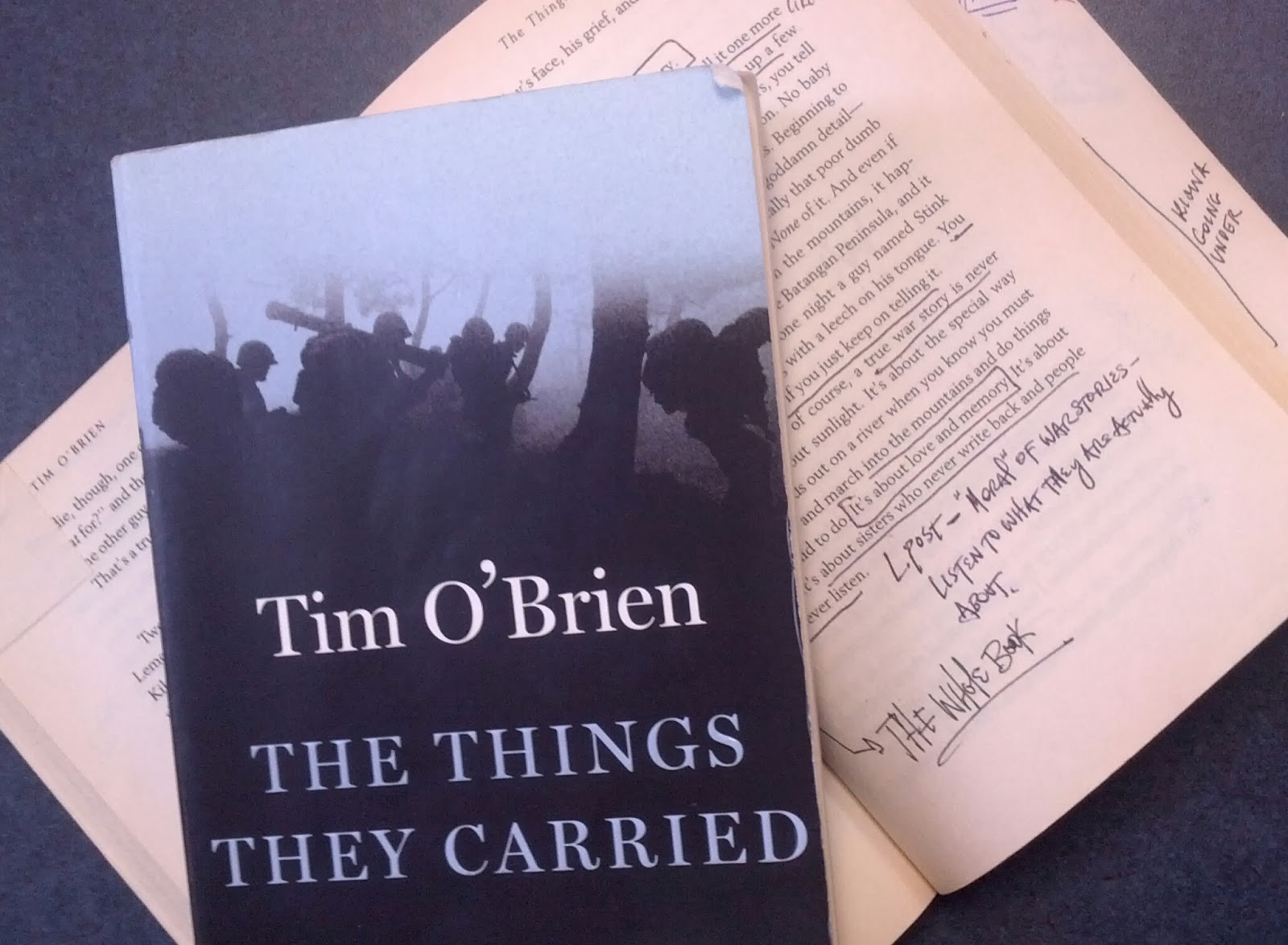
For me, the book in question is Tim O'Brien's The Things They Carried. Here's something Mr. O'Brien says about one of the character's perspectives on storytelling: 

O'Brien is referring to Rat Kiley's proclivity for mixing healthy doses of imagination into his stories in order to conjure the deepest emotional resonance in his audience. The same idea is in play for me when discussing the book in class. After all, this novel thoroughly changed my perspective about so much. For example, it made me reconsider the following: how artists use form to communicate ideas; why stories are so important to tell and to hear; how stories themselves are created; what we mean by the word "truth"; and what it means to be human and to struggle with the burdens of love, death, joy, grief, and all of the "intangibles [with] their own mass, specific gravity, [and] tangible weight" (20).  In light of all this, it is not surprising that I feel frustrated when I perceive the kids are not getting it or are unmoved.  

Perhaps some students have come to expect books they read in class to have little relevance in their lives. Maybe reading books in class too often has followed a similar trajectory: read, take quizzes, write a paper, take a test. O'Brien himself suggests that literature is meant for more than this. In an interview with Big Think, he states that, "literature makes you feel. . .less alone in the world." This makes so much sense. After all, when a reader takes up a book, she must be willing to develop a relationship with the writer. Unlike any other art form, a book is only completed when a writer's words have been processed in another person's mind. 

I want my students to have this relationship with Tim O'Brien. Sometimes I see it grow. Often times, I do not. It is difficult to accept when the relationship does not materialize. It is like introducing students to a close friend who they have rejected without really getting to know. Of course, it is quite possible that the way I frame the book is not helping students to connect with it in deeper ways. This just makes it worse. Like I know they would love this friend if I could just find something they have in common. 

Unfortunately, the introduction only happens once, which is a lot of pressure.  Not to sound melodramatic or unnecessarily solemn, but introducing students to these voices is an important duty. Whether it is O'Brien, Miller, Hurston, Thoreau, or any number of others, the great challenge of my job is to lay the groundwork for a lasting relationship.  Realistically, I know this relationship will not take root between every student and every writer. We all have our discrete tastes. Still, I view every book launch in my classroom as an opportunity to create the conditions for a deep student-writer bond, while grappling with student's rejection of works and writers.

But when it is an old friend, it hurts a little deeper. Tim O'Brien says that "literature does touch people; it's not just to be read in English classes" (Big Think). However, the classroom can be that place where people learn to be readers. Mr. O'Brien, you're out there somewhere. Thank you for such an incredible work (and for all of your work). Know that I'm trying to do it justice. 


Monday, February 17, 2014

CIO: A Special Object

There was just something about the mahogany Alvarez acoustic six string: the deep brown color, the feel of the fretboard, the double “As” on the neck.  It was not the only guitar at the Old Town School of Folk Music in my price range, but it was the only one for me. Since buying it three years ago, I have put a lot of miles on it, some smooth and some bumpy. However, during even the most frustrating moments, like learning barre chords, it has remained my most important possession. In fact, the frustrating moments make it important because those moments have taught me about grit. And of the importance of having a creative outlet.


Sunday, February 9, 2014

What I Learn From Being a Student

This past week, I wrote a 14 page paper for Literary Theory, a graduate class I am taking. Besides considering questions about ideology and the formation of the self in essays by Louis Althusser and Jacques Lacan, here's what else I learned.  Or remembered.

1. It's tough to write a paper when you feel like you only have a tenuous grasp of the material. Theory is difficult stuff.  The professor leading the class explained the material well.  I took good notes in class, asked, and even answered questions.  But I still spent the weekend chiseling my way through sentences like, "The jubilant assumption of his specular image by the kind of being. . .the little man is at the infans stage thus seems to me to manifest in an exemplary situation the symbolic matrix in which the I is precipitated in a primordial form, prior to being objectified in the dialectic of identification with the other, and before language restores to it in the universal, its function as subject" (Lacan, "The Mirror Stage"). Surely, none of the material I give my own students compares to this, right?  But it's not about the relative difficulty of the material. Instead, it's about recognizing in my own anxiety exactly how students must feel when faced with certain writing assignments. Overall, I was able to understand enough to cobble together answers to the questions. But it required reading and rereading. And then rereading again.  Which leads to the second thing:


2. It's time consuming to write a paper when you have a tenuous grasp on the material but are really invested and want to do well.  Knowing that I had other responsibilities to take care of, I gave myself blocks of time. For example, on Saturday morning I said I would work from 9-11, then do some other business.  I remember looking at the clock, thinking, "ok, it's 10:30. Let me finish working on this one point."  And then I remember looking up to see that it was noon. It's like this work creates a weird kind of missing time syndrome.

But that's not all, because working on the paper also reminded me of this:

3. Writing is grueling. It's a mental workout like no other. Sometime in the last year, I heard somebody describe writing as the most difficult thing you can do because it's like conducting an orchestra.  There is just so much to keep track off.  For starters, there's the ideas, the stylistic decisions, and the clarity. At the same time I am attending to Lacan's mirror stage and trying to delineate the ways in which it informs an Althusser's theory that all individuals are subjects of ideology, I also need to consider my use of language, grammar, and punctuation. Did I just write a bunch of long sentences? Then how about a short one. Right here. I looked forward to the opportunity to shovel my driveway because it offered an hour long respite from the mental calisthenics.

Which brings me to the final thing:

4.  As a teacher, I must do my best to remember these things I've learned or been reminded of because it is humbling.  I've read a lot about design thinking lately.  One of the most attractive aspects of the process is the focus on empathy. We all agree that students need situations that ask them to practice this skill. But so do teachers. Generally speaking, the people I work with are among the most empathetic I know. However, most of us know our content so well that, even if we don't know our field as thoroughly as we should, we can rely on our previous experience with the material to see us through. One way or another, it is easy to forget what it is like to be a novice in our field. If the empathic relationship is predicated on understanding deeply the concerns, desires, and struggles of another person, it behooves us to perceive our classes from a student's perspective, to try to "defamiliarize" ourselves with what we know and do. Achieving this leads to a more trusting, genuine relationship because it frees me from playing the expert. Instead, I can focus on the role I truly want to inhabit: a thinker who can teach what he has learned but also continue to grow.

Wednesday, January 22, 2014

4 Views of Love


Here's something difficult about love. . .


You can never know whether a person forgives you when you wrong them. Therefore it is existentially important to you. Neither can you know whether a person loves you. It's something you just have to believe or hope. --Jostein Gaarder, Sophie's World

and something incredibly moving about love. . .

Love is energy. . .
Japandroids

    and love is hope. . .


. . and the funny thing is, at times people don't even recognize it
Because she wasn't listening. It wasn't a war story. It was a love story. --Tim O'Brien, The Things They Carried

Love might be the most oversimplified and least understood emotion.  Not to mention the most necessary.  We're taught to say it when very young and expect to hear it from parents, spouses, children, and those closest to us.  Yet, the word is often treated very superficially, as a Google Image search will illustrate: it's about hearts, holding hands, and the color red.  The artifacts above are meant to stretch the word, to suggest the different ways it can be felt, and even question whether we know exactly what we mean when we say it.  Artifacts 2, 3, and 4 convey the idea that love transcends the romantic associations we make with it.  Love can be about creating something beautiful, about being swept up in the energy of a moment, and about striving for more in one's life.