Tuesday, October 18, 2016

My Eyes Stretched Wide

I'm not a huge fan of the word "inspiration." Unfortunately, I feel like it has been co-opted by kitty poster market and self-help movement. When I hear the word "inspiring," I can't help but imagine


Still, I know that I do get inspired by ideas. I get inspired by artists. I get inspired by words and music and creators of all kinds.

For instance, when Walt Whitman says, "habit yourself to the dazzle of the light and every moment of your life," I feel that push to engage with my world. He inspires me to be active instead of passive. He inspires me to be interested in where I am right now. So here's to Whitman:


Henry David Thoreau also had an unrelenting desire to know the world firsthand. He neither tolerated nor excused passivity. And he did not concern himself with what others thought of his lifestyle. People criticized him for choosing to live at Walden; however, it made no difference to him. Instead, he faced life with the determination to "drive [it] into a corner." When I read this, I think, "how about me? Do I live vibrantly? Do I live vigorously?" So here's to Thoreau:


Both motivate me to observe, think, and create, even if that creating stays private. After all, it's not about changing the world. It's about changing myself. I guess I can be inspired. I know I should remember this:


Wednesday, September 21, 2016

So Many Scott Glasses

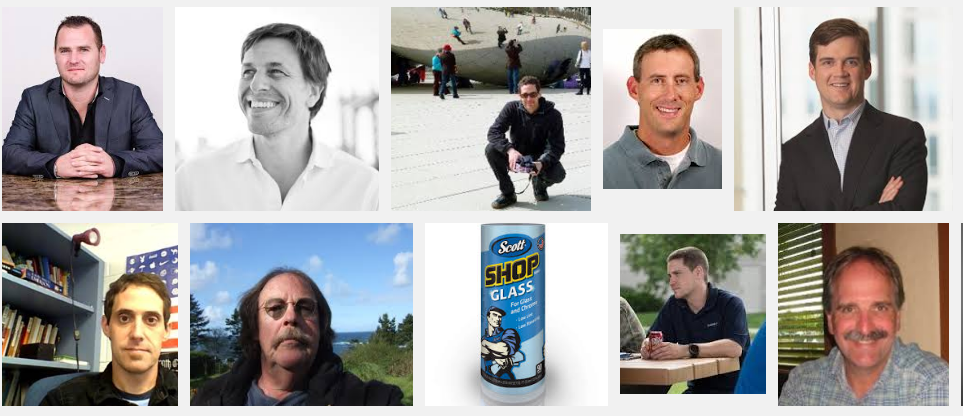
A Google search of my name, Scott Glass, generates an array of people, one of whom is me. It is a bit strange to look at these other men who (might) share my name. Who are these other Scott Glasses?

I look at their faces and have the feeling that I am looking into an alternate dimension: could have been him; could have been him; could have been. A businessman “Scott Glass," a dealmaker “Scott Glass,” a couple of mustachioed “Scott Glasses.” But I am not any of these Scott Glasses. I am me. I am my own history. I am my own experiences. Still, it is a little weird and disarming to see all of these Scott Glasses.

But I wonder, what does this name have to do with me, with my history, with my experiences?

After all, I had no choice in the matter. My parents selected “Scott” without any input from me. They wanted an “S” name because, in the Jewish tradition, children are named for the deceased. In this case, I am named for my Great Grandpa Sam. If I had a say, I would have picked that name. I like that name. It sounds strong in a way I do not think mine does. But that's the way it goes. My own kids had no say in their names. My son, Inman, is named for the protagonist in the novel Cold Mountain. We found our daughter’s name, Brin, on a walk through Chicago's Rosewood Cemetery.
Yep, that's the way it goes.

I am thinking about this because I watched Idris Goodwin’s spoken word, “Say My Name.” In his piece, he explores the meaning of his name and what it was like growing up in midwest, middle-class America with an unusual name. As he puts it, “I asked my mom if I could change my name to something else. Mark, Tony, Sean, something else.” By the end of his piece, however, it is clear that he has embraced his name and has made it his own.

Perhaps this is what freedom means: the ability to make your name resonate with the specific who that you are.

Then again, while watching the film Into The Wild, the main character goes about it a bit differently. After hitting the road with plans to tramp across the United States, he decides he needs to name himself. Goodbye Chris McCandless. Hello Alexander Supertramp.


This reminds me of another spoken word piece, this one by Saul Williams. It is called "Coded Language," and in it he says this:
Which gets me thinking. What if, at a certain age, children could decide whether or not the wanted to stick with the name their parents gave them or if they wanted to change it? How many kids would take advantage of that opportunity? And what does it mean to "claim oneself?" Is that what McCandless was doing by becoming Alexander Supertramp? Williams makes this clear connection between "naming" and "claiming." In fact, it is what we have done throughout our history. As soon as we had language we began to symbolically identify everything around us. Trees became rees, ants became ants, sky became sky. Our names made these things knowable. Our names allowed us to define things and pass on our knowledge. So, yes, to name is to claim, to know, to own. Maybe we should give kids this option.

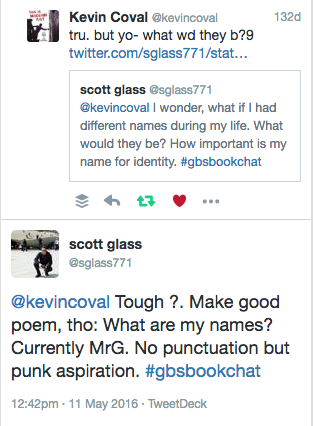
I tweeted Williams's statement once, and a hip-hop poet I know reminded me of Malcolm X’s journey through an array of names. Each corresponded to a certain moment in his development. It made me think about what names I might choose to represent my development. I am not sure what I would pick for my teens, my twenties. But as I get closer to the age I am now, I think about MrG and what it means. Here is one possibility:

Screen Shot 2016-09-20 at 1.13.56 PM.png

Tuesday, September 6, 2016

Is Blogging a Mindset?

Here is something I have been chewing on for a few days:


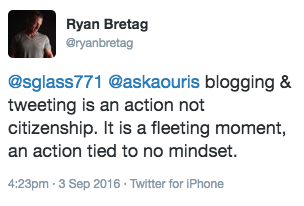
Ryan tweeted this after I tagged him in a tweet of my own:


So, yes, I instigated the debate that ensued. And it was lively. Ryan, a colleague, questioned the necessity for an online presence and balked at reducing citizenship to a discussion of devices and online activity. I agree. I am weary of the calls for "digital citizenship" training in schools because these calls usually have a limited focus: how to be safe, how to maintain privacy, how to cultivate your brand. I find that last one particularly irksome. I'm a person, not a brand.

But I keep coming back to that tweet, particularly the statement that "blogging. . . is a fleeting moment, an action tied to no mindset." Really? As I sit here (paused, fingers over the keys, trying to decide my next move), I disagree completely with the assumption that what I am doing is not indicative of a mindset.

Here is a simple definition:


What, then, is the mindset that blogging affords? Or, what are the attitudes I hold due to blogging?

As I try to answer those questions, let me start by thinking about the writing mindset more generally:

Writing is thinking. It is a kind of mindfulness in that I use it to slow down; to investigate an idea or question more deeply; to take a measurement of my mind. Sure, I think while not writing. But when I want to scan my world more widely and/or deeply, I need to dedicate myself to my thoughts in a way that only writing provides.

Writing is creating. Lately, in education, it feels like STEM (and STEAM) own the words "creating" and "making." If students are not rigging something out of legos, cardboard, and circuits in a maker-space, they must be languishing in classes that deprive them of meaningful opportunities to pursue their curiosity. Wrong. Writing is all about pursuing curiosity and then using the most amazing technology humans have devised in order to express themselves: our language.

Perhaps some of the fault resides with us, the language arts teachers. Maybe we focus too much on teaching students how to fill out forms in the guise of 5-paragraph essays. We should never cease to be amazed by our ability to write clearly, confidently, and engagingly. We should stand in awe at our ability to calm and organize the jumbled and undisciplined cracks of insight in our minds so that, to paraphrase Ralph Waldo Emerson, the innermost can become the outermost. Writing makes this possible.

Writing is craft. Like any creative pursuit, it requires attention to detail and intentionality. When attempting to convey myself thoughtfully and interestingly and clearly, choices seem to be endless. Actually, I'll let the great writer, Tim O'Brien, explain this one:

There are twenty-six letters in our alphabet. And there are some punctuation marks, and that’s it. All we’ve got. Nothing else. And out of those 26 letters you can make Ulysses, or the Iliad, in translation – or . . .some piece of junk. The same twenty-six letters! And it’s the responsibility of the writer to pay attention to those letters, putting them in order so that they’re graceful, lucid, clear, all the things that matter to you as a writer. 

But what about blogging, in particular. So far, the mindset I have described does not require an online presence. So what mindset does blogging prompt and perpetuate? Here are three attitudes:

I can join the conversation. A grad school professor I had stated this once, and it has stuck with me. His point? For virtually anything we are interested in there exists online a robust conversation. The first job of the writer is to familiarize herself with this conversation. The second is to join. Blogging (and technology) has made joining possible for a much wider range of voices than ever before. Of course, joining does not insure an audience. But I know from experience that crafting a blog post makes me consider the potential audience or community, and this has serious implications for the way I present myself. 

I can be generous and empathetic. This goes for me as a blogger, but also as a reader of other people's blogs. I have written blogs in which I highlight other people's ideas and give credit to people for pushing my own thinking. This includes linking to their work as a way to give them more audience. I have also commented and tweeted my gratitude to writers whose work I value. While these actions might not seem like much, I know they matter, both for the individual as well as for a broader community that these actions can help to establish. Similar to joining the conversation, being generous and empathetic are vital to a participatory culture in which people feel comfortable sharing, agreeing, and disagreeing. This is a mindset I mean to practice daily in my digital routine and in my blogging. 


I can be an active producer instead of a passive consumer.

Yes, I do believe that writing is a mindset. And blogging, too.

Tuesday, August 23, 2016

The Best of Time and Place

In 2007, Eric Schlosser wrote a short piece called "The Freak Show." His aim: to show the variety of artists and events that contributed to his understanding of America and offer a brief perspective on the country.

Using his writing as a model, I created my own inventory of stuff that has shaped my view of the United States. It was a definite challenge to pare down my list. For every name and event listed, I thought of five more that easily could be included, especially when considering musicians and filmmakers. Here it is:

The Best of Time and Place

My idea of America was formed by my dad explaining to me how politics works and why it is vital to treat all people with respect, by the music of the Dead Kennedys, Bob Dylan, and dozens of unknown indie and punk bands driving town to town in their vans, by the films of Martin Scorsese, the Coen Brothers and Jim Jarmusch, by writers like Walt Whitman, Tim O’Brien, and the art of Chuck Close, by characters like Huck Finn, by Reagan’s theory that taxes for the rich will trickle down to the rest, by the 1980 hockey team defeating the Soviet Union, and our questionable response to 9/11.

The America that I love combines patriotism with a healthy sense of scepticism. It is made up of people who strike out for the unknown and create their own lives, but who also never forget that they are a part of something greater than any one person. The stories that have forged my perspective can be dark: a low growl meant to warn strangers to tread carefully. At the same time, the optimistic sense that, as Walt Whitman says, “we have the best of time and place” lingers on.


And a short video accompaniment.

Thanks for reading.

Tuesday, August 2, 2016

The Immediacy of a Conversation

The Process
It started with an early morning phone call to Kevin Hodgson, fellow #clmooc traveller. Our chat lasted about 10 minutes, which I uploaded, unedited, to Soundcloud. There were pauses, non-sequiturs, and stumbling attempts to formulate questions (by me). It was an untidy and excellent record of our voices on a July morning, full of springboard ideas.


My next task: shape the 10 minutes so that those ideas could flourish. I accomplished this in Soundtrap. My first decision--remove my voice. I did not make this decision because I am averse to hearing myself. Like most people, I am not crazy about listening to my voice, but I have done it often enough to not get hung up on how strange it sounds. Instead, I cut myself out in order to highlight Kevin.

After snipping a bit more, I added a few musical interludes. I enjoyed playing around with these bits of guitar loops. I listen to podcasts and am always interested in the way that music shapes narrative, moves conversations along, and accentuates mood.


Satisfied with how I highlighted Kevin's compelling thinking about the morning, the unknown, the need to let ideas simmer, I uploaded the Soundtrap file back to Soundcloud as a post that was now half as long as the original.


A Take-away
It is fantastic to hear Kevin's voice. While I've always enjoyed his writing, listening to him reflect on how and why he creates feels even more immediate.

But why?

Maybe this is due to the unified, polished quality of published writing. As readers we know that writers struggle, revise, and, probably, feel a degree of frustration in order to articulate a thought sharply and clearly. (I just spent 10 minutes on that last sentence. . .) But, typically, this is not what we think about in the moment we are engaged with an essay, blogpost, or article. Instead, our minds are occupied by the ideas. If I consider the writing itself, usually it is to relish the masterful way the writer has shaped a particularly powerful moment.

Returning to the point about immediacy, as I listened to Kevin talk, I could hear him working out his ideas in the moment. Seeking, revising, emphasizing: these were happening simultaneously. Or, to put it another way, I got to listen to Kevin's thinking process. I heard him cobbling together explanations, searching for examples, making leaps and taking momentary rests. For both of us, there was this lingering anticipation of what might come next. Maybe this is what it comes down to. In a conversation, anticipation is in play for both the speaker and the listener, whereas, when we read a piece of writing, the shared anticipation is gone. Only the reader feels it.

As I think about this now, I wonder how much different his remarks would be if I emailed him some questions and asked him to respond in writing. It is quite possible that the ideas would be the same. However, Kevin is indisputably a great writer, and I am sure his answers would be executed in a more planned and polished way. Without a doubt, it would be an absorbing piece of writing and one that I would gladly dig into. Sometimes, though, it is conversation, with its messiness, that supplies brighter glimmers than polish can provide.

Thursday, June 2, 2016

Dear Next President

In the midst of this election year, the National Writing Project and KQED have created Letters To The Next President. The idea: motivate students and teachers to get involved. The point is not to campaign for a particular person, but to articulate issues and raise questions that the next leader should consider, regardless of who it is.

Regardless of specific policy positions, I want the next president to be thoughtful, honest, and tolerant.
With that in mind, here's my (first) letter, multimedia style:


Thanks for watching!

Wednesday, June 1, 2016

They're Not Students. They're People.

Over the last few years, I have grown more and more disenchanted with the traditional research paper. Specifically, I felt like the questions students selected lacked emotional resonance. This dissatisfaction led me to experiment with different ways for students to generate questions that mattered. Then, not long ago, I read an interview with Brian Grazer in which the Hollywood producer talked about his use of curiosity conversations. Immediately, I saw the potential application and set out to have my students conduct their own curiosity conversations.

My idea was that through the conversations with a family member, friend, teacher, coach, or whomever, students would hear something that could become a springboard to research. Ultimately, I think the project was successful in this regard. Students ended up with questions about happiness, about curiosity and passion, about work, about leadership, about creativity.

However, as I listened to the conversations, I was struck by something deeper and more critical. I was reminded that my students are people.

Ok, so that sounds a bit ridiculous. After all, what else would my students be. But let me explain.

After 19 years of teaching, one thing remains certain: there is never a lack of things to do. The year starts fast and never really lets up. One problem with the frenetic pace is that sometimes I lose sight of who my kids are outside of class. I end up seeing them as students who appear in my room every other day at the predetermined time, work for 90 minutes, then move on. Where have they come from? Where do they go to? What fills their days and minds besides the novels I ask them to read and the questions I ask them to consider? I don't really know.

Listening to the conversations, though? Here they were. Their voices, removed from the classroom, filled the space in my house.  The surroundings certainly added to the intimacy. As my own family moved through the room where I listened, my students talked with their mothers, fathers, aunts, uncles, brothers, sisters, and friends. In this moment, it was not about teacher and student; instead it was one person listening in as other people shared funny stories, fears, philosophies, and memories. They were no longer names on a roster who I needed to guide through a curriculum.

 Listen from 1:00-2:30

In their easy back-and-forths I heard them laugh at family jokes, sound surprised by a parent's own plans and hopes, compliment a sibling or friend on some accomplishment. I heard them as loved and loving people, full of gratitude and understanding.


Listen from 0:00-1:30

Such a powerful reminder.

And one more important point regarding technology and citizenship. While our devices can often times stand in the way of genuine connection, this is a great example of the way that they can strengthen bonds and deepen our sense of each other's humanity. Too often digital citizenship gets framed as a conversation about privacy and branding. But this reduces the idea of citizenship in a ridiculous way. The conversation must be about how we use technology to practice the same skills that are important in our face-to-face relationships: thoughtfulness, kindness, creativity. This project showed me one way to bring this conversation into the classroom.