So, is there anything that I do about which I feel like an expert? Probably not. But maybe I come closest when I consider my experience as a teacher and a learner.
Tuesday, June 6, 2017
A Learner and A Teacher
Over the years, I have enjoyed acquiring a range of hobbies and interests: I like to cook; I like to play guitar; I like to make some art; I like to do yoga; I like to paddleboard. While I take these activities seriously, I have not done any of them enough to be an expert. I am not a chef. I am not a musician. I am not an artist.
So, is there anything that I do about which I feel like an expert? Probably not. But maybe I come closest when I consider my experience as a teacher and a learner.
So, is there anything that I do about which I feel like an expert? Probably not. But maybe I come closest when I consider my experience as a teacher and a learner.

Monday, May 1, 2017
Decide. Execute. Assess. Redo: A Daily Art Challenge

Although this post is not meant to be a defense of poetry, I will say this: good poetry amazes me. It stuns me. It wakes me. Like a perfectly executed 3 chord riff, a poem relies on so little — a sharply worded observation and an attention to language that can otherwise seem so commonplace. And it relies on so much — the desire by poets to take an active interest in our world and share what they see, what they think they know, and what they know they don’t know, with the rest of us. Like any other art, when a poet makes it click. . .magic.

Back to my self-imposed challenge. I decided that for each day of April I would use Snapchat to illustrate a bit of a poem. And that’s about it. While I allowed myself to import images from my camera roll, I decided I would only use the editing tools available within the app: filters, cut-outs, drawing, and text. No outside photo editors. I think I stuck to it. The only other major requirement was to post by midnight. I think the closest I got was 11ish, which was close enough to make me worry. I also knew I had to make room on each post for the poet’s name and date. I know I forgot that last one a few times.

Pretty quickly I discovered a few of things:
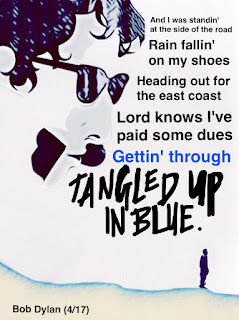

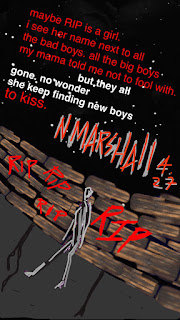
2. Setting out to make something everyday greatly impacts your schedule. This must seem obvious, but it was powerful nevertheless. Since each one could take me anywhere from 45 minutes — 2 hours, I found myself looking at downtime quite differently. A free fifteen minutes before a class? Work on my #poemsnap for that day. Ten minutes of waiting for my daughter’s track practice to end? Work on my #poemsnap for that day. My wife needs five minutes before we watch The Americans? #Poemsnap time.
Recently I have heard interviews and read articles that make a case for boredom. At issue is the way so many of us use our devices to fill in moments of boredom with distraction. According to these interviews and articles, when we give in to the distractions offered by our devices, we are robbing ourselves of time to be bored, which is time to crank up the imagination. This might have particularly insidious effects for younger people. My project gave me something to do in these moments: I was either working on the snap or reading poetry and finding voices that were new to me. It kept me invigorated and distractions became unnecessary. It focused my attention.


1. Restrictions are useful. I guess this was less of a discovery than a reminder. I remember watching The Five Obstructions some years back. Lars Von Trier challenges Jorgen Leth to remake one of Leth’s film. Each time, Von Trier gives him obstructions to the creative process. The problem-solving Leth employs is pretty spectacular. It was probably the first time I understood how limits can bolster creative thinking. I am also a big fan of On Kawara's Today Series, in which the Japanese conceptual artist attempted to paint each day's date every day. He painted each canvas according to some pretty strict guidelines for size, color, and lettering. Furthermore, if he failed to finish a canvas by midnight, he threw out it away. When I have watched and read about both of these art experiments, I have tried to imagine how it would feel to create under such a regimen. While my project is small by comparison, it still gave me insight into how and why an artist would choose to limit their options.
2. Setting out to make something everyday greatly impacts your schedule. This must seem obvious, but it was powerful nevertheless. Since each one could take me anywhere from 45 minutes — 2 hours, I found myself looking at downtime quite differently. A free fifteen minutes before a class? Work on my #poemsnap for that day. Ten minutes of waiting for my daughter’s track practice to end? Work on my #poemsnap for that day. My wife needs five minutes before we watch The Americans? #Poemsnap time.
Recently I have heard interviews and read articles that make a case for boredom. At issue is the way so many of us use our devices to fill in moments of boredom with distraction. According to these interviews and articles, when we give in to the distractions offered by our devices, we are robbing ourselves of time to be bored, which is time to crank up the imagination. This might have particularly insidious effects for younger people. My project gave me something to do in these moments: I was either working on the snap or reading poetry and finding voices that were new to me. It kept me invigorated and distractions became unnecessary. It focused my attention.
3. It is exciting to get it right. And scary. It was so satisfying to (almost) perfectly execute an illustration that captures a mood, an idea, a feeling of some lines of poetry. But it was also daunting because as soon as I posted the snap, I immediately started to think about the next day: the poem, the imagery, the shape of the text. Recently, I watched an episode of the documentary series, Abstract, that focused on the graphic artist Christoph Niemann. In it, he talks about the anxiety caused by success: can it be followed? Will there be another idea? Will he reveal himself to be a fraud? Niemann calls these "lucky moments" when he has "won the lottery." Of course, I am not comparing my #snapchatart to Niemann’s deadlines for New Yorker covers. But I grasped his point. As the month progressed, I was aware of not wanting to copy myself, of not replaying the same moves. It was rough.
 |
| I drew these hands on my iPhone screen! |
If there is one other thing I loved about the project, it was spending so much time being intentional. I think this could be one of the greatest benefits of creative work. If I make thousands of decisions a day, which research suggests, most of them are done without much thought. Perhaps whole days go by without some overarching theme or reason. Or intention. But throughout April, I had a reason for each day. And when I was creating each snap, I was living intentionally. Decision upon decision. Execute. Assess. Perhaps redo. And then make more conscious decisions.
The scale of the work might be small, but the consequences, as it turns out, are massive.
Here is a link to the entire album.

Tuesday, April 18, 2017
Passing Through GBS
At noon, by the old pit,
rumbling past the parapros,
students fill up the stairways.

A girl in a Cubs jersey leans into her screen
listening to music through black earbuds,
left leg resting on the front seat.
Whatever she sees makes her nod. Smile.

A senior boy

In the moment when the rumbling slows
and the kids at the bookstore hustle back to class

Moments like that, you can love GBS.
rumbling past the parapros,
students fill up the stairways.

A girl in a Cubs jersey leans into her screen
listening to music through black earbuds,
left leg resting on the front seat.
Whatever she sees makes her nod. Smile.

with a backwards Hawks hat
darts by the bookstore
where kids line up to buy novels.

and the kids at the bookstore hustle back to class
you can see an excited student tell a teacher
about a success outside of school.

Moments like that, you can love GBS.
Tuesday, March 7, 2017
To Be A Storyteller
I've always had trouble telling stories. This frustrates me. I was raised by incredible storytellers: my mom and dad, my grandmothers and my grandfathers, aunts and uncles.

Not only that, but I fell in love with reading stories early on. I craved books. I craved movies. I craved opportunities to be immersed in other lives.

I was an English major in college, for God's sake, and am now an English teacher! So, yeah, it's frustrating when I find myself without stories to tell.


Over the years he told the story, my dad maintained that he got the story from a custodial worker when he was a student at Bradley University. He and this guy would sit on a bench, and this guy would tell it. I believed this origin story for probably too long. Ultimately, I discovered that he was just making it up as he went along. Now I can see some of the influences: The Wizard of Oz and Gulliver's Travels, among others.

When I had my own kids, I thought about doing this kind of storytelling. But it wasn't in me. I read books instead. I couldn't quite grasp how to weave together characters and plots and dialogue. I wanted to, though. Badly.


Not only that, but I fell in love with reading stories early on. I craved books. I craved movies. I craved opportunities to be immersed in other lives.

I was an English major in college, for God's sake, and am now an English teacher! So, yeah, it's frustrating when I find myself without stories to tell.

Growing up, my dad used to tell me and my brother a bedtime story. It was an episodic, ongoing tale about a kid named Billy Poobah and his gang of misfit friends. Billy falls into his father's underwear drawer and each installment focuses on his effort to get back home.


In The Things They Carried, Tim O'Brien says this about stories: "you dream it as you tell it, hoping that others might then dream along with you, and in this way memory and imagination and language combine to make spirits in the head." Exactly.

Storytelling is both individual and communal. It's an act of self-preservation. But it also binds people together. It awakens a sense of self and invites others to share in your experience.

Man, I want to be a storyteller.
 |
| Quote from Tim O'Brien, The Things They Carried |
Thursday, January 26, 2017
Semester Two To Do
I'm not much for making resolutions. Something about setting a goal for the ensuing year always seems simultaneously overwhelming and unmotivating. The energy propelling it usually falters by late spring (if even). Maybe I just haven't found the right way to frame it.
However, there are things I would like to change or add to my daily routine. There are activities I want to participate in more, relationships I want to strengthen, ideas I want to explore, questions I want to wonder about. Maybe by making some of these public, I will be a bit more compelled to follow up on them.
Here, then, are 6 MUST-WILL-CAN-SHOULDS for Spring '17.
I Can Take More Walks and #makeartnotpics

I Should Seek More Ideas From Students

I Must Make Postcards Out Of My Art

I Will Think Of A Better Answer To "How Are You?" (busy is boring. tired is tired. who isn't?)
I Should Do Some More Social Media Experiments

I Can Smile More

So there they are. As I look over this list, they seem achievable. Maybe I'll follow up with future posts showing my progress on one or more of these. Thanks for reading.
However, there are things I would like to change or add to my daily routine. There are activities I want to participate in more, relationships I want to strengthen, ideas I want to explore, questions I want to wonder about. Maybe by making some of these public, I will be a bit more compelled to follow up on them.
Here, then, are 6 MUST-WILL-CAN-SHOULDS for Spring '17.
I Can Take More Walks and #makeartnotpics

I Should Seek More Ideas From Students

I Must Make Postcards Out Of My Art

I Will Think Of A Better Answer To "How Are You?" (busy is boring. tired is tired. who isn't?)
I Should Do Some More Social Media Experiments

I Can Smile More

Thursday, December 22, 2016
A Poem for The Gene
How does a writer start a book?

Especially when it is a book about something
as complex as the story of what we are?
Of what makes us into us?
Of proteins and phenotypes.
Genes and enzymes.
RNA, DNA,
ribosomes, hemoglobin,
eugenics, natural selection,
genomic coding,
genomic engineering,
genetic disorders,
embryonic development,
Crick and Watson and Franklin
and the laws of
heredity.
. . .

Start with Mendel and end with

(And then, there's this:)


Especially when it is a book about something
as complex as the story of what we are?
Of what makes us into us?
Of proteins and phenotypes.
Genes and enzymes.
RNA, DNA,
ribosomes, hemoglobin,
eugenics, natural selection,
genomic coding,
genomic engineering,
genetic disorders,
embryonic development,
Crick and Watson and Franklin
and the laws of
heredity.
. . .
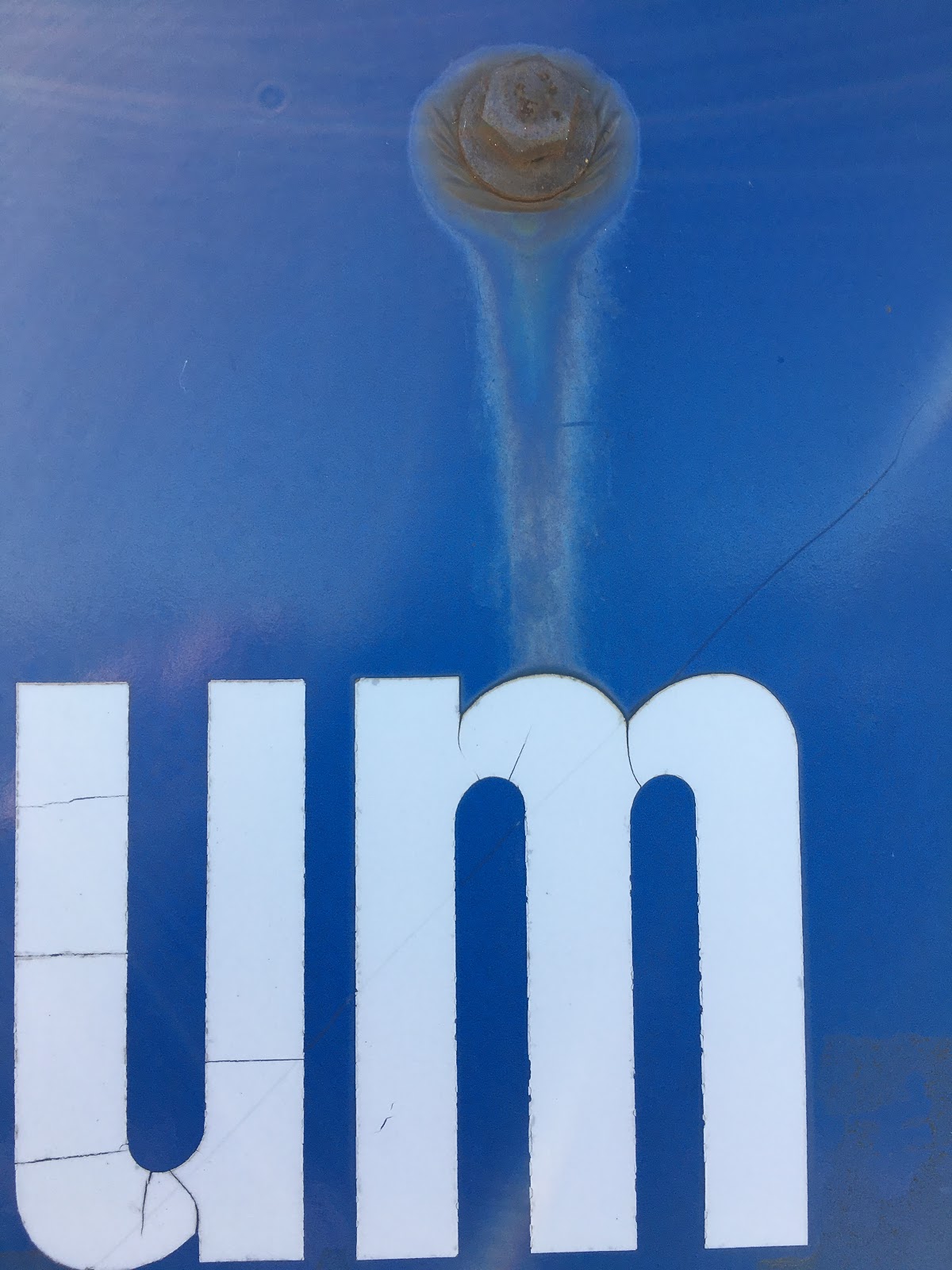
. . .
How does a writer start a book? And keep it moving.Start with Mendel and end with

How does he
keep it moving through
discussions of Darwin,
who was not bothered
by human descent from
apelike ancestors?
and the horrors of Mengele,
whose putrefied experiments,
masquerading as science,
no scientist
could take seriously?
And right up to
the aspirations of science to
sequence our selves?
I have no idea how it's done.
(And then, there's this:)

Monday, November 14, 2016
Dreaming of Opportunity
In her essay, "What is the American Dream," writer Kimberly Amadeo poses the question, "Is the American Dream a myth?" Unfortunately, many economists and political scientists would say "yes." Amadeo herself cites sociologist Richard Wilkinson, who argues "if Americans want to live the American Dream, they should move to Denmark." Ouch. Apparently, Mr. Wilkinson no longer believes the American Dream exists. At least not in America. However, the question of whether the American Dream is reality or myth, does not really matter. What matters is the way it reverberates across time and place to give people hope. The most important definitions of the American Dream highlight the opportunity for all to live meaningful lives as thinkers and creators.
Recently, I was looking at the responses to npr's Your American Dreams. A number of them caught my attention, but here is one that got me thinking:

Historically, our faith in meritocracy has been a major difference between America and other countries. Regardless of who you are, who your parents are, or where you are from, you can succeed as long as you are willing to take advantage of opportunities and work. I realize that for too many people this has been more rhetoric than reality. But still. A dream based on entitlement? This sounds less like people expecting a chance and more like people expecting special treatment.
Then again, I wonder exactly what kind of entitlement this person is talking about. The word gets used in a number of contexts: sometimes it’s used as a criticism of government programs that people rely on, like social security or welfare. But it can also apply to people who have grown up with all the advantages. For sure there are people who go to great schools, take great vacations, and generally get what they want without ever worrying. People in this situation can end up with the attitude that they deserve all of these things simply for being them, and if other people do not have this wealth, it must be due to some deficiency. The problem with this latter definition is that it hinders a person’s ability to think beyond herself.
Can there even be an America if this becomes our underpinning? It would undermine our belief in opportunity. It would make people selfish and unwilling to entertain a shared purpose. It would erode our ability to empathize.
Right now, I am reading Death of a Salesman with students. A country based on entitlement would be like a country full of Howards, Willy Loman's self-absorbed boss. I could picture his contribution to the npr site looking something like this:


Recently, I was looking at the responses to npr's Your American Dreams. A number of them caught my attention, but here is one that got me thinking:

Historically, our faith in meritocracy has been a major difference between America and other countries. Regardless of who you are, who your parents are, or where you are from, you can succeed as long as you are willing to take advantage of opportunities and work. I realize that for too many people this has been more rhetoric than reality. But still. A dream based on entitlement? This sounds less like people expecting a chance and more like people expecting special treatment.
Then again, I wonder exactly what kind of entitlement this person is talking about. The word gets used in a number of contexts: sometimes it’s used as a criticism of government programs that people rely on, like social security or welfare. But it can also apply to people who have grown up with all the advantages. For sure there are people who go to great schools, take great vacations, and generally get what they want without ever worrying. People in this situation can end up with the attitude that they deserve all of these things simply for being them, and if other people do not have this wealth, it must be due to some deficiency. The problem with this latter definition is that it hinders a person’s ability to think beyond herself.
Can there even be an America if this becomes our underpinning? It would undermine our belief in opportunity. It would make people selfish and unwilling to entertain a shared purpose. It would erode our ability to empathize.
Right now, I am reading Death of a Salesman with students. A country based on entitlement would be like a country full of Howards, Willy Loman's self-absorbed boss. I could picture his contribution to the npr site looking something like this:

After all, when Willy comes to talk to him about his inability to support himself and his family, Howard is much more interested in his shiny new technology: the wire recorder. Willy needs Howard to hear him, but all Howard hears is his own wealth and security. Howard even suggests Willy buy one and "tell the maid to turn the radio on when Jack Benny comes on" (78). He is saying this to a desperate man willing to sell himself out for $50. Howard might be listening to the recording of his family, but he is tone-deaf. Earlier in the play, Linda, Willy's wife, implores her sons that "attention must be paid" (56), even though he can be belligerent, judgemental, and irrational. She demands empathy for her struggling husband. But Howard seems to lack the moral imagination to empathize with Willy. A dream based on entitlement, I fear, makes these types of interactions all the more likely. A dream based on entitlement undermines an individual's desire to grow and to celebrate the growth of others.
What about me, though? What would I say my American Dream entails? How about something like this:

Can meaningfulness be found through work? Sure. Can it be achieved through volunteering for a cause? Yes. Can it be nurtured through relationships with loved ones? Definitely. Can it be developed by living lives of curiosity, wonder, and creativity? Absolutely. How about a combination of all of these? This is the point, of course. Naturally, it is important to feel settled, safe, and provided for. But defining the Dream this way leaves untapped that which really makes us not just Americans, but humans: our desire to expand who we are and to"contribute a verse."
Finally, part of our verse should be the opportunity to define the American Dream as we each see fit, and to leave space for others to define it as well. Hopefully we do not have to go to Denmark to make that a reality.
Subscribe to:
Posts (Atom)