Sunday, January 24, 2016

It Was Time

I have always been fascinated by artists. They start with a blank page, a blank canvas, a collection of chords. Then, through sweat, determination, and vision, something incredible happens. Worlds are born, songs are crafted, paintings are created. Since high school, I wanted a part in this. But how? As a 36 year old, I decided one possible avenue. With the help of some talented friends, I picked up the guitar and have been playing it ever since.


My plan for the future: to write songs, even if just for myself.

Thanks for reading.

Sunday, December 13, 2015

Read. And Resist Fear.

This past month has been difficult regarding the news: Paris, Colorado Springs, Laquan McDonald, San Bernardino. Each morning, when I check my updates, I feel a certain anxiety about what I might find. But it is not just the events themselves. The dread also stems from the way that so-called "leaders" have responded to these events. We have entered an ugly moment. Suspicion, hate, and intolerance appear to be on the rise. I am not naive. I understand we face threats to our safety; however, these reactions warrant a different fear--that of losing ourselves.

Then, while rereading Their Eyes Were Watching God, the main character, Janie, reminded me of something. We all have within us the power to resist intolerance and hate.

At a pivotal part of the book, Janie's husband dies. From the moment we meet him, Joe Starks can think of nothing more than becoming the boss and lording over all he sees, just like white folks. His need for power is pathological. It knows no bounds. A reader has just witnessed pages of Joe mentally, emotionally, and even physically abusing Janie, slapping her for poorly cooked food or for having the temerity to defend herself against his ridicule of her body, her age, her looks. Now, with his death, Janie finds the chance to have the kind of freedom and self-determination that she always dreams of.

However, in the moments immediately following his demise, her initial reaction is compassion for the man who tormented her for years. As she looks at his dead body, she considers that "Jody had been hard on her and others, but life had mishandled him too" (83). The way she sees it, in his striving to become a powerful voice he had to sacrifice so much. "In the making of a voice out of a man," Joe surrendered the hope for a genuine, trusting relationship with another human being. It is a peculiar moment, as Janie focuses on the face in front of her, not on the compounded miseries she endured over the years of their marriage. And Janie did suffer in her marriage to Joe. Yet just when she could have celebrated pridefully the fact that his power was gone, and that he "got what he deserved," this woman studies the face of a fellow human being and finds within herself the ability to empathize.


How instructive.

But what exactly allows Janie to react this way? She never says. Maybe she understands the desperation Joe felt at being a black man in a racist society: his overbearing manner an outgrowth of living for 30 years under the weight of a system that denied him a degree of determination.

And this reminded me of the fantastic Ted talk by Chris Abani in which the former Nigerian political prisoner states that "the world is never saved in grand messianic gestures, but in the simple accumulation of gentle, soft, almost invisible acts of compassion, everyday acts of compassion." In order to illustrate this point, Abani tells stories that are disturbing, humorous, and full of suffering and empathy and love--the stuff of our lives. And he talks of Ubuntu, a South African philosophy that focuses on our interconnectedness. Abani defines it this way: "the only way for me to be human is for you to reflect my humanity back at me." We must see each other, accept each other, and resist the ease of one-dimensional caricatures.


I don’t expect shortsighted leaders to understand any of this. After all, they are too busy fear mongering and pointing out the dangers and darkness all around us. But just because they point, do I have to look? Do I have to be scared? Do I have to be angry? No. Because I am a reader.

Manifesto: After Reading, What I Want to Think, Act, Do
The human race is never at a loss for rage and brutality, and any action I take will do little to staunch the global thirst for violence. Wait, this thinking is as misdirected as it is defeatist. Let me start again.

I must not give in. Yes, humanity can inflict a horrific amount of pain upon itself, but it also has the capacity for untold kindness. 

I must control the kind of person I want to be, the kind of father I want my kids to have, the kind of teacher I want my students to learn from. 

I must be thoughtful, caring, and courageous in my empathy--especially when confronted by complexity and the inexplicable. 

I must exercise my imagination and wonder daily, just as the artists I love who make the world so beautiful and intriguing.
Monday, November 23, 2015

It's The Process

I have shown the PBS documentary Between The Folds to students a number of times. While I find the whole exploration into paper folding engaging, my favorite moment occurs when origamist Paul Jackson shows his folding technique. Why does this moment stand out? It's all about the hands.


When I see his fingers, I know I am looking at a creator. I am looking at experimentation, knowledge, curiosity, and passion. Those smudges of green, yellow, and blue confirm Jackson's desire to be active and engaged with materials, with the world. Those are not the hands of a passive consumer.

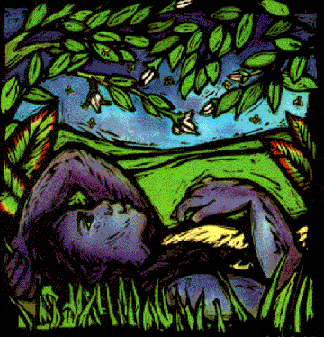
Speaking of process, Jackson explains that "making [something] is the point of it." I could not agree more. In my own experience, creating, even if just for myself, provides an experience that is hard to replicate elsewhere. Whether it is messing around on guitar, figuring out how to carve and print a woodblock, exploring ways to use digital tools to make personally meaningful media, or even crafting a blog post, these activities give me deeper access to my thoughts. A quiet, singular focus replaces the noise that daily competes for my attention. What I hear instead is my own breath and its rhythm, sometimes held at a key moment. Now exhaled.

This physical nature of work can not be overlooked: the senses, the heartbeat, the feel of my fingertips on the materials, whether an exacto knife or keyboard. Together these make the aesthetic experience unordinary. At another point in the documentary, folder Chris Palmer demonstrates a lengthy process of creating a flower/tower. I see how intent he is. But I also hear it--his breath mixing with the sound of the paper being manipulated.

After spending four hours on his work, Palmer says that "the process is 2/3rds of what's special about something that got made." I think I saw this documentary for the first time almost 10 years ago. Since then, I have worked to become a creator. Now I better understand why Palmer and Jackson celebrated the process itself. 
And now I wonder if this could be the most important lesson for students in my classroom.

Thursday, November 5, 2015

Why Beauty?

The other day, I said we should not be satisfied with the cliche idea that “beauty is in the eye of the beholder.” Why not? Because it is overused. It is superficial. It shuts down discussion instead of spurring it on.

Thankfully, over the centuries many people have not been satisfied with “beauty is in the eye of the beholder.” Because people like Immanuel Kant, Albert Einstein, Margaret Mead, John Berger, Maria Popova, Plato, EO Wilson, David Hume, and Denis Dutton have theorized about where our ideas of beauty come from, we have a richer understanding of the term. We also have greater insight into the workings of life and the universe. And we have a deeper understanding of ourselves.

If you have never been curious about beauty before, if you have never wondered why some things strike you in powerful ways, well, it’s time to wonder.

In the end, it can only extend your thinking and make your world more vibrant. After all, this is what learning provides.


Monday, October 26, 2015

Where My Soul Finds Its Space

While explaining his musical influences in the 2009 documentary It Might Get Loud, Jack White says the following about old Blues artists
Why Blue's artists?

For White, men like Robert Johnson, Son House and Blind Willie Johnson spoke honestly about the struggle people face everyday. There were no soft edges or production flourishes. Instead, these "anti-establishment" musicians presented their art with all roughness and imperfections in tact. Although White does not say as much, clearly what he hears is more than a song, it is a philosophy for living: Regardless of the obstacles, the uncertainties, and the pain that life might present, a person still has a voice.


So I wonder, what good does a song, or, for that matter, a painting or poem, offer in the midst of struggle. What does a singular, even isolated voice resolve? One answer is that for the world, probably nothing. But for the individual, the importance of creating is in the act itself. "No, I will not be passive," the creator says the creator. Or, in the case of White and House, the creator sings.

Same for Joe Strummer.  


The former Clash frontman played with a mix of honesty and intensity. His music carries with it the sound of a late night, of toil, coffee, cigarettes, a pen and a notebook. I have no idea if these things accompanied his creative process or what time he found most conducive for creating. But I listen to a song like "Long Shadow," and the tone is undeniable:
Yes, the lyrics demand action: “I’ll tell you one thing that I know/ You don’t face your demons down/ You gotta grab ‘em, Jack/ And pin ‘em to the ground.” But it goes beyond words. Strummer’s hoarse voice, tinged with weariness, sharpens on “grab ‘em” and “pin ‘em,” as he implores himself and the listener to grapple with the demons: those things that terrorize and destroy a belief in oneself. Joe Strummer, Jack White, Son House: all three share a relentlessness, an “attitude,” as White calls it in the film, that precludes passivity.

And now I wonder if I have access to any of this. I am a father, a husband, a teacher. Am I creator? Can I be a creator? Actually, that is the wrong question. Of course I can be a creator. Perhaps the bigger question is, “how do I carve out time and space to be a creator?” Or maybe, “in what ways would being a creator benefit me?”

In his New Yorker article, “Creativity Creep,” writer Joshua Rothman provides a brief history of the 19th Century view of imagination. As he explains it, poet Samuel Taylor Coleridge believed there were two types of imagination. The first one is “practical” and allows us to “understand the world.” The second, however, “cares about it and brings it to life.” As he goes on to argue, this imagination makes it possible to “[assert] your presence amidst the much larger world. . .and [find] significance in that wider world.” It is such a wide world, after all, and one that does not acknowledge or even know that I exist. This might sound depressing.
Gabriel Orozco

But consider Gabriel Orozco’s definition of art. As he walks the streets of Paris, snapping pictures of his surroundings, he explains that he “wants to be intimate with the world and produce signs of intimacy for others” (Art21). Orozco’s work shows major museums and galleries throughout the Americas, Europe, and Asia. However, I think he would be creating even if nobody saw his work. As his wife says of the Mexican born artist, he has insatiable “curiosity and wonder about the world.” While he might be making artworks (products) bought by collectors, he is not an example of “the implicit conflation of the production of things with the living of a creative life” (Rothman) anymore than Son House or Joe Strummer. Each is a creator first, seeking a way to engage their worlds by shining light into the dark, often overlooked spaces.

My Manifesto

I too want this richness and complexity. I want to experience moments when time slows and time disappears, leaving me alone with the materials that I encounter and that I manipulate with my hands. To rip off Langston Hughes, I want my soul, the who that I am, to “grow deep” in the presence of what others have made and in the knowledge that I also have tried.

Monday, October 5, 2015

A Lingering Moment: Sharing Happiness in Into The Wild

Towards the end of Into The Wild, Sean Penn's 2007 adaptation of of John Krakuer's book by the same name, Chris McCandless is alone, in an abandoned bus in the Alaskan wilderness, starving to death. Mustering all of his waning energy, he writes a final message in the white space of a book he is reading: "Happiness is only real when shared."


Of course, the tragedy of the moment is that McCandless is debilitated completely and on the brink of death. In fact, this one action takes colossal effort. In that moment, it is clear what Penn wants me to consider, for it is the same thing McCandless must be contemplating. At key points in his travels he found happiness: when playing guitar with Tracy; working on leather with Ron; hanging out in the bar with Wayne. Only on the brink of losing it forever does McCandless realize what he had but has now lost.

The scene lingers because it makes me interrogate my own life, my own actions. It is beyond cliche to say that "don't take life for granted" and "treasure those around you." So I won't say it. Still, watching this scene, it is hard to shake the questions: do I give enough of myself to those I love? Do I accept without conditions those I love? Do I realize how much of my own happiness comes from those I love? I want to say yes. But what is my evidence?

In English, we have been reading essays by Ralph Waldo Emerson and Henry David Thoreau. The fact that Into The Wild raises these questions about love and happiness points to something that might be missing from "Self-Reliance" and "Civil Disobedience." We are social animals. Yes, I want to believe in myself. Yes, I want to learn to "watch for the light that flashes"(Emerson, "Self-Reliance") across my mind. Yes, I want to "devote myself to. . .contemplations" without exploiting others (Thoreau, "Civil Disobedience). But what else? In these essays, both thinkers emphasize a person's solitary nature, especially as she pursues her interests. For most of the film, McCandless is a perfect representation of this. There is something romantic and alluring about the spectacular way he breaks from his family and the institutions that have shaped his life. When he is lecturing his parents about "things," abandoning his car in New Mexico, and kayaking down the Colorado, I can imagine that light flashing in McCandless's mind and his utter devotion to it.


Ultimately, this devotion makes the end of the film that much more powerful. In the last moment, I find that McCandless's scratchy, hard-fought realization undermines so much about Emerson and Thoreau's insistence on self-reliance. Of course I want to believe in myself.  But I also want to be confident that those I love are secure in their knowledge that I am there for them. That my happiness and theirs depends on us, not I.

How do I balance both of these impulses? That's a good question.

20% Time: Discovery Update 1

This week, as I have researched for sources regarding my project, "how to write a song," I found a blog post on Bob Dylan's thoughts about songwriting. The post draws from a Dylan's interview with Paul Zollo, for his book Songwriters on Songwriting.

In short, Dylan offers his opinions on the best conditions for songwriting, his mental approach, and whether songwriting is a viable pursuit for others. Here are some choice statements:
  • The best songs to me — my best songs — are songs which were written very quickly. Yeah, very, very quickly. Just about as much time as it takes to write it down is about as long as it takes to write it.
  • First of all, there’s two kinds of thoughts in your mind: there’s good thoughts and evil thoughts. Both come through your mind. Some people are more loaded down with one than another. Nevertheless, they come through. And you have to be able to sort them out. . .You must get rid of all that baggage. You ought to be able to sort out those thoughts, because they don’t mean anything, they’re just pulling you around, too. 
  • The world don’t need any more songs… As a matter of fact, if nobody wrote any songs from this day on, the world ain’t gonna suffer for it. Nobody cares. There’s enough songs for people to listen to, if they want to listen to songs. For every man, woman and child on earth, they could be sent, probably, each of them, a hundred songs, and never be repeated. There’s enough songs. Unless someone’s gonna come along with a pure heart and has something to say. That’s a different story.
I already knew that Dylan is an opinionated guy, and his thoughts in this interview bear it out. I am surprised by his comment regarding the quick nature of songwriting. I have yet to read what other songwriters say; however, I have read insights by other artists regarding their creative processes. Most of them talk about the laborious nature of making something. In our culture, there is a sense that art is a result of a moment of inspiration. While inspiration could be important for locating an idea, artists typically describe the creative process as work. Dylan seems to undermine this when he says that the "best songs are. . .written very quickly." I don't think I could possibly work this way. In my limited experience creating, I need time to reflect and play with possibilities. Perhaps he means the ideas come quickly, but crafting takes more time.

On a different note, I need to keep in mind that his statement that, "the world don't need any more songs." It is wonderfully ironic, since I  am working on a project to create another song. Then again, I don't think he necessarily has somebody like me in mind. In any case, I think this could work as a hilarious line in a song.

Here's a question for further research: what role does inspiration play in songwriting?

Popova, Maria. "Bob Dylan on Sacrifice, the Unconscious Mind, and How to Cultivate the Perfect Environment for Creative Work." Web log post. Brainpickings. N.p., n.d. Web. 3 Oct. 2015.