Tuesday, March 1, 2016

Create Community. Create Art!

Hurricane Katrina devastated the Gulf Coast.  Among the hardest hit areas is New Orleans's 9th Ward.  Since 2005, local, state, and federal funds have been used to re-establish the institutions that are necessary for a community's survival: housing, schools, health services, etc.  While these are all necessities, there is one more requirement for a robust community: a sense of shared experience among its people.  

It's easy to overlook this last necessity in the midst of the tangible rebuilding efforts.  But this intangible is crucial.  With a sense of shared experience, people are more willing to support one another, be empathetic towards what others are enduring, and work together.  So how do communities nurture these connections?  One way, according to Candy Chang, is through art.

Although her project, "Before I Die, I Want To," is not targeted specifically at communities most affected by the Hurricane, it did turn an abandoned space in her New Orleans neighborhood into a giant chalkboard on which she asked people from her community to share with each other their hopes, goals, and dreams in a very public way. As she says in her inspiring Ted Talk, "[A community chalkboard is] about knowing you're not alone. It's about understanding our neighbors in new and enlightening ways."  As she shows pictures of the statements people left, she expresses her incredulity at the project's popularity.  Not only did her neighbors flock to the wall to share their profound and humorous thoughts, complex and simple goals, but people from across the country and around the world began to do the same in their own communities.   

Lately, I've been wondering about the degree to which art can help affect social change. This short, spirited talk by Chang provides me with an uplifting answer: art can do much to rectify issues within our communities.  With this idea in mind, I have curated a number of artists who provide examples of using art to affect change on large and small scales.

Edi Rama has affected change on a large scale. The mayor of Tirana, Albania, Rama, like Chang, employed the vocabulary of art to convince his constituents to take ownership of their city. Instead of using text, however, Rama used color itself.
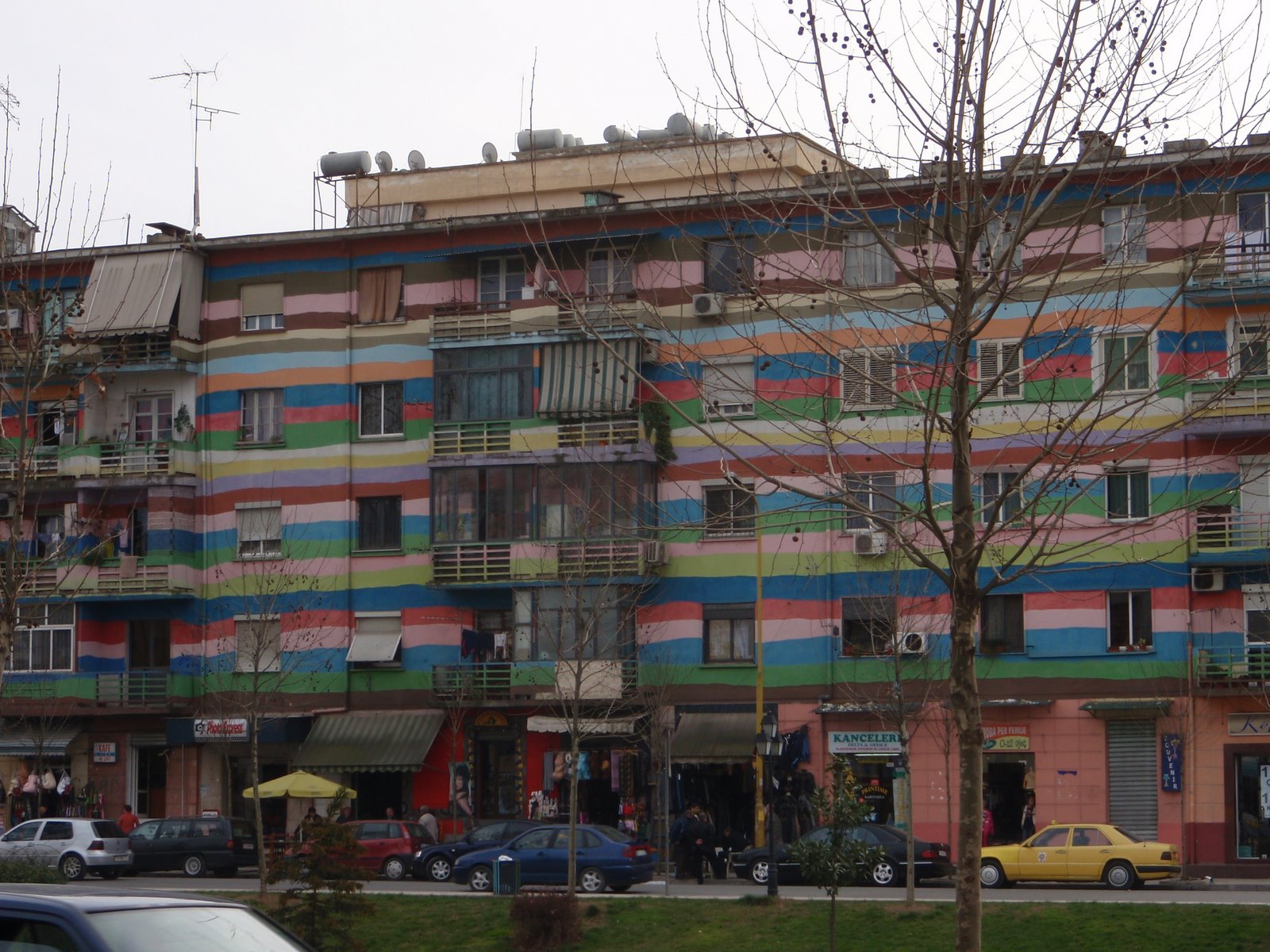

In his Ted Talk, "Take Back your City With Paint," Rama describes the immediate effect that painting buildings had on the citizens of Tirana: "When we painted the first building. . something unimaginable happened. There was a traffic jam and a crowd of people gathered as if it were the location of some spectacular accident, or the sudden sighting of a visiting pop star."

Of course, this is an art project on a grand scale.  Grander, even, than Chang's. In order to succeed with his project, Rama used the political leverage at his disposal. 

So what happens if an individual does not have this kind of political muscle?  Or even the wherewithal that Chang shows in taking over an abandoned building? Perhaps that is where an individual can participate in projects made possible by social media, like JR's "Inside Out" campaign.

Thursday, February 25, 2016

Culottes and Tongues: War's Transformative Power

In The Things They Carried, Tim O'Brien says


The contrast of images in this passage makes them memorable. Clearly, O’Brien dresses Mary Anne Bell in a way that accentuates her femininity. The culottes sound more appropriate for a day at a country club. And, of course, she doesn’t just wear a sweater. It’s a “pink” sweater. The color most associated with the stereotypical girl. However, he then finishes off her ensemble with a token of absolute gruesomeness: the tongues. The outlandish incongruity of her appearance suggests an important point: war changes people. However, maybe this statement is too easy. Maybe O'Brien is saying something more than this generally agreed upon point. After all, look at the character O'Brien has created.

Mary Ann Bell is "an attractive girl [with] terrific legs, a bubbly personality, a happy smile" (90). She comes from a small Ohio town and knows exactly what her future will be: getting married to Mark Fossie and "liv[ing] in a fine gingerbread house near Lake Erie" (90). She is about as far from the stereotypical image of the soldier as one can get.


And yet, her transformation makes Rambo look soft. Take, for example, her own description of how she feels when out in the land. She says, "I get scared sometimes--lots of times--but it's not bad. I feel close to myself. . .I'm burning away into nothing. . .I know exactly who I am" (106). This isn't about change. This is about a person who has come into contact with a deeper, darker part of herself. Beneath the suburban girl femininity lurks a being that embraces and thrives on the brutality and violence of war. The fact that she says "close to herself" emphasizes that what she is becoming is not something foreign. Instead, she sees this as a transformation to a truer self.

When he was telling the story, Rat makes the point that the soldiers should not be surprised by Mary Anne's transformation. After all, he argues, it is what happens to them all: they "come over clean and get dirty." I suppose this is true. At the same time, this none of the other soldiers in the unit go quite this far: not Rat, not Fossie, not Eddie Diamond. Rat even says that most of them liked their post because it kept them out of danger. Only Mary Anne found comradeship with the Greenies and their “decayed leopard head” and “stacks of bones” (105). Mary Anne senses how she has been seduced by the war in ways that the other soldiers have not when she tells Fossie, “you’re in a place where you don’t belong” (106). This line can be read in so many ways. Fossie doesn’t belong in the Greenies hooch. Fossie doesn’t belong in Vietnam. Fossie doesn’t belong in the dark, mysterious place that she has found within herself. So, returning to Rat’s statement, I wonder about the degrees of “dirtiness” and why Mary Anne went so much deeper.

I wonder if we all are barely removed from wearing a necklace of tongues.

Tuesday, February 2, 2016

Witnesses to the Sorrow

I have been watching the documentary Restrepo. The film gives an unprecedented look at the experiences of soldiers deployed in one of the most dangerous parts of Afghanistan: the Korengal Valley.


But the film is not just about maneuvers and strategy. Instead, it gives the viewer a look at how this combat deployment affects the men by interlacing interviews with on the ground footage. It is these interviews that make the film so potent.

These are some powerful statements by Sgt Aron Hijar, and maybe even surprising. Too often, our culture focuses on the soldier as warrior, a man unaffected by the violence swirling around him. But these interviews suggest something different. Like Joseph Robertson in "Germans in the Woods," these men understand that they have witnessed painful events that they will carry with them for the rest of their lives. In Robertson's case, although decades had passed since his lethal confrontation with a young German soldier in WWII, he says "I still see him in my dreams, and I don't know how to get him out of my mind." As he chokes out these words, Robertson's voice tells us everything we need to know about the consequences of taking another life.

However, it is not just what they say. It is how they say it. It is their eyes as the speak. What the filmmakers capture before and after each soldier speaks is a mixture of sorrow, uncertainty, resignation, and endurance. The film shows us war and its consequences: a middle distance stare in search of meaning.

Sunday, January 24, 2016

It Was Time

I have always been fascinated by artists. They start with a blank page, a blank canvas, a collection of chords. Then, through sweat, determination, and vision, something incredible happens. Worlds are born, songs are crafted, paintings are created. Since high school, I wanted a part in this. But how? As a 36 year old, I decided one possible avenue. With the help of some talented friends, I picked up the guitar and have been playing it ever since.


My plan for the future: to write songs, even if just for myself.

Thanks for reading.

Sunday, December 13, 2015

Read. And Resist Fear.

This past month has been difficult regarding the news: Paris, Colorado Springs, Laquan McDonald, San Bernardino. Each morning, when I check my updates, I feel a certain anxiety about what I might find. But it is not just the events themselves. The dread also stems from the way that so-called "leaders" have responded to these events. We have entered an ugly moment. Suspicion, hate, and intolerance appear to be on the rise. I am not naive. I understand we face threats to our safety; however, these reactions warrant a different fear--that of losing ourselves.

Then, while rereading Their Eyes Were Watching God, the main character, Janie, reminded me of something. We all have within us the power to resist intolerance and hate.

At a pivotal part of the book, Janie's husband dies. From the moment we meet him, Joe Starks can think of nothing more than becoming the boss and lording over all he sees, just like white folks. His need for power is pathological. It knows no bounds. A reader has just witnessed pages of Joe mentally, emotionally, and even physically abusing Janie, slapping her for poorly cooked food or for having the temerity to defend herself against his ridicule of her body, her age, her looks. Now, with his death, Janie finds the chance to have the kind of freedom and self-determination that she always dreams of.

However, in the moments immediately following his demise, her initial reaction is compassion for the man who tormented her for years. As she looks at his dead body, she considers that "Jody had been hard on her and others, but life had mishandled him too" (83). The way she sees it, in his striving to become a powerful voice he had to sacrifice so much. "In the making of a voice out of a man," Joe surrendered the hope for a genuine, trusting relationship with another human being. It is a peculiar moment, as Janie focuses on the face in front of her, not on the compounded miseries she endured over the years of their marriage. And Janie did suffer in her marriage to Joe. Yet just when she could have celebrated pridefully the fact that his power was gone, and that he "got what he deserved," this woman studies the face of a fellow human being and finds within herself the ability to empathize.


How instructive.

But what exactly allows Janie to react this way? She never says. Maybe she understands the desperation Joe felt at being a black man in a racist society: his overbearing manner an outgrowth of living for 30 years under the weight of a system that denied him a degree of determination.

And this reminded me of the fantastic Ted talk by Chris Abani in which the former Nigerian political prisoner states that "the world is never saved in grand messianic gestures, but in the simple accumulation of gentle, soft, almost invisible acts of compassion, everyday acts of compassion." In order to illustrate this point, Abani tells stories that are disturbing, humorous, and full of suffering and empathy and love--the stuff of our lives. And he talks of Ubuntu, a South African philosophy that focuses on our interconnectedness. Abani defines it this way: "the only way for me to be human is for you to reflect my humanity back at me." We must see each other, accept each other, and resist the ease of one-dimensional caricatures.


I don’t expect shortsighted leaders to understand any of this. After all, they are too busy fear mongering and pointing out the dangers and darkness all around us. But just because they point, do I have to look? Do I have to be scared? Do I have to be angry? No. Because I am a reader.

Manifesto: After Reading, What I Want to Think, Act, Do
The human race is never at a loss for rage and brutality, and any action I take will do little to staunch the global thirst for violence. Wait, this thinking is as misdirected as it is defeatist. Let me start again.

I must not give in. Yes, humanity can inflict a horrific amount of pain upon itself, but it also has the capacity for untold kindness. 

I must control the kind of person I want to be, the kind of father I want my kids to have, the kind of teacher I want my students to learn from. 

I must be thoughtful, caring, and courageous in my empathy--especially when confronted by complexity and the inexplicable. 

I must exercise my imagination and wonder daily, just as the artists I love who make the world so beautiful and intriguing.

Monday, November 23, 2015

It's The Process

I have shown the PBS documentary Between The Folds to students a number of times. While I find the whole exploration into paper folding engaging, my favorite moment occurs when origamist Paul Jackson shows his folding technique. Why does this moment stand out? It's all about the hands.


When I see his fingers, I know I am looking at a creator. I am looking at experimentation, knowledge, curiosity, and passion. Those smudges of green, yellow, and blue confirm Jackson's desire to be active and engaged with materials, with the world. Those are not the hands of a passive consumer.

Speaking of process, Jackson explains that "making [something] is the point of it." I could not agree more. In my own experience, creating, even if just for myself, provides an experience that is hard to replicate elsewhere. Whether it is messing around on guitar, figuring out how to carve and print a woodblock, exploring ways to use digital tools to make personally meaningful media, or even crafting a blog post, these activities give me deeper access to my thoughts. A quiet, singular focus replaces the noise that daily competes for my attention. What I hear instead is my own breath and its rhythm, sometimes held at a key moment. Now exhaled.

This physical nature of work can not be overlooked: the senses, the heartbeat, the feel of my fingertips on the materials, whether an exacto knife or keyboard. Together these make the aesthetic experience unordinary. At another point in the documentary, folder Chris Palmer demonstrates a lengthy process of creating a flower/tower. I see how intent he is. But I also hear it--his breath mixing with the sound of the paper being manipulated.

After spending four hours on his work, Palmer says that "the process is 2/3rds of what's special about something that got made." I think I saw this documentary for the first time almost 10 years ago. Since then, I have worked to become a creator. Now I better understand why Palmer and Jackson celebrated the process itself. 
And now I wonder if this could be the most important lesson for students in my classroom.

Thursday, November 5, 2015

Why Beauty?

The other day, I said we should not be satisfied with the cliche idea that “beauty is in the eye of the beholder.” Why not? Because it is overused. It is superficial. It shuts down discussion instead of spurring it on.

Thankfully, over the centuries many people have not been satisfied with “beauty is in the eye of the beholder.” Because people like Immanuel Kant, Albert Einstein, Margaret Mead, John Berger, Maria Popova, Plato, EO Wilson, David Hume, and Denis Dutton have theorized about where our ideas of beauty come from, we have a richer understanding of the term. We also have greater insight into the workings of life and the universe. And we have a deeper understanding of ourselves.

If you have never been curious about beauty before, if you have never wondered why some things strike you in powerful ways, well, it’s time to wonder.

In the end, it can only extend your thinking and make your world more vibrant. After all, this is what learning provides.